
Have you ever wondered whether it is actually possible to rank 100% AI-generated content at the top of Google, legitimately, without shortcuts, and without triggering a penalty?
I recorded this week’s AI SEO tip on Monday, fresh off a weekend experiment that answered that question definitively. I published a LinkedIn article about my wife’s and my trip to climb Kilimanjaro, do a Serengeti Safari, and explore Zanzibar. By the time I sat down to hit record, the article had already cracked position one in Google for the primary search phrase someone would realistically use to plan that exact kind of trip.
What’s fascinating about this is that the article was 100% AI-generated. But there’s a lot of important context behind that statement, and that context is exactly what this week’s tip is about. Watch the full video above to learn more.
Speaking of AI SEO strategies that actually work, I am joining the WideFoc.us webinar on Friday, 11:00 am to 12:00 pm, February 20, 2026, to discuss exactly that. If you want to go deeper into how AI and SEO are converging right now.
Why LinkedIn Was the Right Platform (and It Was Not Random)
I want to be clear about something upfront: publishing on LinkedIn instead of my personal website was not laziness. It was a deliberate strategic decision rooted in years of SEO thinking, and one I would make again without hesitation.
My personal website, chrisraulf.com, is positioned entirely around AI SEO expertise. It’s where potential clients and students go to learn about my methodology and services. Publishing a Kilimanjaro travel guide there would have created a brand mismatch that could actually hurt the site’s topical authority. That’s not a trade-off worth making.
But here is the thing: I have been building my LinkedIn profile since the platform’s early days. I was an early adopter, and that investment has compounded significantly over time. What most people don’t realize is that LinkedIn is not just a social network. In Google’s eyes, it’s a high-authority publisher. And the authority of the specific profile or page publishing the content matters just as much as the platform itself.
My LinkedIn profile currently ranks for hundreds of keywords and has accumulated backlinks from 41 referring domains, representing over 100 high-quality inbound links. Many of those referring domains have very high domain authority scores. That trust transfers directly to every piece of content I publish through my profile. Google does not just rank articles in isolation. It ranks entities it already trusts, and LinkedIn is one of the most trusted publishing entities on the internet.
The Universal Content Engine: AI Content Done the Right Way
Here’s what I’ve learned after 30 years in this industry, going back to before Google was even called Google. The problem with most AI-generated content is not that AI wrote it. The problem is that the source material feeding the AI is generic, recycled, and indistinguishable from what other marketers are feeding it. If you go to ChatGPT and type ‘write me a blog post about planning a Kilimanjaro trek,’ you will get the same article that ten thousand other people have already published. Google knows this. And it is increasingly good at identifying and deprioritizing that kind of content.
My Universal Content Engine methodology is built on a completely different premise. The content that goes into AI must be unique, first-hand, and impossible to replicate without having actually lived through the experience. Only then does AI become a genuine accelerant rather than a shortcut to mediocrity.
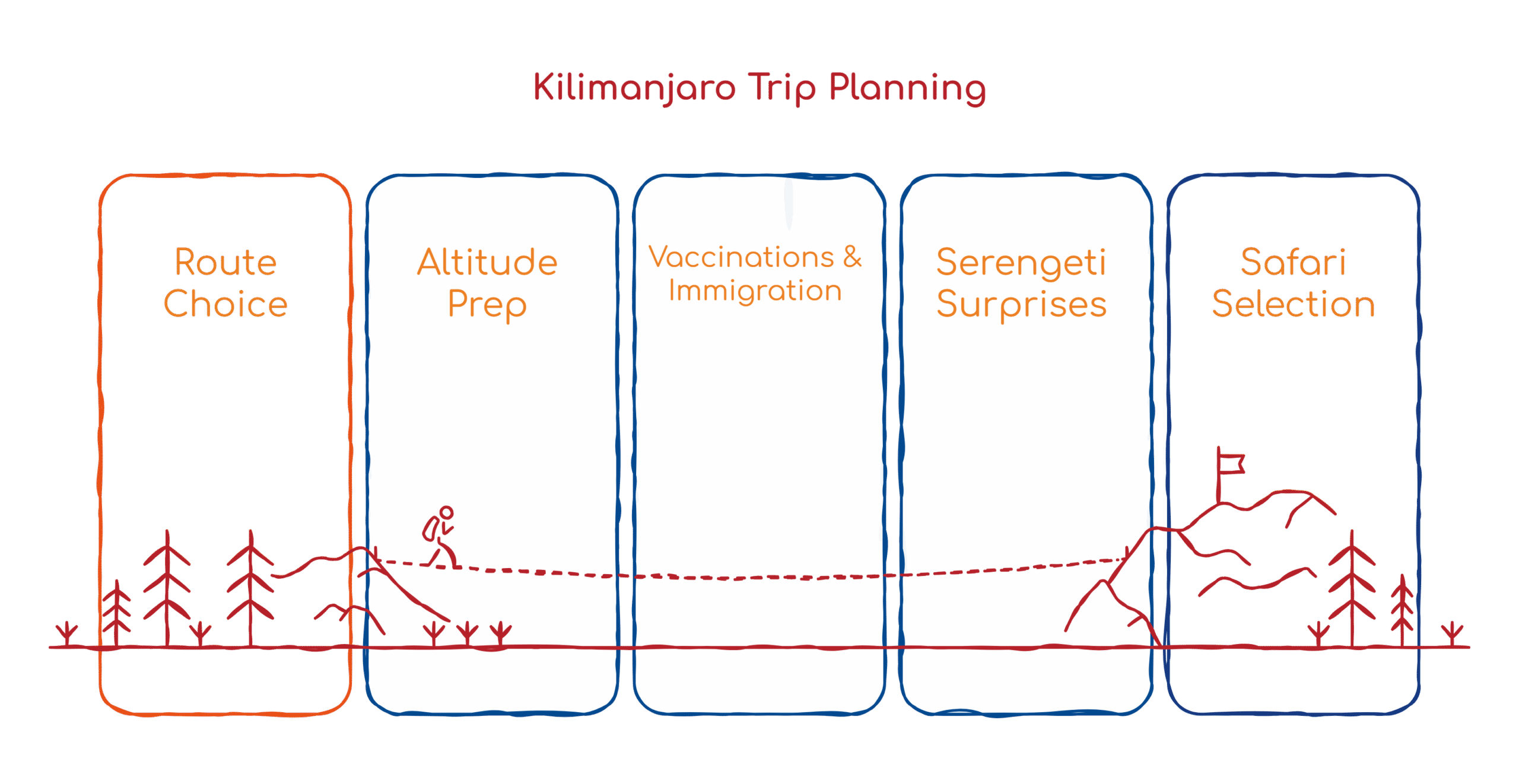
For this article, I spent the better part of the weekend doing something that probably looked a little strange from the outside: going on long walks and talking to myself. I recorded voice memos answering questions that Virtual Chris, my custom AI persona built on Claude Opus 4.6, had generated for me based on the trip details I had shared with it:
- Why did we choose the eight-day Lemosho route over the more popular Marangu route?
- How did we prepare physically for the altitude?
- What vaccinations were required, and how did the Tanzanian immigration portal actually work?
- What surprised us most about the Serengeti compared to our expectations?
- How did we choose our safari provider?
- What did Zanzibar offer that we were not expecting?
By the time I finished, I had many pages of completely original source material that had never existed anywhere on the internet before. That is the foundation on which the Universal Content Engine is built. Only then did I apply our sophisticated prompting sequences inside Claude to shape that raw material into a structured, comprehensive, well-optimized article.
The result was a deeply personal, highly detailed piece of content that AI helped me produce efficiently, but that no language model working from generic prompts could ever replicate. That originality is not just good writing. It’s a ranking signal. You can read the full Kilimanjaro article on LinkedIn to see what the finished output looks like.
The Featured.com Backlink Strategy That Built the Foundation
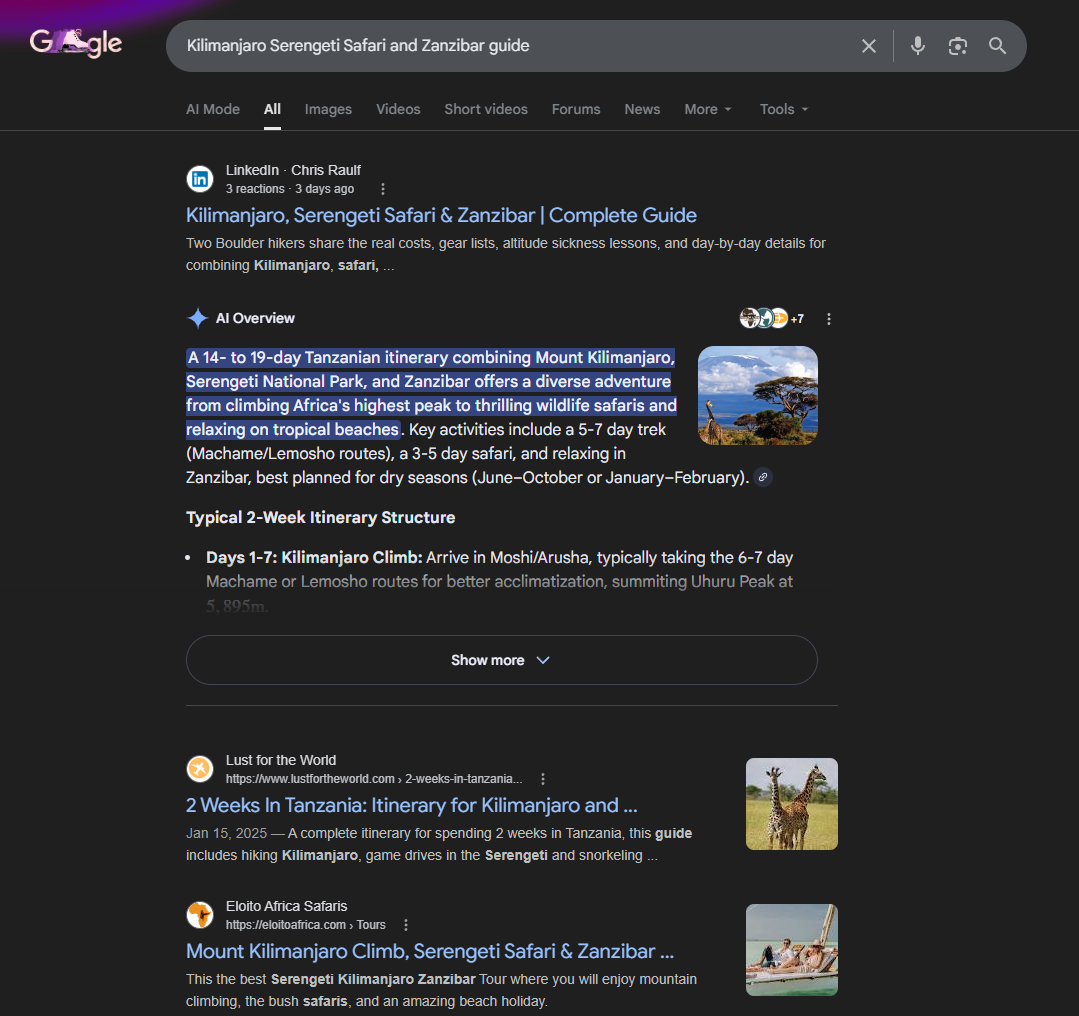
Ranking fast on LinkedIn did not happen because of this one article published on a Monday. It happened because of a systematic backlink-building strategy I have been running for years, and it is one of the highest-ROI link acquisition approaches I have come across for building personal brand authority.
The platform is called Featured.com. Think of it as a marketplace where journalists, editors, and content managers at major publications post requests for expert quotes on specific topics. They are building roundup articles, listicles, and guides, and they need credible expert voices. My team monitors these requests regularly and submits thoughtful, high-quality responses on my behalf.
When a submission is selected, it is published as an article on that platform. Here is where the SEO value comes in: on the backend of Featured, I can specify exactly which URLs I want associated with my expert profile. One backlink goes to my LinkedIn profile. A second can go to one of my company’s website Boulder SEO Marketing. So every accepted submission generates two active, high-quality backlinks from a site with strong domain authority. You can see an example of this in action in a TechBullion article titled “18 ways businesses use customer content to boost sales.”
The logic compounds over time. The more high-Domain Authority sites that link to my LinkedIn profile, the higher that profile’s own authority becomes. And the higher my LinkedIn profile’s authority, the easier it is to rank new content I publish through it quickly. This is a long game, but it pays dividends every time I publish something new.
I also recently recorded a full podcast episode with Brett Farmiloe, the founder of Featured.com, specifically about earned media strategy in the AI agent era. It’s a conversation I’d strongly recommend listening to if you want to understand how to build this kind of authority at scale.
Why YouTube Embeds Are a Ranking Signal Most People Ignore
Here is a tactic that almost nobody is taking advantage of, and it made a meaningful difference in how quickly this content got traction: embedding YouTube videos inside the LinkedIn article.
Think about it from Google’s perspective. YouTube is a Google product. It is one of the most frequently cited sources in AI Overviews. When you embed a YouTube video inside a piece of content, you are not just adding a media element. You are creating a connection between your content and one of Google’s own platforms. That is an additional trust signal, and Google has every incentive to reward it.
For this article, I created a dedicated YouTube channel called Honest Trip Advice and published video content from the Tanzania trip directly through it. Those videos were then embedded inside the LinkedIn article. This approach served two purposes simultaneously: it added multimedia depth to the article, improving the reader experience, and it provided Google with a second proprietary platform signal confirming that this content has real-world authority.
I want to be honest about something here. Creating a YouTube channel for a single content piece represents a significant time investment. But this is exactly the kind of multi-signal stacking that separates content that ranks from content that doesn’t:
- The article
- The LinkedIn authority
- The backlinks
- YouTube embed
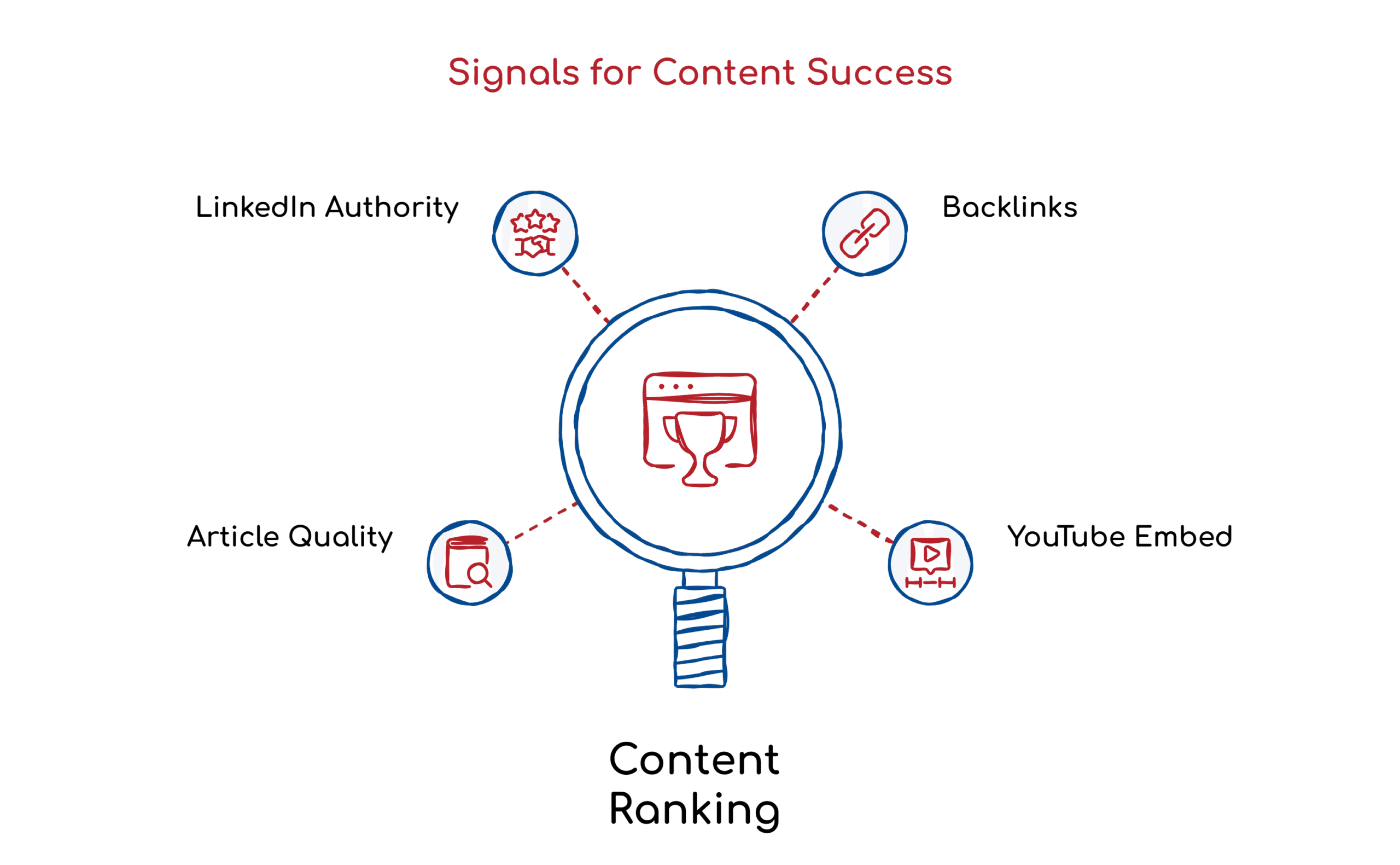
All worked together. Remove any one of those elements, and the result might have been very different.
What SE Ranking Showed Me the Next Morning
I track all of my SEO performance through SE Ranking. Full disclosure: I am a brand ambassador for SE Ranking, and I am not going to pretend otherwise. But the reason I promote them is straightforward. I use the tool daily, I teach with it in my university courses, and it genuinely delivers. They also give my students free access to their full platform, which matters to me because access to professional SEO tools should not be a barrier to learning this craft.
What genuinely surprised me when I checked the data the morning after publishing was how quickly SE Ranking was already picking up keyword ranking signals for the article. Even on a high-authority platform, it typically takes several days for a tracking tool to capture meaningful data for newly published content. Seeing it appear in tracked results less than 24 hours after I put it in place was unusual, and it was a clear signal that the combination of factors I had set up was working as designed.
I want to be careful not to overstate this. At the time of recording, only one keyword was being credited in SE Ranking. But the LinkedIn analytics dashboard was already showing healthy impressions and member reach within the first day. And the incognito Google search I ran in the video confirmed that it ranked first in the organic blue links for the primary search phrase. For a piece of content published on a Sunday evening, that result was remarkable.
If you are publishing content on LinkedIn or any third-party platform and you are not tracking its performance in a dedicated SEO tool, you are flying blind. Knowing which keywords your content ranks for and how that changes over time is what allows you to refine your strategy and prove ROI.
What You Can Take Away From This and Apply Right Now
I am aware that this methodology sounds complex, and honestly, at the level my team and I are executing it, it is. But I do not share this to discourage anyone. I share it because the underlying principles are accessible regardless of your budget or team size.
You do not need a custom Claude persona. You do not need a full team managing Featured.com submissions. What you do need is a genuine commitment to creating source content that only you could create. Start there. Record voice memos. Write down your real experiences. Pull from specific details that no AI prompt could generate on its own. That original input is what separates AI content that ranks from AI content that disappears.
From there, think carefully about where you publish. Choose platforms that already have domain authority in Google’s eyes. LinkedIn is the obvious choice for most professionals. If you have been active there for years, you may already have more authority built up than you realize.
If you want to go deeper into the full Universal Content Engine methodology, including the GEO layer and how it fits into our BSM Copilot framework, my business partner Daniel Burns and I will cover it in detail in our upcoming AI SEO webinar on March 25, 2026. And on April 1st, 2026, I will be moderating our quarterly AI SEO and GEO Online Summit, where Brett Farmiloe of Featured.com will be one of the featured speakers. It is a free two-hour session, and I would love to see you there.
I am also speaking at the GALA WorldReady Conference in Berlin on April 13th, 2026, presenting this methodology to a global audience of localization and translation professionals.
Stay safe and healthy.
Cheers,
Chris