
What would it mean for your business if you could publish a piece of AI-generated content today and see it ranking in Google within days? Watch the full video above to learn more:
That is exactly what happened with a blog post I published on April 4th. The content was 100% AI-generated using a methodology I call the Universal Content Engine. It started indexing, went through Google’s sandboxing process, and began ranking organically for keywords like ‘outdoor recreation SEO’ in under a week. Not months. Days.
I have been doing SEO since the late 1990s, and I will be honest with you: this is one of the more exciting things I have demonstrated in a long time. Not because AI content is new, but because this approach produces content that actually behaves the way quality content should. It indexes and ranks because it is built on genuine expertise rather than a generic prompt and a paste.
I am presenting this full methodology live at the GALA WorldReady Conference in Berlin on April 13th, in a session titled “From Search Engine to Answer Engine: Why Your Global Content Strategy Needs Generative Engine Optimization Now.” I also teach a version of it as part of the TCLoc Master’s Program at the University of Strasbourg in France. But I do not believe in gatekeeping, so here is the complete breakdown.
Why Most AI Content Fails to Rank
Here is the thing. Most people are using AI wrong for content creation. They feed a generic prompt into ChatGPT, paste the output onto their website, and wonder why nothing happens. Google is not impressed by AI text that contains no original insight, no first-hand experience, and no information that could not have been scraped from a hundred other sources.
The core problem is that, by definition, generic AI content is a remix of existing content. There is no net-new information, no unique perspective, no genuine signal of expertise. Google’s E-E-A-T guidelines are extremely clear on this. Experience, Expertise, Authoritativeness, and Trustworthiness cannot be faked. The AI Overviews and Perplexity citations everyone is chasing right now draw on sources that demonstrate genuine expertise, not content that merely sounds plausible.
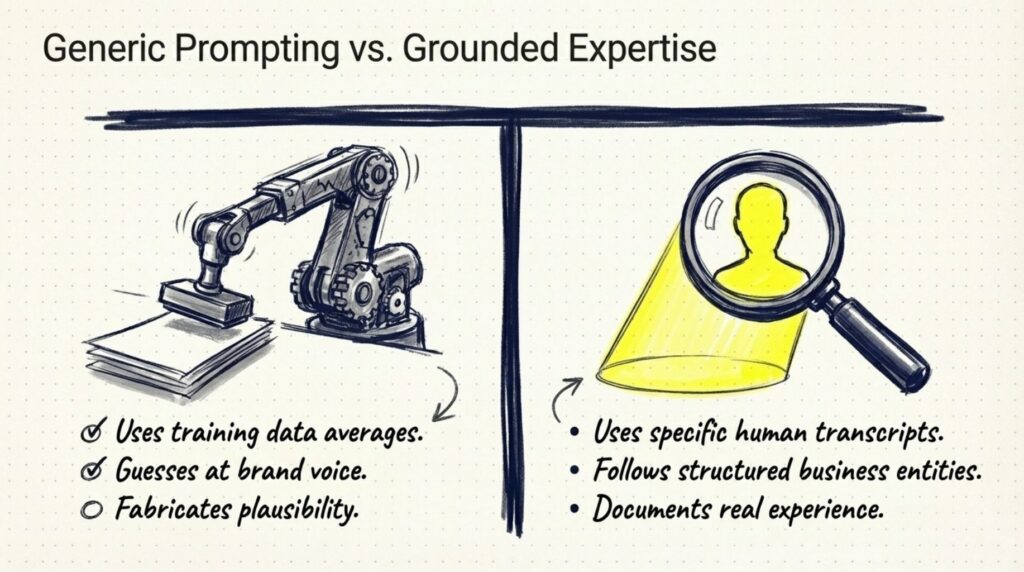
There is also a practical issue most people miss. When you prompt a generic AI tool to write about a topic, you are getting an average of everything that has already been published on that subject. You are not getting insight. You are getting a reorganized version of what everyone else already knows. That is not a competitive advantage.
The Universal Content Engine solves this by making expert knowledge the literal foundation. When you capture a real conversation with a subject-matter expert, you generate information that did not previously exist in that form. That is content no AI could fabricate, because it comes from a specific person’s specific experience. That is what ranks.
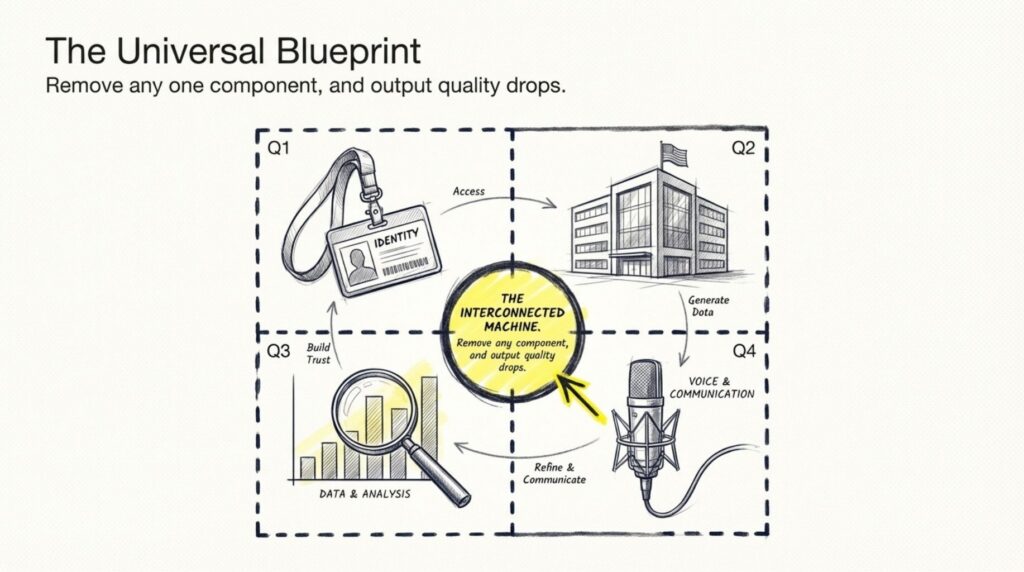
The full methodology has four essential components, and you need all of them working together. Remove any one, and the output quality drops.
The first is an expert profile. A structured document capturing your credentials, your experience, your key perspectives, and your areas of authority. This tells the AI who you are, so it can write in your voice and draw from your actual knowledge base rather than generic training data.
The second is the business entity context. Your company, your services, your target audience, your competitive positioning. It grounds every piece of content in your actual business reality. Entity context is also increasingly important for GEO, since AI search systems are actively trying to understand what your business is and who it serves. ChatGPT, Perplexity, and Google’s AI Overviews are all making decisions about whether to surface your content based on how well they can understand your business as an entity. If that structured context is missing from your content creation process, you are leaving citations on the table.
Third is keyword research. I use SE Ranking for this, and I recommend it without hesitation. Before a single word of content is written, you need to know what you are targeting, what the monthly search volume looks like, and what the competitive difficulty is. For the outdoor recreation example I walked through in this tip, I did a relatively light keyword pass. The content still started ranking. More thorough research would make it perform even better.
Fourth, and most critically, is the expert interview. This is the component most people skip, and it is the reason their AI content does not rank. Record a 20-minute conversation with someone who knows more about the subject than your average reader. Get the transcript. That transcript becomes the raw material the AI uses to build content with genuine depth rather than recycled information. My students in the TCLoc program do this as part of their final project, and the difference in output quality versus standard AI prompting is immediately obvious.
Why the Expert Interview Changes Everything
Let me spend a moment on this because it is the part of the methodology that surprises people the most. The instinct is to think that AI is the content creator and the human is just providing a topic. That is backward. The human is the content. The AI is the formatter.
When I spoke with an executive from a ski resort association about crisis management and the difficult winter season, the conversation included opinions, observations, and strategies that were nowhere to be found online. Not in any blog post, not in any whitepaper, not in any training dataset. It was a specific person’s specific thinking about a specific situation. When I fed that transcript into the Universal Content Engine prompting sequence, the AI had something genuinely new to work with. The output reflected real insight, not an average of existing content.
This is also why the methodology works for multilingual content production, which is a major focus of my Berlin presentation. The expert interview can be conducted in any language. The prompting sequence works regardless of the target language. You can produce high-quality, expertise-grounded content for any market in the world using the same system. That is a significant advantage for organizations operating across multiple languages and regions.
Building a Virtual Version of Yourself
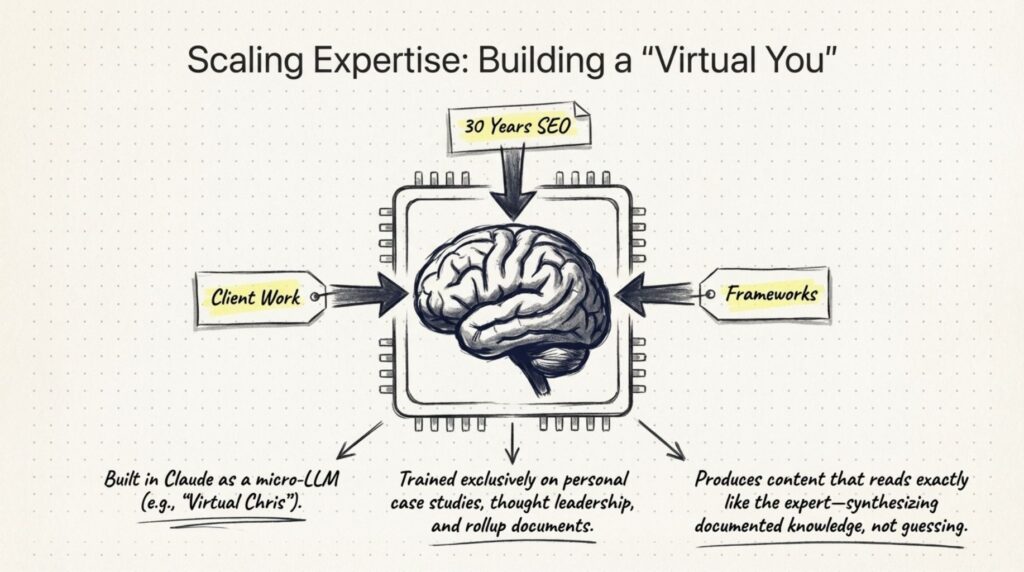
The version of this methodology I use personally involves something I call Virtual Chris. It is a micro language model built and trained on my 30 years of SEO expertise, my voice, my case studies, my client work, and my thought leadership. I built it in Claude, and it has access to rollup documents I update regularly that capture my evolving knowledge base.
When I feed the Universal Content Engine prompting sequence into Virtual Chris, the output reads as I wrote it. That is not an accident. The AI is genuinely drawing on my expertise. It knows my frameworks, my opinions, and the specific examples from my career that illustrate the points I want to make. It is not hallucinating from generic training data. It is synthesizing my own documented knowledge.
Building a virtual version of yourself does not require 30 years of documented expertise. It requires intentionality. Capture who you are, what you know, how you think about your field, and what makes your perspective distinct from everyone else writing on the same topics. The more structured the information is, the better the AI performs. The full walkthrough is in the Universal Content Engine blog post, including a dedicated video on how to set up your own virtual expert profile in Claude.
The Prompting Sequence Is the Secret Weapon
I spent a significant amount of time developing and refining the prompting sequence that drives this methodology, and I share the complete version in the Universal Content Engine blog post. This is not a single prompt. It is a structured sequence that simultaneously feeds in your target keywords, your business entity context, your expert profile, your strategic theme, your supporting keywords, and your full expert interview transcript.
When all that information is combined into a single, well-structured prompt delivered to a virtual expert profile, the AI has everything it needs to produce content with genuine depth. No hallucination. No generic padding. No vague platitudes that apply to every business in every industry. Just real insight, structured for search.
Here is what the completed prompting sequence covers: the top three target keywords for the piece, the business context and entity information, the expert profile details, the strategic theme and content angle, the supporting keywords and related terms, and the full expert interview transcript. Fill in all of those fields correctly, and the output quality is consistently strong.
What Google’s Sandboxing Process Means for New Content
One thing worth understanding before you publish: every new piece of content goes through Google’s sandboxing process. Google evaluates whether the content meets its quality guidelines before fully committing to ranking it by exposing the content and watching how users engage with it over time.
During this period, which can last from a few weeks to several months depending on your domain’s authority, rankings fluctuate. They go up, come down, settle somewhere, then shift again. This is normal. On an established site with strong domain authority and a track record of high-quality content, the sandboxing period typically lasts a couple of weeks before rankings begin to solidify.
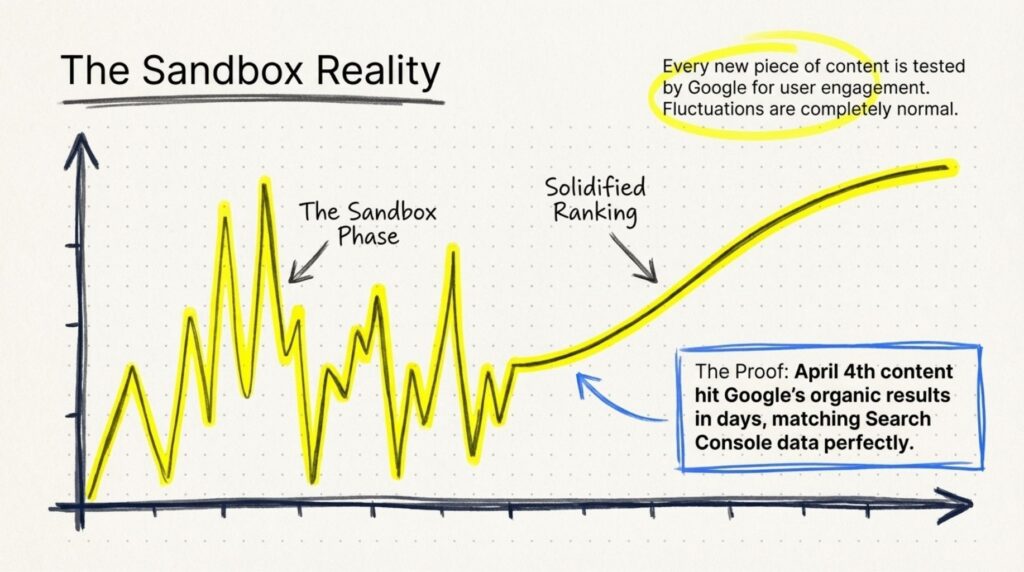
The outdoor recreation SEO content I published on April 4th is already showing organic rankings for its target keyword. A few days in, it is sitting in position in incognito search, lining up exactly with what Google Search Console is reporting. The rankings will solidify further as Google accumulates more confidence signals. New content appearing in organic results this quickly is precisely the proof of concept I wanted before getting on a plane to Berlin.
This Is Not Just a Google Play
I want to be clear about something before we wrap up. The Universal Content Engine is not only an SEO strategy. It is a GEO strategy. The same content that ranks in Google is being picked up by AI search platforms. Perplexity is citing it. ChatGPT references it. Google’s AI Overviews surface it. The reason is the same in every case: the content contains real expertise, is documented clearly, and is structured for search.
The zero-click reality is here. More and more searches are being answered directly in AI interfaces without a click ever happening. The way you stay visible in that environment is not by publishing more content faster. It is by publishing content that AI systems trust enough to cite. That means E-E-A-T signals, entity clarity, and genuine first-hand expertise baked into every piece. The Universal Content Engine is designed specifically to produce that kind of content at scale.
What to Do With This Right Now
If you are attending GALA WorldReady in Berlin next week, come to my session on Monday, April 13th. The full Universal Content Engine walkthrough is there, including how to adapt the methodology for multilingual content production. You will walk out with a system you can put to work immediately.
If you are not in Berlin, here is the sequence I would follow. Start by reading the Universal Content Engine blog post on chrisraulf.com. Get familiar with the prompting sequence and the four components. Then identify one subject matter expert in your field or organization and schedule a 20-minute recorded conversation. Transcribe it. Run it through the prompting sequence with your keyword research from SE Ranking. See what comes out. That first run will show you more about how this methodology works than any explanation I can give you.
For keyword research, sign up for a free month-long trial of SE Ranking. My students at the TCLoc Master’s Program get complimentary access for the duration of the course. It is an outstanding tool, and I genuinely recommend it, not as a paid promotion.
One more thing before you go. If you are teaching or studying in the localization and technical communication space, the TCLoc Master’s Program at the University of Strasbourg is genuinely worth looking at. I have been part of this program for several years, and the quality of the students coming through it is exceptional. The fact that TCLoc teachers and students are showing up at GALA WorldReady in Berlin this year is a good indicator of where the program sits in the industry.
The methodology works. A piece of content published a few days ago is sitting in Google’s organic results right now. That is not a claim. That is a screenshot.
Stay safe and healthy.
Cheers,
Chris