
When someone searches your name plus the word “reviews,” what does Google’s AI Overview show them?
For one Denver marketing consultant, it shows a local magazine interview. Not her website. Not a review platform. An interview she gave to a regional online publication, sitting right there as a source in Google’s AI-generated answer.
That’s this week’s tip, and it’s built on one of the oldest strategies in our industry: digital PR. I’ve been doing SEO since the late 90s, and I’ve watched plenty of tactics come and go. This one keeps coming back, because the logic underneath it never changed. Search engines trust what other credible sites say about you. Large language models like ChatGPT, Claude, Perplexity, and Gemini work from that same raw material.
Here’s what makes this different from the usual “go get press” advice. You can do this one today. No retainer, no PR firm, no paid placement.
Watch the full above below to learn more.
An Email I Didn’t Expect
The other day, an email landed from VoyageDenver. Short and sweet: your interview is live.
If you haven’t come across it, VoyageDenver calls itself Denver’s most inspiring stories. It’s an online publication, and like every online publication, it lives on content. They sell ads, they need a steady stream of interesting people to feature, and they go out and find them.
That’s how they found me. We recently launched a new company, Enterprise GEO, which helps in-house marketing teams and agencies create content that ranks in Google and gets cited in AI search. My guess is the launch put us on their radar. They reached out, said they’d love to feature me, and pointed out that we’re located right here in the Denver and Boulder area. Then they sent over their questions and asked for photos.
I completed everything about two, maybe three weeks ago. On November 3rd, the story went live: Exploring Life & Business with Chris Raulf of Enterprise GEO.
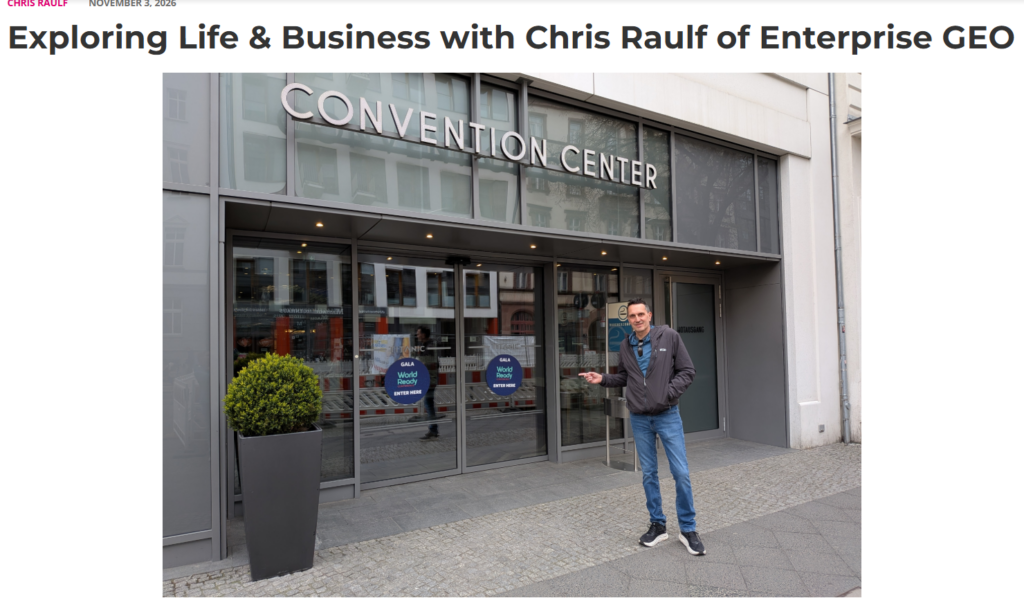
The interview went live on November 3. No pitch, no fee, just a questionnaire and a few photos.
It’s a long piece. There’s a photo of me speaking at a conference in Berlin, more shots from the stage, and one of my wife and me hiking Mount Kilimanjaro. If you know the altitude sickness story from that trip, you know why that photo still makes me smile.
What Actually Matters on That Page
Look, a nice profile is nice. But here’s what got my attention as an SEO.
The article includes active backlinks to the Enterprise GEO website, our LinkedIn company page, and our YouTube channel. Three links from a publication that, as you’ll see in a minute, carries real authority.
Notice it isn’t only the website. The links to the LinkedIn company page and the YouTube channel tie Enterprise GEO, the brand, to its official profiles on a third-party site. For a company that launched recently, that kind of connection helps Google and the AI models understand that the brand is real, what it does, and who’s behind it.
And it cost nothing. Zero dollars. All I did was give them content about me, my business, and Enterprise GEO.
I’ll be honest with you, it did take some time. It’s a lot of content. These publications ask real questions about your story, your challenges, and your business, and they expect real answers. That’s exactly why most people never finish the form. And that’s exactly why the ones who do finish it get the benefit.
How I Wrote It in No Time
Here’s where it gets interesting. I didn’t sit down with a blank page.
I used our company brain, which is a closed-loop AI system. That’s a conversation for another time, but here’s the short version: the content it produces is AI-generated, and it’s feeding entirely on content I created myself. My own talks, my own writing, my own recorded thinking, all of it loaded into one place.
So when VoyageDenver asked me to tell them my story, I wasn’t inventing answers on the fly. The system already knew my story because I had fed it my story. I reviewed the drafts, adjusted what needed adjusting, and sent it off. They liked it. They published it.
There’s a quality control angle here too. When AI drafts from generic training data, you get generic answers, and an editor can smell that from a mile away. Because my system works from my own material, the answers sound like me, carry real dates and real stories, and I’m not wasting my time correcting details the AI made up.
That’s the bigger lesson hiding inside this tip. AI doesn’t replace your expertise in this workflow. It makes your expertise portable. Every interview request, guest post invitation, or speaker bio becomes a quick review job instead of a weekend project.
If you want to see how I set up a version of this for myself, I wrote a full guide on how to build a Virtual You in Claude. The same principle drives my Universal Content Engine methodology: feed AI first-hand material, and it gives you output nobody else could produce.
Is This Backlink Actually Worth Anything?
I don’t take a publication’s word for it. Before I recommend something to you, I check it.
So I ran VoyageDenver through SE Ranking, my favorite SEO tool, and did a competitive research pass on the domain. The questions I care about are simple. What keywords is this website ranking for? Is it actually getting traffic?
The answers were encouraging. VoyageDenver has a Domain Trust score of 83 out of 100, and that matters a lot for a backlink, because a link from a trusted domain is essentially an endorsement. It ranks for about 19,200 keywords in the US and pulls roughly 2,100 organic clicks a month, about double where it was a year ago. And the traffic it gets from Google’s AI Overviews, which barely registered a year ago, has climbed steadily since.
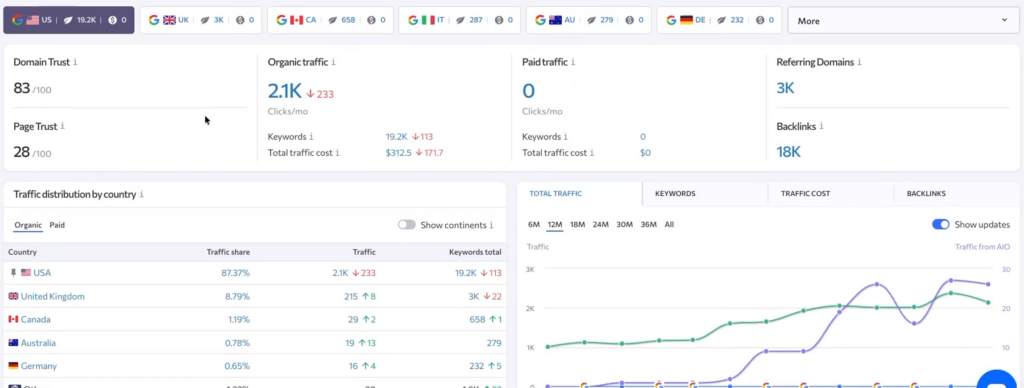
VoyageDenver in SE Ranking: Domain Trust 83/100, about 2,100 organic clicks a month, and AI Overview traffic climbing.
That last one is the reason I’m sharing this with you. I don’t just want a link. I want to know the content on this domain shows up where buyers are looking now, and more and more, that means AI search.
This is also why I’d encourage you to test before you assume. Every publication sounds great when it’s asking for your time. Five minutes in a tool like this tells you whether the domain is actually earning its reputation, or just borrowing one.
Quick plug: SE Ranking offers my viewers a 30-day free trial. I’m not making money on that. I like giving them a shout-out because they give my students free access to their tool.
The AI Overview Test
Traffic is one thing. I wanted to see whether this site’s content actually surfaces in AI results.
In SE Ranking, you can see which keywords a domain appears for in Google AI Overviews. You know the box I mean. Whenever you do a Google search now, Google slaps an AI Overview at the very top of the results page.
One keyword jumped out: a person’s name plus the word “reviews.” She’s a Denver marketing consultant featured on the site. I don’t know her, but she made a perfect test case.
I opened an incognito window so my browser history wouldn’t skew anything, searched that exact phrase, and there it was. The AI Overview featured her, and the source behind it was her VoyageDenver article.
Think about what that means for a second. Someone vetting her, typing her name and “reviews,” which is about as bottom of the funnel as a search gets, receives an AI-generated answer built partly on a feature she got for free. That’s reputation management, SEO, and GEO in one move.
If you want to start tracking where your own pages show up in AI Overviews and AI Mode, keep an eye on the Search Console AI visibility report I covered earlier this year.
Why an Old-School Play Wins in the Age of AI
Here’s what I’ve learned in nearly three decades of doing this: the fundamentals don’t die. They just find new surfaces.
Digital PR worked twenty years ago because Google counted credible links as votes. It works now for the same reason, plus one more. AI Overviews, AI Mode, and the large language models all build their picture of who you are from what’s published about you across the web, not just from what you publish yourself.
Your own website says you’re great. Every website says that. An independent publication telling your story is different. It’s corroboration from a third party, and corroboration is what both Google and the AI models are looking for when they decide whose name to put in an answer.
Most businesses skip this because it feels small. A local magazine? An online interview site? Meanwhile, these publications need content to survive, so they’re actively hunting for people to feature. You’re not begging for coverage. You’re solving their problem, and they’re paying you back in authority.
This matters even more for a new brand. Enterprise GEO is young. When there’s very little published about you yet, the first few credible third-party mentions carry outsized weight in shaping how Google and the AI tools describe you. Get those first mentions right, and you’re setting the foundation every later mention builds on.
The reality is that the expensive version of this, a PR agency chasing national placements, still has its place. But if you can only do one thing this month, start local. The barrier is a form and a little time, and the payoff shows up in places your competitors aren’t even watching.
What to Do Next
If you’re a business in the Denver area, do this right after you finish reading. Head to VoyageDenver and scroll to the Suggest a Story link, or go straight to the story recommendation form. It asks for your name, email, website, and social media, and you can recommend yourself or someone you think deserves a feature.
Then get ready. If they reach out, they’ll send questions and ask for photos. Pull together your best images now, including a few that show who you are outside of work. Answer the questions with your real story, the setbacks included, not your sales pitch. That’s what makes these interviews worth reading, and it’s what makes them worth citing.
Block an hour on your calendar this week for it. If you already have a library of your own content, a podcast, past talks, blog posts, use it as your source material, the same way I used our company brain. You’ll be done faster, and it’ll sound like you.
Not in Denver? Look for the equivalent in your own market: local online magazines and interview-style publications that feature business owners. Then run each one through the same check I did: domain trust, organic traffic trend, AI traffic trend, and whether its content appears in AI Overviews.
And if you’d like a second set of eyes on how your brand currently shows up in Google and AI search, I offer a free AI SEO audit. For more tips like this, browse the full AI SEO Tips archive, or check out my appearances and features to see this playbook at work.
It takes a little time. It’s well worth it.
Stay safe and healthy.
Cheers,
Chris