
For two years, you could not tell whether your website was showing up inside Google’s AI answers. That black box just cracked open.
On June 3rd, Google announced something the SEO world has been asking for since AI Overviews first started pushing traditional results down the page. A dedicated report inside Google Search Console that finally shows you whether your content is appearing in Google’s generative AI features. AI Overviews. AI Mode. The part of search that, until now, handed you exactly nothing to measure.
Our AI Director here at Chris Raulf AI SEO and Boulder SEO Marketing, Harold De Guzman, breaks down what is coming and how to get ready in this week’s tip.
Watch the full video above to learn more.
I have been doing this for close to thirty years, and I can count on one hand the Search Console updates that genuinely changed how we work. This is one of them. Most updates tweak a metric or rename a tab. This one hands us a window into a part of search that has been completely sealed off since AI Overviews arrived. That is rare, and it is worth your attention even if the report has not yet reached your account.
Why This One Actually Matters
Here’s the thing. For the last two years, AI Overviews and AI Mode have been quietly deciding who gets seen, and you had no window into any of it. Your content might have been feeding answers to thousands of people, or it might have been invisible, and you had no way to know which. That is a strange place to operate from. You were optimizing for a surface you could not measure.
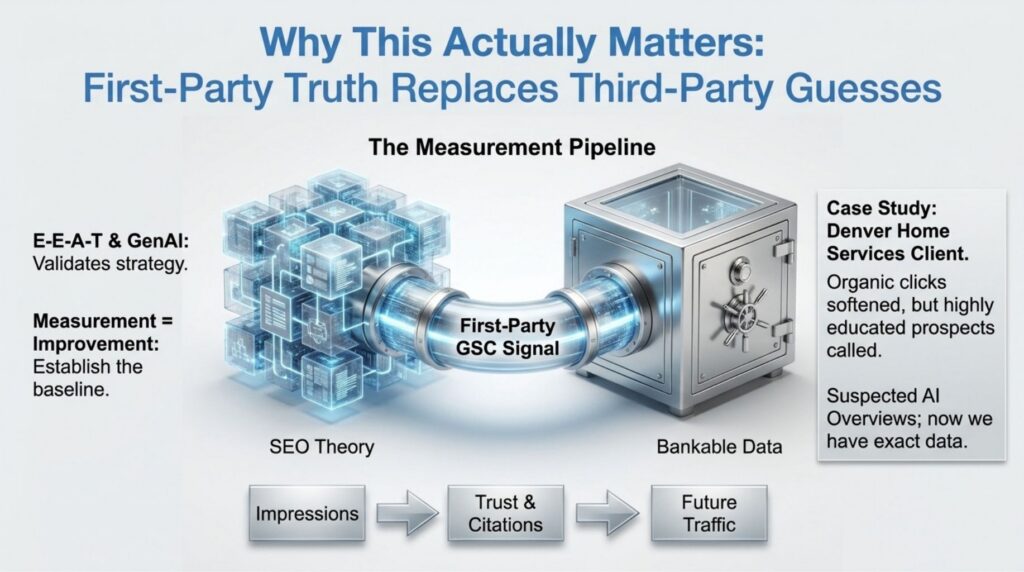
This report changes that. For the first time, you get a first-party signal, straight from Google, telling you when your pages show up inside AI answers. Not a third-party estimate. Not a scraping tool guessing on your behalf. The real thing, in the same place you already check your rankings every week.
I want to be clear about why that is a big deal and not just another dashboard. When you can measure something, you can improve it. For two years, GEO, optimizing to get cited inside AI-generated answers, has felt a little like coaching a team you are not allowed to watch play. You knew the score showed up somewhere. You just never got to see the field.
Take a Denver-area home services client we work with. For months, we suspected their detailed how-to pages were feeding AI Overviews because their organic clicks were softening while their phone kept ringing with people who already knew the specifics of their process. We had a theory. We had no proof. A report like this is the difference between a theory and a number you can take to the bank. Now you get to watch the game, not just guess at the final score.
What You Are Actually Looking At
Let me describe the report itself, because the layout tells you a lot about how to use it.
Inside Search Console, under Performance, there is a new item called Generative AI. It shows up in two places, once under Search results and once under Discover, so you can see AI visibility across both surfaces separately. Up top, you get total impressions. In Google’s own example screenshot, that number sits around 9,000 impressions from AI features, with a simple trend line tracking it over time.
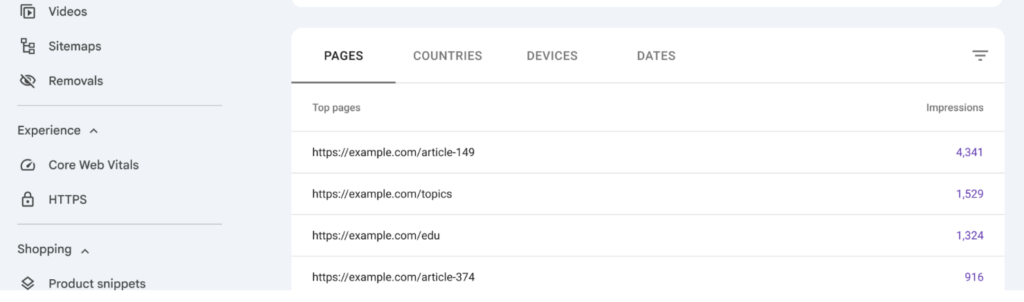
Below that, four tabs: pages, countries, devices, and dates. The one I care about most is pages. That tab shows you exactly which of your URLs are getting pulled into AI answers, with the impression count for each one. Read that carefully, because it is the most useful thing in the whole report. It tells you which pages Google’s AI already trusts enough to cite, which is a roadmap for what to create more of.
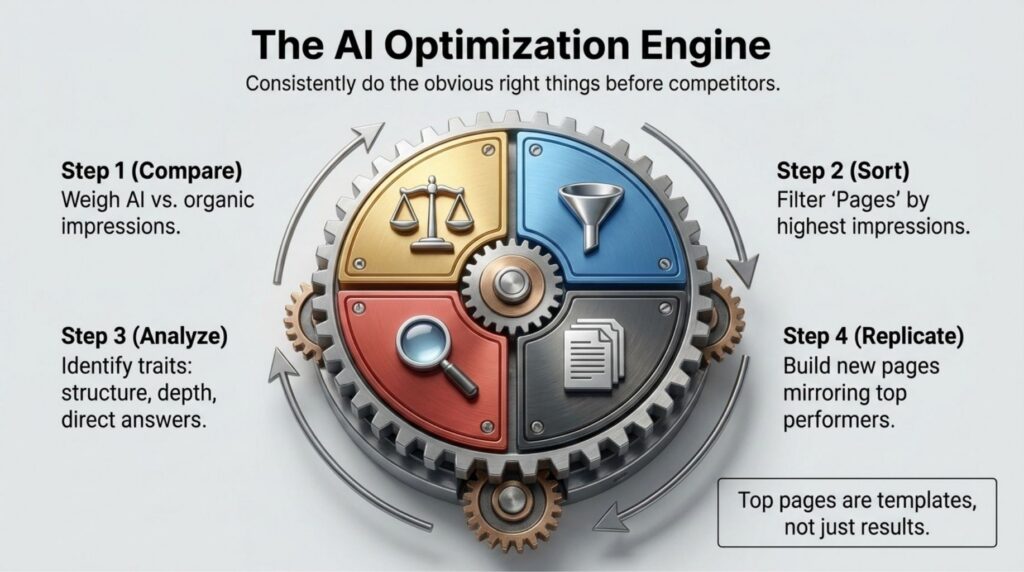
Here is how I would actually use that pages tab once you have it. Sort by impressions and look at your top performers. Those are the pages Google’s AI already considers authoritative on their topic. Ask yourself what they have in common: the structure, the depth, the way they answer a specific question directly, and then go build more pages that share those traits. Your highest AI-impression pages are not a trophy shelf. They are a template.
That is the entire report. Clean, simple, and honestly long overdue.
The Catch Nobody Is Warning You About
Now, here is the honest part: it is the reason this is a heads-up, not a full walkthrough.
Most of us do not have this report yet. Google is rolling it out slowly, in waves, and it started in the United Kingdom before moving outward from there. So if you open Search Console today and the Generative AI item is not there, do not panic. You are not behind. It is coming. When it arrives, it will not replace your normal performance report. It sits right next to it as a separate view, so nothing you already rely on goes away.
One more thing to set expectations on. When the report does land for you, the data only goes back to May 18th. You will not see years of history. You start fresh and build from there. I actually think that is fine. A clean baseline beats no baseline, and you will be glad you started tracking the day it showed up rather than three months later wondering what your trend used to look like. The owners who screenshot their numbers on day one and check back monthly will understand their AI visibility far better than those who wait for a year of pretty history that will never come.
About That Toggle Google Slipped In
Buried in the same announcement was a second feature that deserves attention. Google added a toggle that lets you block your content from appearing in AI Overviews and AI Mode. It takes effect on June 17th, 2026, and Google has confirmed it does not hurt your rankings in regular search.
I know some people will see that toggle and feel tempted. There is a whole debate right now about whether AI answers cannibalize clicks, and I understand the worry behind it. I hear it from audiences everywhere. At a conference in Europe earlier this year, the very first question after my talk was some version of this exact thing: Should we block AI from using our content? The fear is real and global. But for most small businesses, my advice is simple. Leave it off.
Think about what you would be doing. You would be voluntarily removing yourself from the fastest-growing surface in search, right as it becomes measurable, to protect traffic patterns that are already shifting whether you like it or not. You want to be inside those AI answers, showing up where people are increasingly looking. You do not want to be hidden from them. The businesses that win the next two years are the ones leaning into AI visibility, not the ones opting out of it. If you run a large publisher with a specific monetization model, the calculus might differ, and we should talk it through. For the small and midsize businesses I work with every day, staying visible is the move.
What I Tell Clients to Do Right Now
So what do you actually do while you wait for the report to reach you? Harold lays out a simple plan in the video, and it mirrors what I tell our clients.
First, open Google Search Console now and get genuinely familiar with it. Click around. Know where Performance lives, know what your current impressions and queries look like, so the moment the Generative AI item appears, you spot it immediately instead of stumbling onto it months later. Second, keep creating the kind of content that AI loves to pull. That means clear answers, real first-hand expertise, and helpful, well-structured pages. This is not a new trick. It is the same E-E-A-T foundation that has always earned trust, now paying off in a new surface. Third, the moment the report lands, compare your AI impressions to your regular impressions. That single comparison tells you how big AI search already is for your specific business, which is a number most owners are guessing at right now.
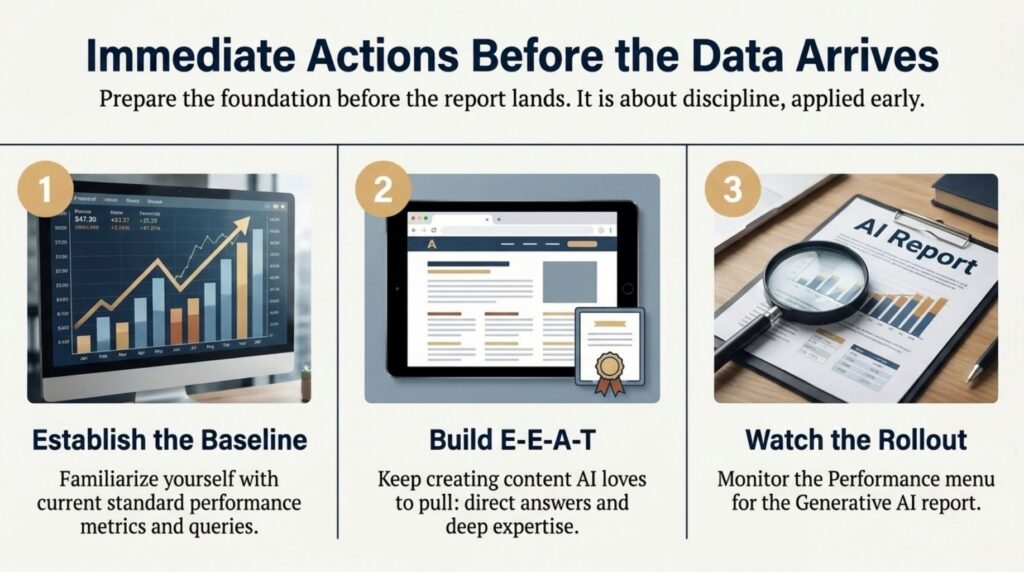
None of this is complicated. It is just discipline, applied a little earlier than your competitors do. That is most of the game, honestly. The businesses that win are rarely the ones with the cleverest tactics. They are the ones who do the obvious right things consistently, before everyone else gets around to it.
Impressions Before Clicks, and Why That Is Still a Win
I can already hear the objection, because someone raises it every time. When the report arrives, it will not show you clicks. Not yet. So is it even worth the wait?
Yes. Without hesitation, yes.
Impressions are the first signal that matters. Before anyone can click you, before anyone can call you, before any of it, they have to see you. Visibility comes before everything else in the chain, and it always has. And now, for the first time in two years, you can prove you are even in the conversation. That is not a small thing. Most of your competitors are still arguing about whether AI search matters at all. You are about to have a chart that settles the argument for your own business, one way or the other. I learned a version of this lesson the hard way back in 2021, when one of my own properties lost around 80 percent of its traffic almost overnight. What got me through it was not panic. It was measurement, patience, and trusting the fundamentals long enough for them to work again. You cannot fix what you cannot see. This report finally lets you see.
AI search is not waiting for any of us. It is already deciding who gets seen. The businesses that prepare now, while most owners are still ignoring the shift, are the ones who will own the next two years.
What to Do Next
Get ready for this report. Open Search Console, keep publishing genuinely helpful content, and watch for the Generative AI item to appear. When it lands, we will bring you a full walkthrough on exactly how to read it and what to act on.
And if you would rather not navigate this alone, that is what we are here for. At Boulder SEO Marketing, we help small businesses get found in AI search, not just regular search, using our human-driven AI-assisted approach to Micro SEO Strategies℠. Come find us at boulderseomarketing.com, or reach out to me directly. I read every message.
Stay safe and healthy.
Cheers,
Chris