
How many hours did your team lose this week to work that a machine could have done for them?
I want you to sit with that question for a second. Not the scary version of it, the honest one. Most business owners are still doing things manually that AI could handle for them right now. Not because they doubt AI. Because nobody has shown them exactly how to apply it to their own business. There is a real difference between believing in something and knowing how to use it, and that gap is where most teams are stuck today. I have watched it happen for 30 years across every shift this industry has been through, and the pattern never changes: the technology arrives long before the know-how does.
This week, our Head of AI R&D, Harold De Guzman, walks through exactly how we close that gap inside our own business, and how you can apply the same approach in yours. Watch the full video above to learn more.
We are on a mission to automate 80% of our repetitive work using AI. Read that carefully, because the word that matters is repetitive. We are not talking about replacing people with robots. We are talking about freeing our team to do the work that actually moves the business forward: strategic thinking, creative work, and client relationships. The work a human brain is built for. Everything we are building at Boulder SEO Marketing can be applied to your own business, and you do not need our budget or headcount to start.
The Work That Is Quietly Eating Your Week
Every business has them. Tasks that happen over and over again. Same process, same format, same output, every single week without fail. Writing the same type of report. Responding to the same kind of client email. Summarizing meeting notes. Researching competitors. Pulling data and formatting it into something readable. None of it is hard. That is exactly the problem. It is not hard; it is just constant, and it quietly drains the hours your best people should be spending on work only they can do.
Here is what I have learned. The tasks that feel too small to fix are usually the ones costing you the most, precisely because they repeat. A two-hour project you do once is just an afternoon. A 40-minute task you do every single week is more than 30 hours a year, gone, on autopilot, and that is one task held by one person. Multiply it across a team of ten, and you are looking at the equivalent of a full-time hire spent on work nobody actually chose to do. That is the real cost, and most owners never add it up because each individual instance feels too minor to notice.
The reality is that this invisible work compounds in the wrong direction. It does not just cost you hours. It costs you the energy and attention your team would otherwise put into the things that grow the business. Nobody does their best strategic thinking right after their fourth straight hour of copying data between two tools. The work gets done, but the person doing it is running on empty, and the quality of everything else they touch that day quietly slips with it.
The Repetitive Task Audit, Do This First
Before you touch a single tool, do this. Open a blank document and write down every task your team does repeatedly. All of it. Get it out of your head and onto the page, because you cannot fix what you have not named. Then run each task through three simple filters.
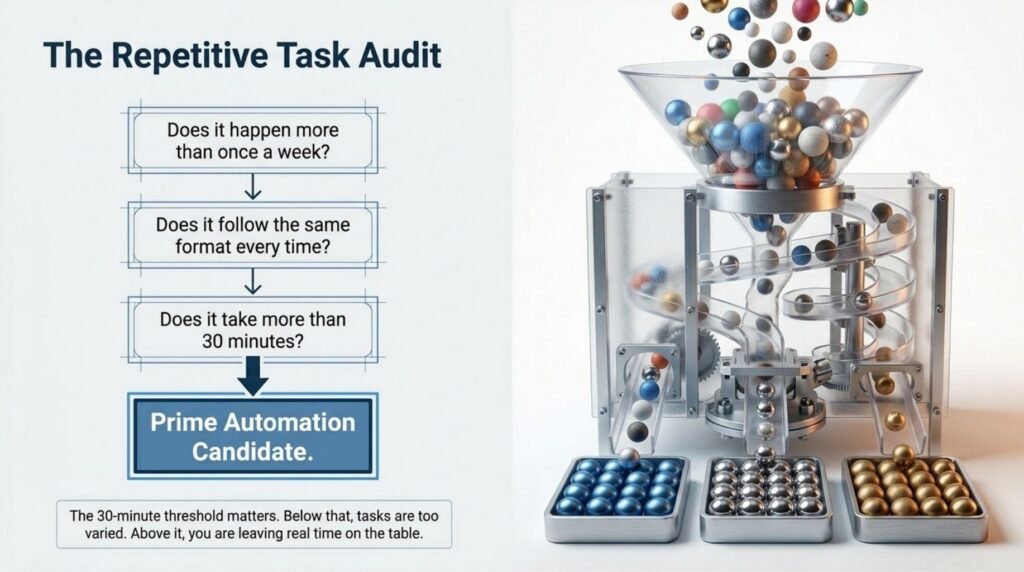
Does it happen more than once a week? Does it follow the same format every time? Does it take more than 30 minutes? If a task checks all three boxes, it is a candidate for AI automation. We call this a repetitive task audit, and it is the most useful 20 minutes you will spend this month. The 30-minute threshold matters, by the way. It is not arbitrary. Below that, the task is usually too small or too varied to be worth systematizing. Above it, and happening weekly, you are almost always leaving real time on the table.
When we ran this exercise at BSM, we found tasks that were eating hours every single week, work that AI now handles in minutes. We did not guess our way there. We made the list, we looked at it honestly, and the answers were sitting right there on the page in front of us. Yours will be too. The hard part is not finding the tasks. The hard part is being honest enough to admit how much time they have quietly been costing you.
What We Actually Hand to AI Inside BSM
I want to be specific here, because vague advice helps no one and you have heard enough of it already. We now have four people in our AI department, and here is the real work we have handed off, not the theory, the actual day-to-day that used to sit on someone’s plate.
Meeting notes and summaries. Every client call is held on Google Meet, and the transcript is generated automatically. We feed that transcript into Claude, and it returns structured action items, decisions, and follow-ups. Nobody on our team manually types meeting notes anymore. That one change alone gave hours back across the whole team.
Keyword research. What used to take a team member hours now runs through SE Ranking connected directly to Claude through our MCP integration. The keyword data gets pulled, analyzed, and formatted in minutes. This is the human-driven, AI-assisted approach in action: the machine does the heavy lifting, and the strategist makes the calls that actually require judgment.
Content creation. One video or one blog post becomes email newsletters, LinkedIn posts, social captions, and YouTube descriptions. All of it generated from a single original piece. We create the work once, then we let AI repurpose it everywhere it needs to live. The newsletter you are reading right now came out of that exact process.
Video production. Here is the one that still makes people pause. The video Harold delivers this week was scripted by Claude, presented by an AI avatar built in HeyGen, and voiced with a clone created in ElevenLabs. No camera. No studio. No recording session. That is not a someday capability you have to wait for. That is available to your business right now, today.
Start With One Task, Not Forty
Here is the mistake I watch people make over and over. They get excited, run the audit, see fifteen things they could automate, and try to fix all fifteen at once. Two weeks later, they are overwhelmed; nothing is finished, and they have quietly decided that AI does not work for them. Do not do that.
Pick the single most repetitive task your team does every week and focus on that one first. Master it. Get it running cleanly and reliably. Then, and only then, add the next one. Automation compounds, but only if you actually finish the first thing before you go chasing the second. One task automated well beats ten started and abandoned, every single time. Momentum is built on completion, not ambition.
Document It Like You Are Training a New Hire
This is the step almost everyone skips, and it is the one that separates a clean result from a frustrating one. Before you hand anything to AI, write down exactly how the task gets done. What are the inputs? What does a good output actually look like? What are the rules and the standards it has to hit every time?
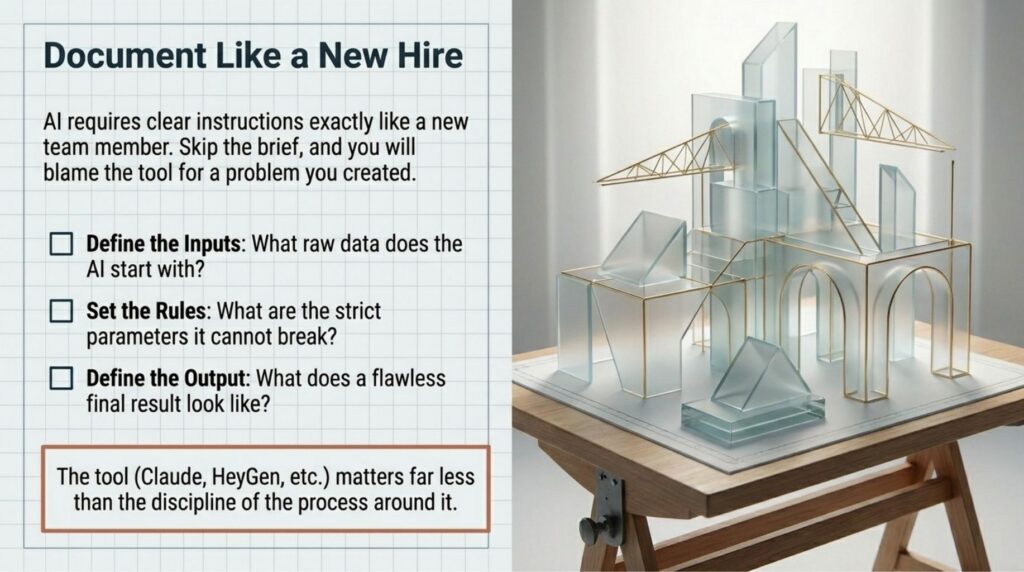
Think about it this way. AI needs clear instructions, just as a new team member would on their first day. You would never drop a new hire into a task with no brief and then be shocked when the work came back wrong. The clearer your instructions, the better your output. It really is that direct a relationship. Spend the time documenting and the tool rewards you for it. Skip that step, and you will end up blaming the AI for a problem you actually created yourself.
Then pick the right tool for the job. For writing and content, we use Claude. For meetings and transcripts, Google Meet. For keyword research, SE Ranking. For video, HeyGen and ElevenLabs. You do not need all of these on day one, and you should not try to. Start with one, master it, then add the next. The tool matters far less than the discipline of the process around it.
AI Is Not Replacing Your Team. It Is Freeing Them.
I talk to a lot of business owners, and I hear the same fear almost every time. I am scared AI is going to replace my team. I understand that feeling completely, and I would never tell anyone it is silly to feel it. It comes from a good place: you care about your people.
But here is what I have actually seen inside our own AI department, not predicted, seen. Every single time we hand a repetitive task to AI, our people do not lose their jobs. They get to do better work. They get back the hours that were being swallowed by formatting, copying, and typing up notes, and they pour those hours into the thinking that genuinely requires a human being: the strategy, the creativity, the client relationships that win the work and keep it.
That is the entire point. Your people bring judgment, relationships, and strategy. AI handles the repetitive execution. Put them together, and they accomplish more than either one ever could alone. This is what human-driven, AI-assisted work actually looks like in practice, and I am convinced it is the model every serious business will be running on within a few short years. The teams that get there first will be very hard to catch.

What to Do Next
You do not need a budget, a developer, or a six-month roadmap to begin. You need a blank document and 20 minutes. Run the repetitive task audit. Find the one task that costs you the most every week. Document exactly how it gets done. Pick one tool and put it to work this week, not next quarter.
The businesses that win over the next 12 months will not be the ones with the fanciest tools. They will be the ones who actually know how to use them. If you want a team that has already built these systems, tested them, and figured out how to apply them to a specific business, that is exactly what we do. Come see how we work, and reach out if it feels like a fit. We would genuinely love to talk.
Your move.
Stay safe and healthy.
Cheers,
Chris