
What if you could go from “I have an idea for an SEO tool” to a working production version in days instead of months?
That’s no longer a hypothetical for our team. It’s how we ship now. And the gap between teams that ship at this speed and teams that don’t is widening every quarter.
One of the hardest things about this current era is that the ground keeps moving. Google evolves. ChatGPT, Claude, and Perplexity update their answer engines almost weekly. AI Overviews are changing how people interact with search results. The window between “we need a tool to solve this” and “this opportunity is gone” keeps shrinking. Traditional software development cycles, where you brief a developer, wait weeks for a build, review it, and ship the next quarter, simply cannot keep up with the pace of AI search.
So our Head of AI R&D, Harold De Guzman, and our Senior AI Developer, Pey Garchitorena, sat down for this week’s AI SEO Tip to show exactly how our team has rebuilt the way we ship custom AI SEO tools. They walked through the full vibe coding workflow, the AI agent orchestration we use, and the IDE we’ve standardized on, and they built a complete branded landing page from scratch, live on camera, in just a few minutes. No mockups. No staged screenshots. Real, working code generated in real time. Watch the full video above to learn more.
Why Traditional Tool Development Is Too Slow for AI SEO
Here’s the reality. Businesses today don’t just want to rank at the top of Google. They want to be cited as a trusted source inside ChatGPT, Claude, Perplexity, and AI Overviews. The strategies that get you there require custom data work, custom prompts, custom audits, and custom monitoring tools. There is no off-the-shelf SaaS that covers everything we need across our client base, and the gap between what generic tools provide and what real AI SEO requires keeps growing every month.
In the old world, that meant hiring multiple developers, scoping a project, building, testing, and deploying. Months. By the time you ship, the search landscape has changed. The opportunity you were optimizing for is already saturated, and the data the tool was built around is already stale. You spent the budget, but the moment passed.
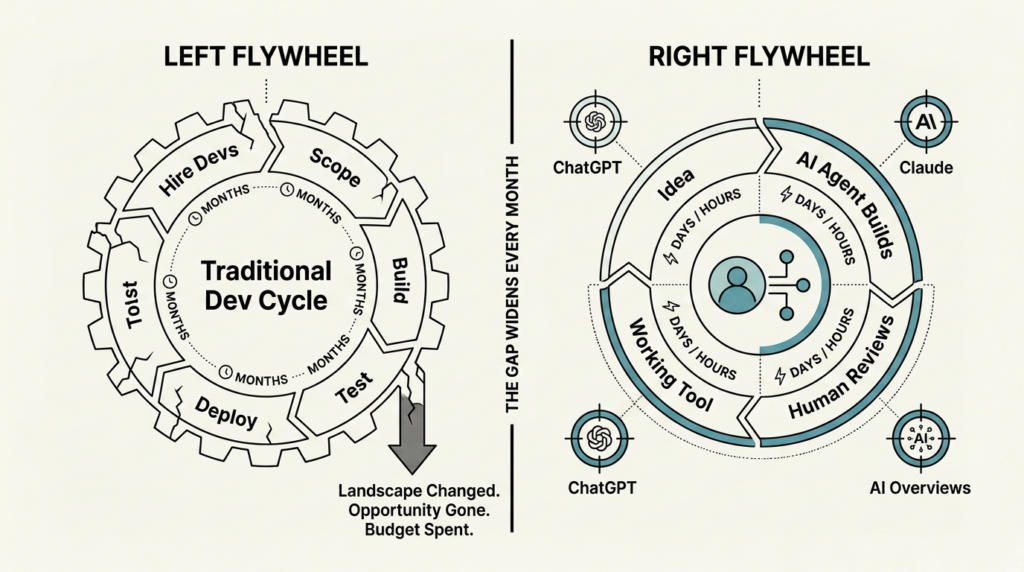
What our team has implemented is a completely different approach. We use AI agents to do the heavy lifting in an AI-powered IDE, with a human developer in the loop to orchestrate and review the output at every step. The result is that we go from idea to working tool in days. Sometimes hours. And because a real developer is always in the loop, the output meets production standards from the start.
What Vibe Coding With AI Agents Actually Means
Vibe coding gets thrown around a lot, so let me be specific about how we do it.
Pey, who’s been a full-stack developer for 15 years across Japan and the Philippines, leads our development execution. He doesn’t write every line of code by hand anymore. Instead, he orchestrates multiple AI agents that work together to design, build, critique, and refine code. Think of it like having a team of expert developers who never sleep, never get tired, and can write functional code in seconds.
The IDE we’ve standardized on is Google Antigravity. It’s an AI-powered integrated development environment with built-in agents that understand not just code, but context. It’s free to install. We pair it with Claude for the agent intelligence layer, which slots in as an extension. Sign in with your Claude account, and you’re ready to go.
The combination matters. Antigravity gives the agents access to the full project context, the file structure, the dependencies, and the live preview. Claude provides the reasoning. Together, they let one developer do what used to take a small team of engineers, designers, and SEO specialists working in parallel for weeks.
The AI Agent Stack: Personas Doing Specific Jobs
This is where the workflow gets interesting. Pey doesn’t just point one AI agent at a project and ask it to build everything. He builds a stack of AI agents, each modeled after a famous expert, with each agent assigned a specific role.
For our standard build flow, the lineup looks like this:
→ Steve Jobs is the orchestrator. He receives the brief, decomposes it into the work each other agent needs to do, and runs the show.
→ Elon Musk is the critic. His job is to push back, question assumptions, and pressure-test the system before it ships.
→ Jony Ive is the designer. He owns visual hierarchy, typography, color, and overall aesthetic.
→ Mark Zuckerberg is a full-stack developer. He writes the actual code across the front end and the back end.
→ A Google SEO persona handles structured data, schema, semantic markup, and on-page optimization.
→ A Jeff Bezos persona handles marketing copy, calls to action, and conversion-focused messaging.
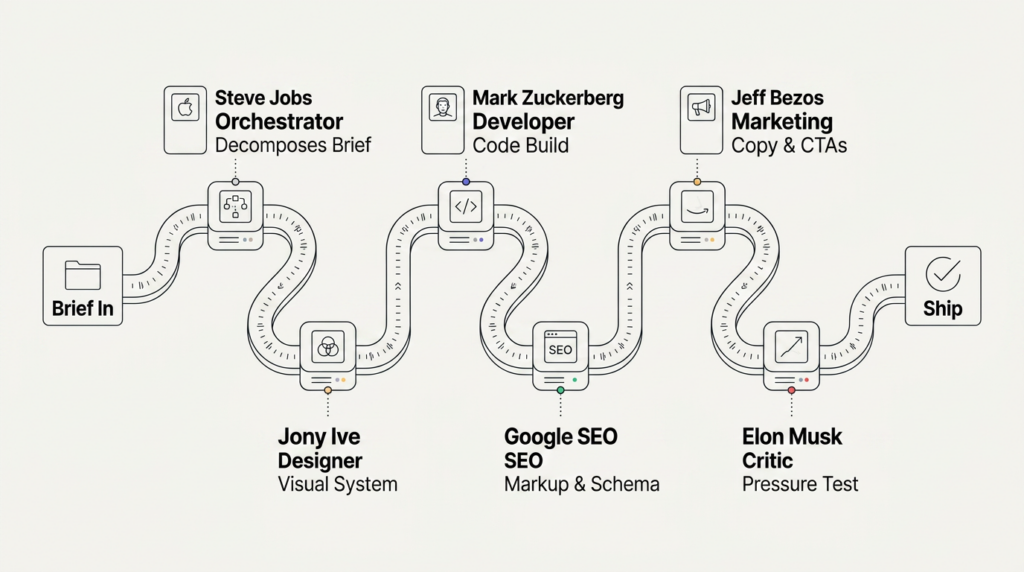
When Pey starts a build, he calls Steve Jobs first with a single prompt. Steve Jobs reads the brief, decides who needs to do what, and dispatches the remaining agents. The other agents debate, critique, and refine in real time. Pey watches the orchestration, approves agent permissions when prompted, and reviews the output as it’s being assembled.
The reason this matters is that quality goes up dramatically when each agent is specialized. A generic agent trying to be a designer, developer, SEO expert, and marketer all at once produces generic output. A stack of specialists produces output that feels like it came from a real cross-functional team, because functionally, that’s what it is.
Why We Don’t Use Lovable, Base 44, or Other Builders
I get this question a lot. If you can build a landing page with Lovable or Base 44 in five minutes, why bother with vibe coding inside an IDE?
Pey put it perfectly during the recording. With third-party builders, you can produce a good website or system, but you cannot own the code. The code lives on their platform. Your data flows through their infrastructure. Your migration path is controlled by their roadmap. And if you ever want to ship a mobile app version, integrate with internal pipelines, or refactor the back end for scale, you’re stuck waiting on their feature releases.
When you vibe code inside an IDE, you’re really building your website with your own code. Full control over the architecture. Full ownership of the back end. Full freedom to migrate the system to a new platform, deploy to the App Store, ship a Google Play version, or refactor anything you want without asking permission from a vendor.
For our agency, that distinction is non-negotiable. The tools we build for our SEO work need to integrate with client data, internal pipelines, monitoring infrastructure, and our own AI workflows. They cannot live in someone else’s walled garden. The same is true for any business that takes its tooling seriously and wants to compound the value of what it builds over time, rather than rebuilding from scratch every time a vendor changes direction.
Live Demo: A Branded Landing Page Built in Minutes
To make the whole workflow concrete, Pey ran a live build during the episode. The brief was simple: build a high-converting, modern, cute, and impactful landing page for a boutique cat shop using Next.js, Tailwind CSS, and Framer Motion.
He typed the prompt, called Steve Jobs the orchestrator, and let the stack run. Within minutes, you could see Mark Zuckerberg writing components, Jony Ive shaping the layout, the SEO persona implementing schema, and the marketing persona refining the call to action. Files appeared, organized themselves, and were automatically commented so a human developer could read and audit them later without guessing what each block does. That commenting step alone saves hours of onboarding when another developer has to pick up the project later.
When the build finished, Pey ran one command in the terminal, and the local dev server spun up the full landing page. Hero section. Product filter. Brand voice copy. Clean call to action. Schema markup baked in. All of it, fully owned, fully editable, fully deployable.
This is the workflow we now use to build the AI SEO tools that power what we do for our clients. The same principles that produced that landing page in minutes are what let us ship audit tools, content briefing systems, and monitoring dashboards in days instead of months. The tooling layer of our agency now moves at the same speed as our content layer, which used to be a structural bottleneck for everyone.
What This Means for Anyone Building SEO Tools in 2026
If you’ve been holding back on building custom tools because you assume it requires a development budget, a long timeline, and a team of engineers, that assumption no longer holds.
The technology stack to vibe code with multiple agents is free to install. The intelligence layer is accessible through a Claude or ChatGPT account. The IDE is free. The only investment is the time to learn the orchestration pattern, build your agent stack, and develop your prompting muscle to the point where you can brief a stack of agents the way a creative director briefs a team.
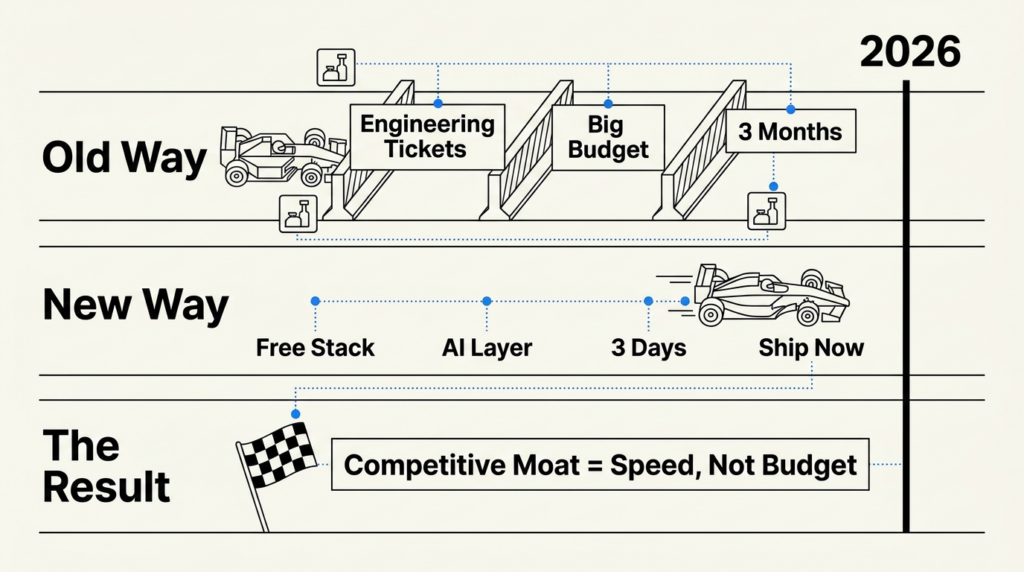
For SEO professionals specifically, this changes the economics of the job. The agency that can ship a custom AI Overview monitor in three days will outcompete the agency that takes three months to commission one. The in-house SEO team that can build a custom internal linking auditor in an afternoon will move faster than the team waiting on engineering tickets that may never come. The competitive moat is no longer about who has the biggest budget. It’s about who can ship the right tool at the right moment.
The agencies and teams that win in 2026 will be the ones that figure out how to ship tooling at the speed at which search itself is evolving.
What to Do Next
Here’s where to start if this resonates.
First, install Google Antigravity. It’s free. Spend an hour exploring the IDE and the built-in agent panel so the interface stops feeling foreign before you try to build anything serious. Familiarity with the workspace is half the battle.
Second, install Claude as an extension and connect your account. Once you’re signed in, you have access to the same agent layer Pey uses every day on real client work for our agency.
Third, build one agent persona. Start with an orchestrator. Give it a clear role. Then add a critic. Then add a developer. Build your stack iteratively the same way Pey did, and let your prompting style develop alongside it as you learn what each agent does well and where it needs more direction.
If your team needs help getting AI-powered SEO tools built fast, or if you want a working example of what AI SEO that ranks across both Google and the LLMs looks like in practice, you can always reach out through chrisraulf.com. Our team is shipping this kind of work every week, and we love showing other teams what’s possible.
Stay safe and healthy.
Cheers,
Chris