
What if a 100% AI-generated blog post could rank #1 in Google in just a few days? Not for some easy long-tail keyword. For a real, competitive search term that home builders are actually typing into Google right now.
I just got back from Berlin, where I presented at the GALA Conference. Before I left, I ran a test. I created a brand new blog post titled “SEO for Home Builders” using a methodology I call the Universal Content Engine. The piece is 100% AI-generated. I published it on the Boulder SEO Marketing website. And by the time I landed in Germany, it was already ranking #1 in Google organic results for the keyword “SEO for builders.”
That is the proof point I want to walk you through today, because the methodology behind it is something you can use in your own business starting this week. Watch the full video above to learn more.
Here’s the thing. Most business owners I talk to are scared of AI content. They’ve tried using ChatGPT to write blog posts, and the output sounds generic. It doesn’t rank. It doesn’t convert. It just sits on their site collecting dust and probably hurting their authority signals more than helping. I get it. I’ve seen the same thing happen to dozens of clients before they came to us.
But the problem isn’t AI. The problem is the workflow.
Why Most AI Content Fails to Rank
The reality is that most people are using large language models incorrectly. They open ChatGPT, type “write me a blog post about SEO for builders,” and hit enter. What comes out is exactly what you’d expect. Surface-level. Generic. The same regurgitated advice that’s been published a thousand times on a thousand other websites. There’s nothing in that content that signals expertise to Google or to the AI search engines like ChatGPT, Perplexity, Gemini, and Claude.
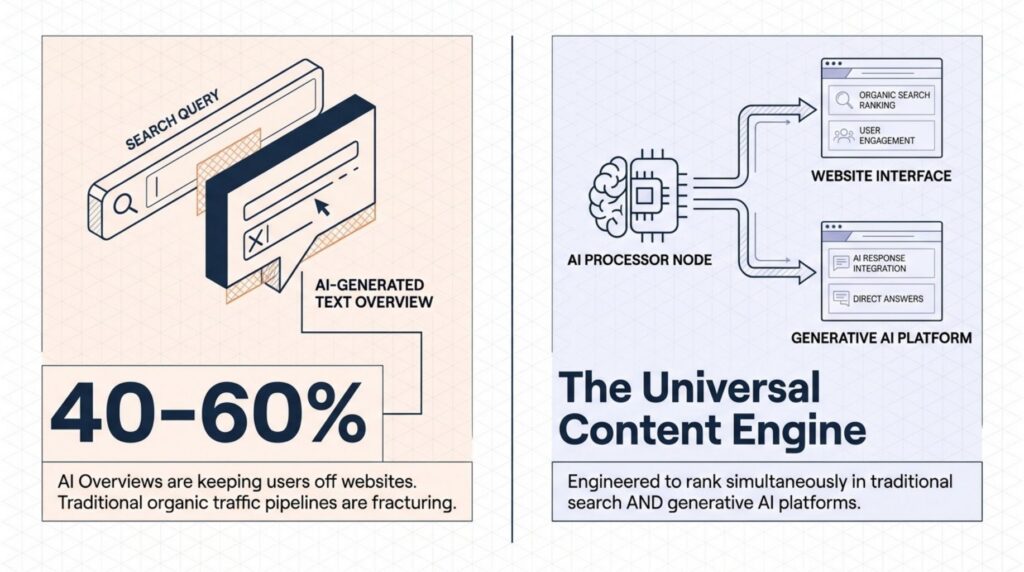
In my experience, Google has gotten incredibly good at spotting this kind of content. Their helpful content systems are designed to demote pages that lack what they call “experience.” That’s the first E in E-E-A-T, which stands for Experience, Expertise, Authoritativeness, and Trustworthiness. If your AI-generated content doesn’t show real, first-hand experience, it won’t rank. Period. And it’s only getting harder. Google now shows AI Overviews on roughly 40 to 60 percent of all searches, which means even when you do rank, you’re often ranking below an AI summary that’s keeping the click on Google’s own page. The bar for content quality has gone way up.
That is exactly the problem the Universal Content Engine solves.
The Universal Content Engine in Plain English
Here’s what the Universal Content Engine actually is. It’s a structured prompting workflow that takes a subject matter expert’s real, first-hand experience and turns it into a comprehensive piece of content that Google and AI search engines actually want to recommend.
It used to live inside our internal platform called BSM Copilot. We’re now relaunching it under a new name, Micro SEO. The methodology itself stays the same. What changes is that the platform now also helps slice and dice that one core piece of content into LinkedIn posts, Facebook posts, X posts, Instagram posts, press releases, and more. That distribution layer is critical because the content needs to live in more than one place for the AI search engines to pick it up. ChatGPT, Perplexity, and Gemini don’t just feed on Google search results. They feed on YouTube, LinkedIn, Reddit, Quora, and a dozen other platforms.
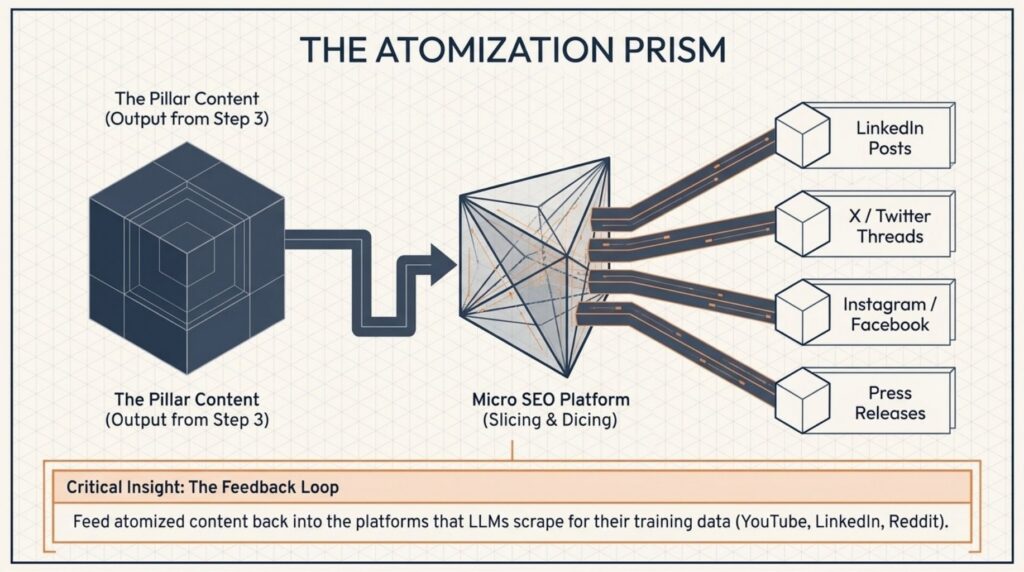
But let’s stay focused on the core piece for now. The blog post that becomes the foundation. Because if that piece isn’t strong, nothing downstream of it will rank either.
The Three Components That Decide Whether AI Content Ranks
Before I walk you through the actual prompting sequence, I want to be honest about what makes this work. There are three components you absolutely need in place. Without them, the methodology will produce a perfectly fine piece of content that goes absolutely nowhere.
The first component is domain authority. Some of you remember the old PageRank score that Google used to publish, where every website got a number out of 100. Google doesn’t share that score publicly anymore, but the underlying concept hasn’t gone away. Tools like SE Ranking can show you your domain authority or domain trust score. The higher the score, the easier it is to rank new content quickly. If your site is brand new and has no backlinks, no press, and no authority signals, this methodology will still help you create a great piece of content. But you should expect a longer runway before it ranks.
The second component is the author’s E-E-A-T score associated with the content. Google wants to know who created this piece. Is this person legit? Do they have a verifiable track record on the topic? Do other authoritative sources reference them? In my case, I’ve been doing SEO since the late 90s. I rank #1 for “international AI and SEO expert” on Google. I teach at the University of Strasbourg. I speak at conferences globally, including the one I just came back from in Berlin. All of those signals add up. If you don’t have that kind of public footprint yet, start building it. Get yourself on Featured.com. Publish on LinkedIn consistently. Get quoted in industry publications. The author signals matter just as much as the content itself.
The third component is what I call your virtual copy. At Boulder SEO Marketing and at Chris Raulf AI SEO, we use a tool we call Virtual Chris. It lives inside a Claude project. Every meaningful piece of content I create, every sales call I have, every podcast I record, and every webinar I deliver gets fed into structured roll-up documents within that project. Over time, Virtual Chris develops a memory of how I think, speak, use examples, and what I believe about the industry. The better you set up your virtual copy, the more authentic the content it produces will sound. That authenticity is what AI detection tools and Google’s helpful content systems are looking for.
The Prompting Sequence Walkthrough
Now, let me walk you through the actual prompting sequence. I’ve shared the full prompts on the blog post that accompanies this video, so you can copy and paste them directly into your favorite large language model and run them yourself.
The sequence starts with three primary keywords you want to rank for. Pick them carefully. Use a tool like SE Ranking to validate that there’s actual search volume and that you have a realistic chance of ranking. Then you fill in your business context. Who are you, what do you do, who do you serve? Then your expert profile. This is where the E-E-A-T signals get baked in. List your accomplishments. List your credentials. List the publications you’ve been featured in. The more detail you provide here, the more grounded the output will feel.
Next is the strategic theme. What is this specific piece of content about? What is the most important thing the reader should learn, and what is the call to action? Then a little bit of supplementary keyword research. The three primary keywords plus three to five supporting keywords. SE Ranking is what I use for this, and there’s a free month-long trial linked in the YouTube description if you want to test it.
Then comes the most important input. The expert interview transcript. This is where the methodology becomes truly different from generic AI prompting. You have a real conversation with a subject matter expert. Could be your head of R&D. Could be your marketing manager. Could be a customer success conversation. Could be you talking into your phone while walking. You transcribe that conversation and paste it into the prompt as raw source material. The large language model uses that transcript as the spine of the content, weaving in the expert’s actual phrases, examples, and perspective. That’s what gives the final piece its E-E-A-T signal. It’s not invented. It’s a record of someone with real experience explaining something they actually know.
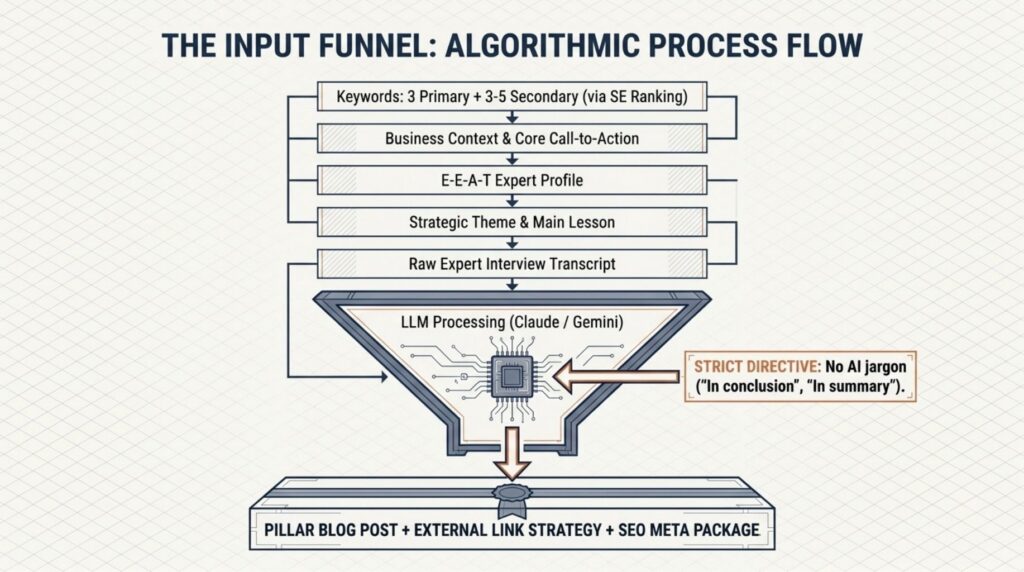
Finally, you add directives. Tell the model exactly what kind of blog post to write, what tone to use, what to avoid, and how to structure the output. I always include directives like “no AI slop giveaways,” so the model doesn’t open every section with “in conclusion” or “in today’s digital landscape.” Then I ask for link recommendations and a full SEO package at the end.
The Live Gemini Demo and What It Tells You About Tool Choice
In the video, I run the entire prompting sequence live through Gemini. I usually use Claude for content creation because Virtual Chris lives there, and the output tends to be sharper. But for this demo, I wanted to see how Gemini would handle it cold, with no virtual expert profile, just the prompting sequence and the source transcript.
The output was genuinely impressive. Gemini produced a complete blog post with the right structure, link recommendations, a sharp callout to the Google Search Quality Raters guidelines, and a full SEO package with a meta title and meta description. Was it perfect? No. You always want to go back and refine, beef up sections, tighten others, swap out phrasing that doesn’t sound like you. But the foundation was solid.
The takeaway here is not that Gemini is the best tool. The takeaway is that the methodology works across multiple platforms. ChatGPT, Claude, Gemini, Perplexity. Use whichever fits your workflow. The prompting sequence is what does the heavy lifting. The tool is the vehicle, not the engine.
What to Do Next
If you’re a business owner who depends on leads, here’s what I’d do this week. First, pick one underperforming page on your site. Something that’s ranking on page two or three of Google. Not page one, because you don’t want to disrupt what’s already working. Pages two and three are where the opportunity lives. Second, identify the subject matter expert in your business who can speak to that topic with real first-hand experience. Sit down and record a 15 to 20-minute conversation with them. Get the transcript. Third, fill in the Universal Content Engine prompting sequence with your business context, your expert profile, your keywords, and that transcript. Run it through Claude or Gemini. Refine the output. Publish. Then take that one piece and slice it into LinkedIn posts, a Bluesky post, a press release, and a YouTube video script. That’s where the real distribution leverage compounds.
Then watch what happens.
If you’d rather not do this yourself, that’s what we do every day at Boulder SEO Marketing. We work with local service businesses, white-label agency partners, and B2B companies that depend on leads to survive. Reach out and let’s talk about whether this methodology is a fit for your business.
Stay safe and healthy.
Cheers,
Chris