
What if your customers stopped visiting your website to buy from you and started buying directly inside Google instead? What if Google’s AI agents were working on their behalf at 3 AM while they slept, deciding which businesses to surface and which to skip?
That is not a hypothetical anymore. That is what Google announced at I/O 2026.
Google I/O 2026 just happened. 100 announcements in two days. And if you own a business or create content online, several of these are going to change how your customers find you. Our Head of AI R&D at Chris Raulf AI SEO and Boulder SEO Marketing, Harold De Guzman, read the entire official Google I/O 2026 blog post so you do not have to. Here is everything that matters, from my perspective after nearly three decades in this industry.
Watch the full video above to learn more.
The Model Section Is Where Everything Starts
Gemini 3.5 Flash is the first model Google describes as combining frontier intelligence with action. Fast, smart, and less than half the cost of other frontier models. Here is why that matters.
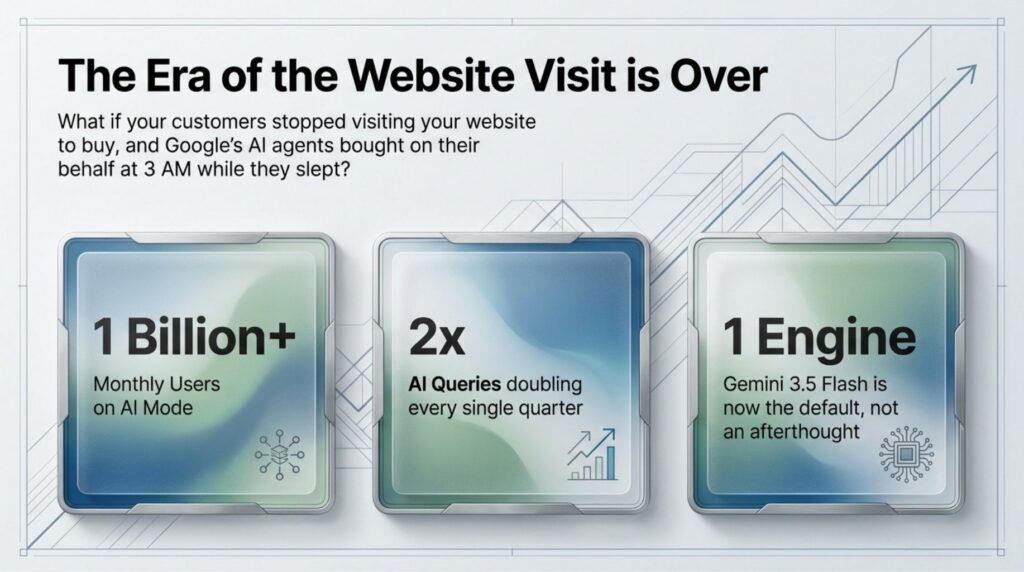
It is now the default model powering AI Mode globally. Every AI answer your customers are seeing inside Google right now is generated by this model. When I think about how much has shifted in just the last six months, this one announcement reframes the entire conversation about rankings. The model running underneath search is no longer an afterthought; it is the search engine itself.
Then there is Gemini Omni. This is the game-changer for content creators and SEOs. Google says it can create anything from any input. Text, video, audio, images. Your video content, your transcripts, and your audio files are now fully readable and citable by Google’s AI. And Gemini Omni is available for free inside YouTube Shorts Remix. You can even create a custom AI avatar that looks and sounds like you. Sound familiar? That is exactly what Harold is doing in the video above, using ElevenLabs to clone his voice.
For service businesses, this is the moment to stop treating video as a “nice to have.” A medical practice, a law firm, a financial advisor: every consultation you record (with permission), every educational webinar, every Q&A session is now potential ranking fuel. For e-commerce brands, your product demo videos and unboxing content now carry real SEO weight. The transcripts are the new metadata.
AI Mode Crossed 1 Billion Monthly Users
Read that number again. One billion monthly users on AI Mode. Queries are more than doubling every single quarter. That is not a trend; that is the new normal of search.
Google also just made the biggest upgrade to the search box in over 25 years. You can now search using text, images, files, videos, and Chrome tabs all at once. That is live today across desktop and mobile worldwide. Here is what I have learned over the years, watching Google make changes of this magnitude: the businesses that move first capture the disproportionate share of the new traffic. The ones that wait spend the next two years trying to catch up.
The visual search component matters most for industries that offer visual products or services. Home services contractors, interior designers, landscapers, dentists showing before-and-after work, automotive dealers, fashion and apparel brands. Your customer can now snap a photo of a problem (a leaking pipe, a damaged car bumper, a chipped tooth, a paint color they want matched) and ask Google to find the local business that solves it. If your visual content is not optimized with proper alt text, schema markup, and image filenames, you are entirely invisible to that query type.
Information Agents Are the One Most Businesses Are Sleeping On
Google is launching AI agents that operate in the background 24 hours a day. And look at what they scan. Blogs, news sites, social posts, real-time data. If your content is not present in those sources, these agents will never surface your business to a buyer. Ever.
This is the part of the announcement that should be making every business owner reading this rethink their content distribution strategy. Being on your website is no longer enough. You need to be in the places these agents are actually crawling and citing. That means a real presence on LinkedIn, YouTube, Reddit, and the trade press that covers your industry.
For B2B and professional services, LinkedIn is now table stakes. Not optional. If your CEO, your founders, and your senior practitioners are not publishing consistently on LinkedIn, your competitors who are publishing will be the ones these agents cite when a buyer asks Google for a recommendation. For local services, Reddit and niche community forums are now ranking signals through the back door. The agents are reading those threads. So are your buyers. For SaaS and tech, the trade press still matters more than founders realize. Getting featured on TechCrunch, The Verge, or a vertical-specific publication used to be about brand awareness. Now it is about being in the citation pool.
Generative UI in Search is another quiet but enormous shift. Search can now build custom layouts, tables, graphs, and interactive visuals for every query. Rolling out free to everyone this summer. The implication is that your content needs to be structured cleanly enough for Google to remix it into these custom layouts on the fly. Schema markup, clean headings, well-organized data tables. These are not optional anymore.
And then personal intelligence. Available in nearly 200 countries across 98 languages. No subscription required. AI search is now truly global.
Universal Cart Means Customers Never Need Your Website to Shop
This one is for every business owner who sells anything online. Google announced Universal Cart, an AI-powered shopping cart that works across Search, Gemini, YouTube, and Gmail all at once. Your customers can add products to their cart while browsing search, chatting with Gemini, watching YouTube, or reading Gmail. They never need to visit your website to shop.
The cart does not just hold products. It finds deals, tracks price drops, alerts customers about restocks, and proactively flags incompatible products. This is an AI agent acting as your customer’s personal shopper. It is rolling out this summer.
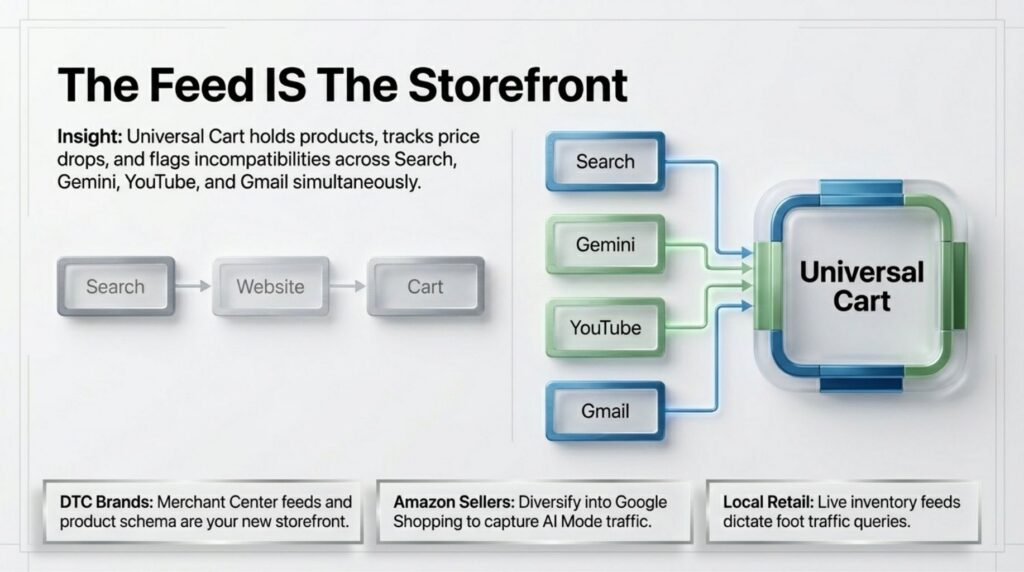
The reality is that if you sell anything online, your product data, structured data, and feed quality need to be optimized for this right now. Not next quarter. Right now. For DTC e-commerce brands, this is an existential shift. Your Google Merchant Center feed quality, your product schema, your inventory accuracy, your shipping data- all of it now functions as both your product catalog and your storefront. For Amazon-dependent sellers, this is the moment to seriously diversify into Google Shopping with full feeds, because Universal Cart will route AI Mode traffic into a Google-controlled buying environment rather than Amazon. For local retailers, this also pulls foot traffic queries (think “buy this nearby today”) into the agent’s decision layer. Your local inventory feed needs to be live and accurate, or the agent will pass you over for a competitor whose feed is.
Gemini Spark Changes How Your Customers Use the Internet
This is the announcement that matters most for long-term positioning. Gemini Spark is Google’s personal AI agent that works 24 hours a day, 7 days a week, even when your customer’s laptop is turned off.
Read that last part again. Even when devices are turned off.
This is not a chatbot. This is an agent that works for your customer around the clock. Finding content, taking action, and making decisions while they sleep. The beta is coming to AI Ultra subscribers in the United States in the coming weeks. And the roadmap includes texting or emailing Spark directly, creating custom sub-agents, and authorizing payments.
Daily Brief is rolling out today to all Google AI subscribers. It analyzes your inbox, calendar, and tasks overnight and gives you a prioritized digest of what matters most. The businesses whose content ends up inside these daily digests stay top of mind every single morning. That is the new fight for attention. Not the first page of Google. The morning brief.
For high-consideration purchases (real estate, financial services, B2B software, professional services), Gemini Spark will handle the initial research, vendor comparisons, and shortlisting on your buyer’s behalf. By the time they contact you, the agent has already filtered three to five competitors. You need to be in that shortlist, and the only way to do that is consistent, citable, expertise-driven content across multiple platforms. For subscription businesses, recurring brand presence in Daily Brief becomes the new email open rate. If your content is the thing the agent surfaces on Tuesday morning, you stay relevant. If not, you disappear from the buyer’s daily mental rotation.
Ask YouTube Turns the World’s Second-Largest Search Engine Conversational
Almost nobody is talking about this one, and that is exactly why I want to flag it. Google just launched Ask YouTube, a conversational AI search inside YouTube itself. Complex questions. Structured responses. Long-form video and shorts compiled together into a single interactive answer.
For anyone creating video content, this completely changes your YouTube SEO strategy. Your transcripts matter more than they ever have. Your chapters matter. Your descriptions matter. Your shorts matter. Every piece of metadata is now indexable in a conversational context, not just a keyword-match context. Rolling out this month in the United States on desktop.
For education, training, and how-to industries, this is the single biggest opportunity in the announcement. Online course creators, certification providers, technical training companies, software documentation teams. Your long-form tutorials are now searchable in conversational chunks instead of full videos. If your content has clear chapters and accurate transcripts, the AI will pull the exact 90-second segment that answers the user’s question and cite you as the source. For consumer brands and creators, the shorts strategy just got more important. Ask YouTube treats shorts and long-form as a unified library. A well-structured 30-second short with a strong transcript can now appear in the same conversational answer as a 20-minute deep dive.
And the final item in the announcement, number 100, mentions that ElevenLabs is one of the partners bringing SynthID watermarking to their AI-generated content. That is the exact tool Harold uses to clone his voice in our weekly videos. The voice you hear in the AI SEO Tip episodes is verified, watermarked, and transparent. Google and ElevenLabs are building the trust infrastructure for AI content online. And that trust infrastructure is going to matter enormously for AI SEO going forward, especially as E-E-A-T continues to weigh more heavily in how AI systems decide what to cite.
What to Do Next
Here is what I would do this week if I were running marketing or owning a business right now.
Audit your content distribution. If you are only publishing to your website, you are invisible to the agents Google just launched. Get serious about LinkedIn, YouTube, and the trade publications your buyers actually read. Then optimize your product data and structured markup for Universal Cart. If you sell online, this is not optional. Then go look at your YouTube transcripts, chapters, and descriptions. Ask YouTube is going to reward structure and punish lazy metadata.
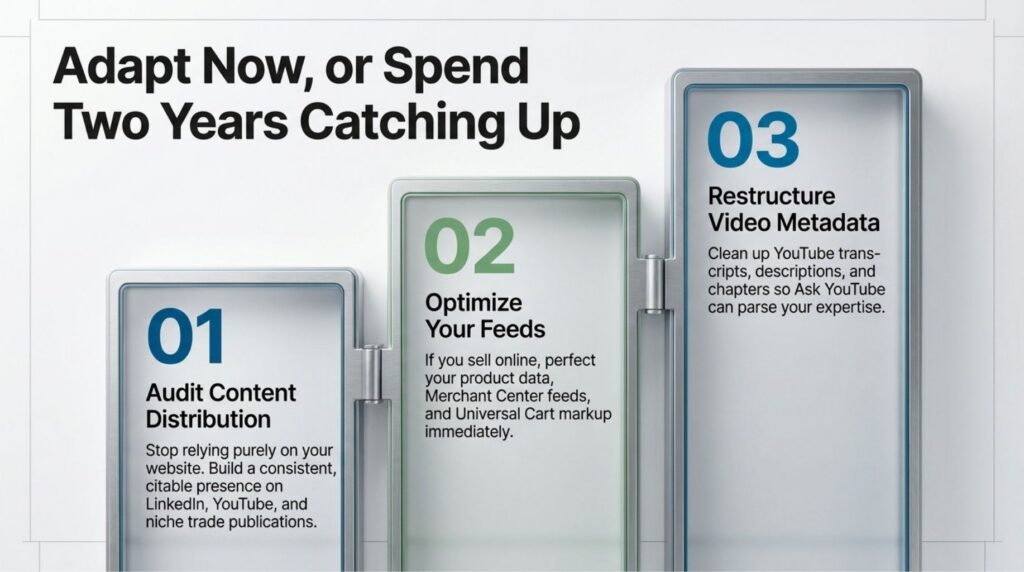
The era of traditional search is over. The era of agentic AI search is here, right now. There is only one question left. Are you going to adapt now, or are you going to wait?
If you want a real AI SEO strategy, not just tips but an actual system that drives visibility and leads, head over to Boulder SEO Marketing and see what we do. If it feels like a fit, reach out. We would love to talk.
Stay safe and healthy.
Cheers,
Chris