
Is the person speaking in this week’s video real, or is it AI?
That is the exact question Harold De Guzman, our AI Director here at Boulder SEO Marketing, opens with in this week’s AI SEO Tip. And the answer, I’ll be honest with you, surprised even me the first time I saw the finished cut.
The Harold you see on screen is an AI avatar. The voice is a cloned version of his actual voice. No camera was turned on. No studio was booked. No editing session burned through an afternoon. The entire video was produced from a written script using two tools that I’m now convinced every business owner reading this needs to understand by the end of the quarter. Watch the full video above to learn more.
I’ve been doing SEO for nearly three decades. I’ve watched search shift from BackRub to Google, from blue links to AI Overviews, from desktop to mobile to voice to AI chat. And here’s what I’ve learned: every time the medium changes, most businesses lag behind by eighteen to twenty-four months because production feels too hard. Video is the perfect example. Everyone knows it works. Almost nobody ships it consistently. That gap, the gap between intention and follow-through, is exactly where AI avatars come in. The companies that close it first will take a visibility lead that will be very hard to catch up to.
Why Video Is Suddenly the Center of AI Search
Look, this part isn’t complicated. Google still owns YouTube. YouTube is still the second-largest search engine on the planet. And when Google’s AI Overviews pull together an answer, video carousels and YouTube embeds sit right alongside the text snippets.
ChatGPT and Perplexity are doing the same thing. They are increasingly referencing YouTube as a credible source because the video transcript, the actual words spoken on screen, becomes indexable content. That is a signal. That is something AI can cite. That is a path to visibility that text-only publishers are leaving completely on the table.
Harold made a point in the video that I want every reader to sit with: in the age of AI, video is not becoming less important. It is becoming more important. The platforms reward it. The audience trusts it. And right now, your competitors who are publishing on YouTube are stacking visibility across traditional search, AI Overviews, and direct YouTube search. That is three search surfaces from a single asset. A blog post alone hits one.
How Video Actually Builds the E-E-A-T Signals AI Platforms Read
Here is the part most SEO conversations skip. E-E-A-T is not a checklist. Experience, Expertise, Authoritativeness, Trustworthiness. Those are the four signals that Google and AI platforms are actively trying to identify when deciding what to surface in an AI Overview or a chat response.
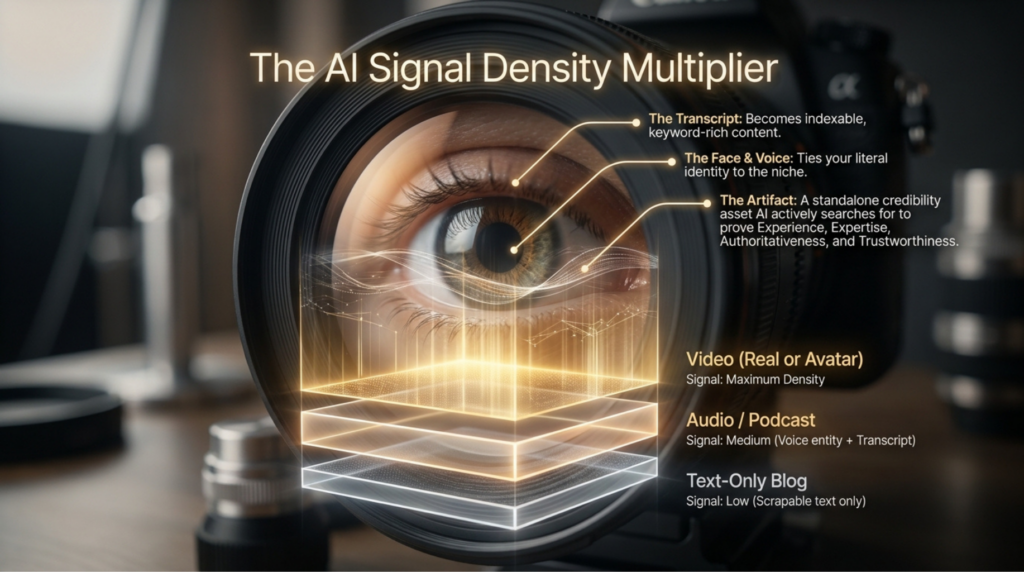
Video carries those signals harder than any other content format. When a real person, or in this case, a real expert delivered through an avatar, looks at the camera and explains a methodology, the platforms gain signal density that text simply cannot match. The transcript becomes indexable content. The video itself becomes a credibility artifact. Your face, your voice, and your name get tied to the topic in ways that compound across every platform that surfaces the content.
That last part is the piece most people miss. When you publish a YouTube video on a topic, you are not just chasing a YouTube ranking. You are training every AI platform that scrapes YouTube to associate you with that topic. Six months later, when a prospect asks ChatGPT a question in your space, the chance that your name surfaces is materially higher because the video existed. That is the long arc that most businesses miss when evaluating video ROI.
The Real Reason Most Businesses Skip Video
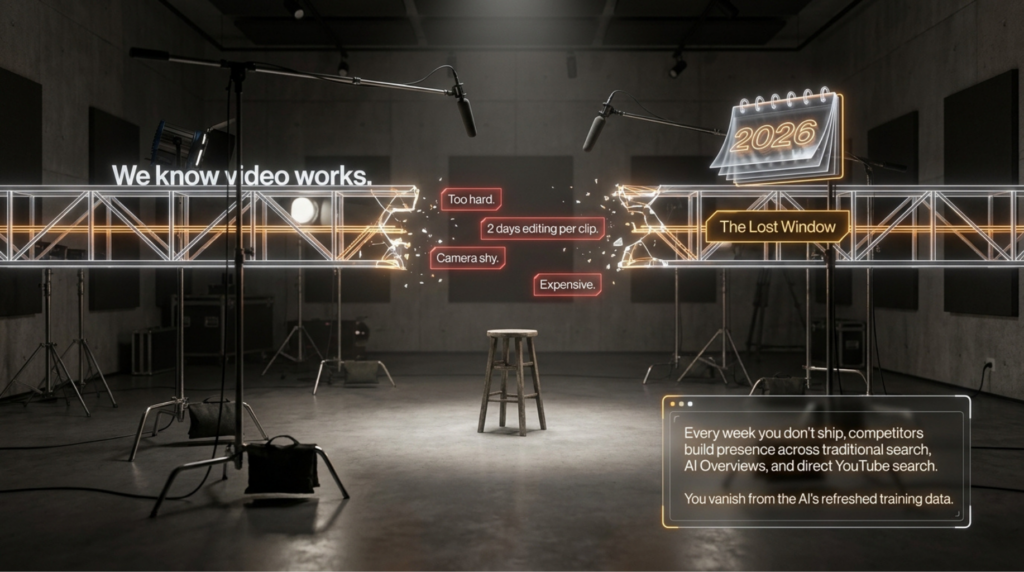
I have this conversation almost weekly. A marketing director will tell me their team understands video matters. They’ve read the same studies you have. They believe in the strategy. And then they explain why it never ships. Too hard. Too time-consuming. Too expensive. No one on the team feels comfortable on camera. Editing takes 2 days for every 5-minute clip. The scheduling alone kills momentum.
Here’s the thing. None of those objections are about belief. They are about execution. The intention is there; the follow-through isn’t. That is the gap AI avatars close.
And I want to be specific about what that gap actually costs. If your business is only producing blog posts in 2026, you are leaving a massive visibility window open. Competitors who are on YouTube, even with imperfect content, are building presence across traditional search, AI Overviews, and direct YouTube search simultaneously. Meanwhile, every week you don’t ship is a week when your name isn’t associated with your category in the training data that AI search platforms keep refreshing.
The Production Economics Are Not Close
Let me walk through what the math actually looks like, because this is where the argument stops being theoretical.
A traditionally produced five-minute SEO video at a small agency typically costs between two and four hours of script writing, half a day of filming, and another half day of editing. That is one to one and a half days of human time per piece. Multiply that by 52 weeks, and a weekly video commitment becomes a part-time job for someone on the team. Most marketing departments cannot absorb that, so they ship monthly, then quarterly, then not at all.
With the avatar workflow, the math changes completely. Script writing still takes time because that is where the actual thinking happens. But filming drops to zero. Editing drops to near zero. The render is automatic. A five-minute video that used to take ten hours of human production now takes the time it takes to write the script plus a few minutes of generation. For a marketing team that already writes weekly content, video becomes additive instead of competitive. That is the unlock. Not the tools themselves, but the schedule they make possible.
How Harold Actually Made This Video
Let me pull back the curtain the way Harold did. The workflow uses two tools that work together cleanly.
HeyGen handles the visual side. Harold filmed himself once, roughly five to ten minutes of footage, and HeyGen built a photorealistic digital avatar from that recording. From that point forward, the camera became optional. He writes a script, pastes it into HeyGen, and it generates a video of his avatar delivering that script with realistic lip sync and natural movement. That is the entire visual production process.
ElevenLabs handles the voice. You upload a few minutes of your voice, and it creates a clone that sounds like you. Not a generic robot. Not a stock voice. You. When the two tools work together, you get a fully AI-generated video that looks like you, sounds like you, and produces an SEO signal identical to a traditionally recorded video.
From a search standpoint, this is the part that matters most. Google sees a video. YouTube sees a video. AI search platforms see a video. The signal is real, even if the recording session was not. Let that sink in for a second. The ranking factor doesn’t care how the video was made.
Four Ways to Put This to Work This Week
Harold laid out four use cases in the video, and I want to amplify them because each one solves a real bottleneck I see in client workflows.
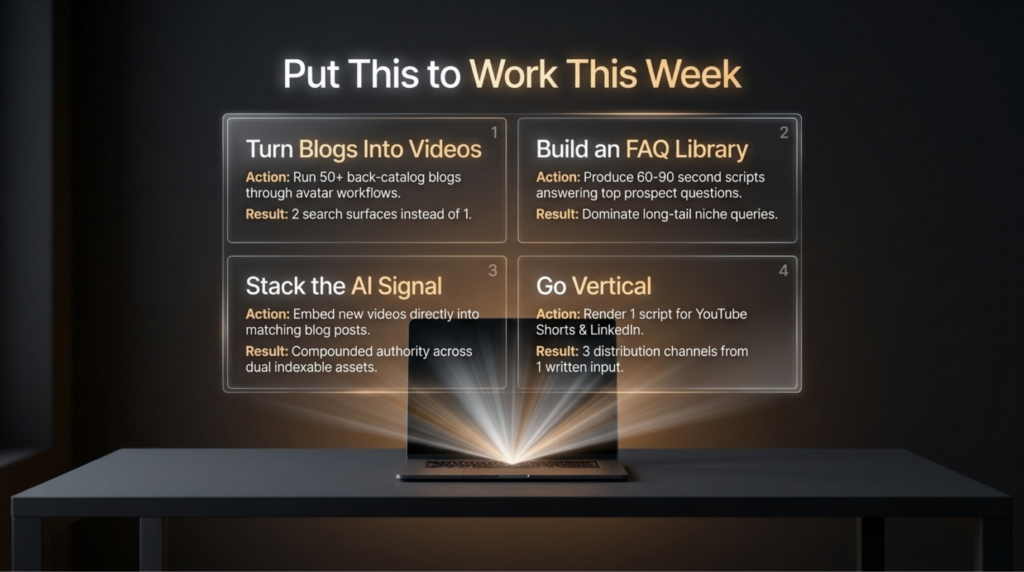
First, turn existing blog posts into videos. You already wrote the content. You already did the research. Run that asset through the avatar workflow, produce a two- to three-minute explainer, upload it to YouTube, and you now have the same content-earning signals on two search surfaces instead of one. For most businesses sitting on a back catalog of 50 to 100 blog posts, this single use case represents months of high-leverage repurposing.
Second, build an FAQ video library. Short scripts, sixty to ninety seconds each, answering the specific questions your prospects ask most. With an avatar workflow, you can produce that entire series in a single afternoon. The compounding effect on AI search visibility is significant because each FAQ video targets a distinct query, and the cumulative library begins to dominate the long tail in your niche.
Third, stack the AI signal. When a YouTube video covers the same topic as your blog post, AI platforms gain more confidence that you are a real authority on the subject. The combination matters more than either piece alone, because you are now signaling expertise across two formats and two indexable assets.
Fourth, go vertical. The same script can be rendered in vertical format for LinkedIn video and YouTube Shorts. One script becomes three distribution surfaces. That is how you stay consistent without burning out a small team.
The Ethics Question Is Worth Taking Seriously
I appreciate that Harold tackled this head-on in the video, because it deserves a real answer. Is it misleading to use an AI avatar? Honest answer: it depends entirely on what you’re doing with it.
If the expertise being shared is genuinely yours, if you are transparent about the use of AI when it matters, and if the avatar is delivering insight that you would have delivered in person anyway, then an AI avatar is a delivery mechanism. Nothing more. Think of it the way you think about a teleprompter or a ghostwriter. The substance is yours. The medium just got more efficient.
The line I would not cross is using an avatar to fabricate authority you don’t have. Don’t put your AI avatar in front of a topic you couldn’t speak to in person. That is where transparency breaks down, and trust erodes fast. Use the avatar to scale the expertise you already have, not to manufacture expertise you don’t.
What I found especially clever about Harold’s video is that he opened by showing AI clones of himself walking behind him. That choice is itself a hook. It signals to viewers that the creator is actively using the tools they teach. That is credibility in action.
What to Do Next
This week, run the experiment. Sign up for HeyGen, generate one avatar, and ship one video. Then head over to ElevenLabs and clone your voice. The whole loop takes less than a day, and you’ll know within an hour whether it fits your workflow. Pick a blog post you already published, turn the introduction and the three biggest takeaways into a 90-second script, and run it through the pipeline. Watch the result. Then decide whether weekly is realistic for your team.
If you are watching this and thinking the strategy is right but you don’t have the team to execute it, that is precisely what we do at Boulder SEO Marketing. We help businesses build AI SEO strategies that drive real visibility, real leads, and real results. If it feels like a fit, reach out.
Until next time, thank you for being part of this community. Harold and the team will see you in the next AI SEO Tip.
Stay safe and healthy.
Cheers,
Chris