
For years, the SEO question was simple: are you on page one? Today there is a sharper one. When someone asks AI a question your business answers, does the AI name you as the source, or does it name someone else?
That single shift is what this week’s tip is about. I asked our AI Director, Harold De Guzman, to walk through Google’s June 8 rebuild of NotebookLM, because it quietly handed us a faster way to build the kind of content that AI engines actually cite. If you only have a few minutes,
Watch the full tip above to learn here.
I have been doing this since before Google was called Google, back in the BackRub days, and in thirty years I have rarely seen the ground move this fast. I get to see how this is playing out across very different markets, and the pattern is the same everywhere. So let me give you the honest version of what changed and what to do about it.
Search is not ten blue links anymore
Here is the reality. People are no longer scanning a page of results and choosing for themselves. They ask, and AI answers, pulling from a small handful of sources it decides to trust. If you are one of those sources, you get the visibility, the clicks, and the authority that follows. If you are not, you are invisible, and the hardest part is that you do not even know it is happening. I see it constantly. A business owner asks an AI assistant about the exact service they sell, and the answer confidently recommends three competitors but never mentions them. They have a perfectly good website. It simply was not the source the model reached for.
Think about what that does to the old model. A search used to send a stream of visitors to a ranked list of pages. Now a growing share of those searches end with an answer and a few cited links, and the citation is the new page one. Being the source the model trusts is worth more than being the tenth blue link ever was. This is the heart of GEO, generative engine optimization, and it rewards the same things strong SEO always has, just more strictly: experience, expertise, authoritativeness, and trust. E-E-A-T is not a buzzword here. It is the filter.
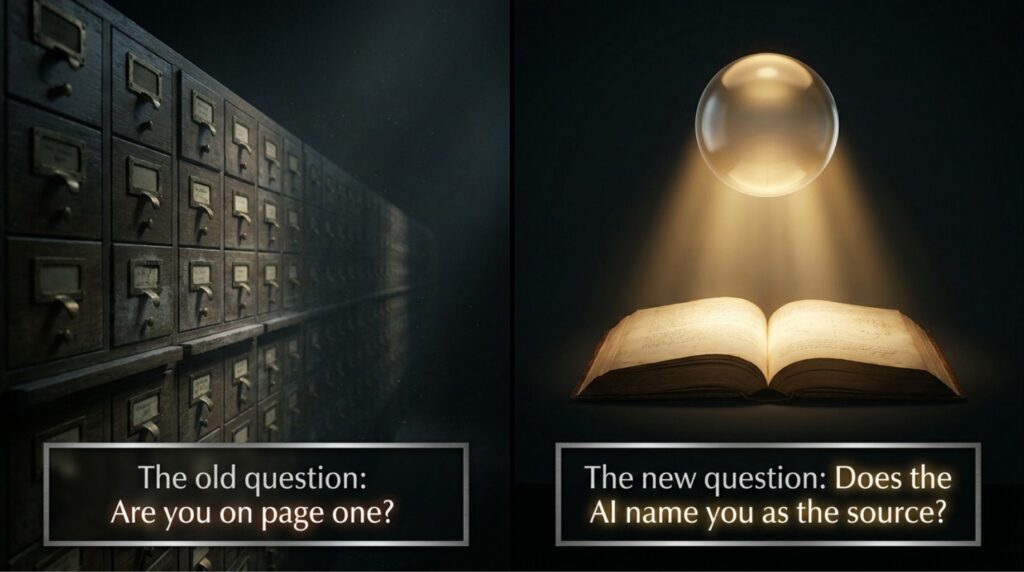
What is fascinating about this moment is that the rules for being chosen are not a secret. AI engines do not cite slop. They cite sources they can trust. Well-sourced, well-structured, and backed by something real. Most content on the web misses that bar. It is fast to make, thin, unsourced, and completely invisible inside ChatGPT and AI Overviews. The new NotebookLM is built to help you close that exact gap, and that is why it matters for anyone serious about getting found.
What actually changed on June 8
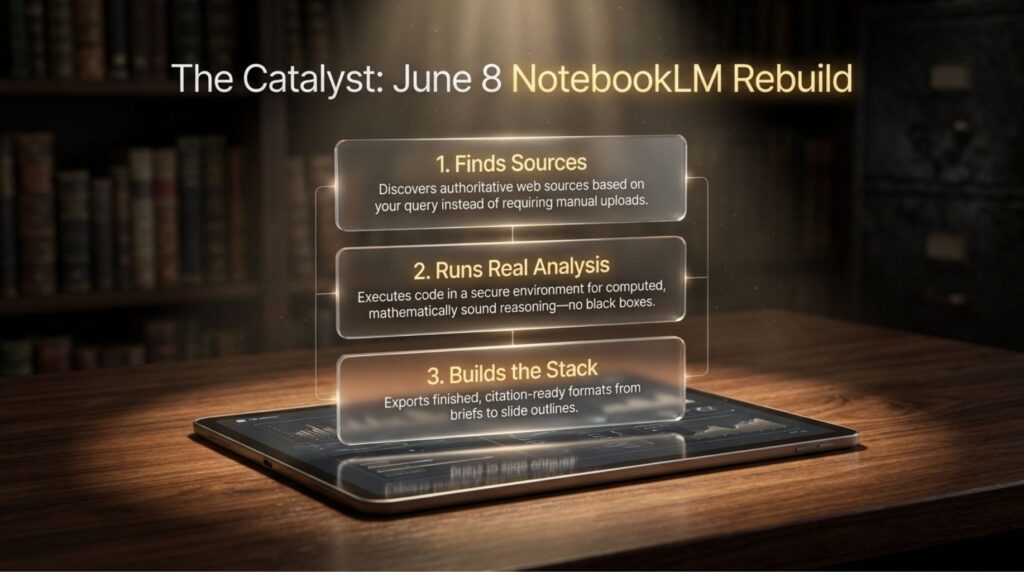
I do not want to oversell this, so let me be precise. For a long time, NotebookLM was a place to chat with documents you brought yourself. Useful, but limited. The June 8 update changed what it is, and it did three things that matter to us.
First, NotebookLM now finds your sources for you. You describe a topic, and it searches the web and brings back authoritative sources, instead of you uploading every document by hand. Second, it can run real analysis. There is a secure environment that actually writes and runs code, so the numbers are computed rather than guessed, and you can see the reasoning instead of trusting a black box. Third, it builds finished, exportable content in a stack of formats, from briefs to tables to slides.
Three upgrades, one tool, and all of it points in the same direction: helping you build content grounded in sources AI can trust. You can read Google’s own announcement for the full detail, and it is worth ten minutes of your time before you build a process around it.
The workflow Harold walks through
Here is where it gets practical. In the tip, Harold starts with a single query, phrased the way a real customer would type it. He does not upload any documents. He just describes the topic, and NotebookLM goes out and brings back a set of sources.
Then comes the part that matters most, and it is the part most people will skip. He does not keep everything it finds. He keeps the sources he can trust: Google’s own documentation and genuine research, and he drops the random vendor blogs. That curation is the whole game. The quality of what you feed in is the ceiling on what you get out, and choosing trustworthy sources is itself an E-E-A-T decision that shows up in everything you build afterward.
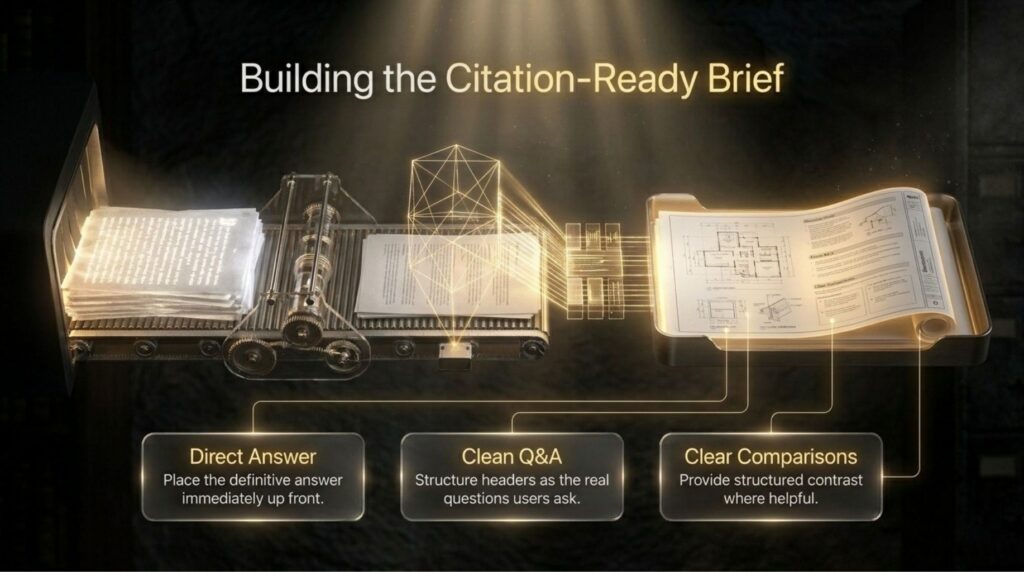
From there, he asks a simple question: what does a top page on this topic actually need to cover? The answer comes back grounded, with every claim carrying a citation that traces straight back to the source you approved. You can click through and verify it. In a few minutes, one query has become a citation-ready brief built on sources you choose and trust, rather than a confident-sounding draft you have to fact-check line by line. And the brief itself comes out structured the way AI likes to read: a direct answer up front, a clean set of questions and answers, and a comparison where it helps. That structure is not decoration. It is what makes the content easy to lift into an answer later. That is the difference between content AI ignores, and content AI cites.
What earns the citation
So what makes AI choose your page over the next one? In my experience, it comes down to three things, and they have not really changed even as the technology has.
One, write non-commodity content. Not another generic listicle that repeats what is already everywhere. Think about the difference between a page titled seven tips for homebuyers and a page titled why we waived the inspection and what it cost us. The first is a commodity the model has seen a thousand times. The second is first-hand experience with a genuine point of view, and that is what gets pulled into an answer. AI synthesizes the generic and skips right past it, because it adds nothing new.
Two, format for extraction. Use headings phrased as the real questions people ask, and put visible answers and FAQ content directly on the page, written in plain text. Build genuine topical depth around the entities and concepts that matter, rather than chasing a list of rigid keywords. The model reads what is actually on the page, so make the answer easy to find and easy to lift.
Three, and this one trips up a lot of teams: do not fall for the schema fallacy. Adding FAQ markup in the background with no visible answer on the page does nothing for AI citations. The structured data does not replace the words. The answer has to actually be there for a reader to see, because that is what the model reads and quotes.
What to stop doing
While we are here, let me save you some wasted effort, because there is a lot of noise out there right now. According to Google’s own guidance on optimizing for generative AI, several popular tactics simply do not help.
You do not need to chop your content into tiny artificial chunks for the AI. Modern systems parse a full page just fine. You do not need a special llms.txt file, because Google Search ignores it. And buying mentions across random blogs and forums does not work either, because the core ranking and spam systems are built to catch exactly that. The fundamentals win. Everything else is noise dressed up as a hack, and chasing it costs you the time you should be spending on real content.
Why this is bigger than one tool
Step back from NotebookLM for a second, because the tool is not the point. The point is the approach. The teams that win in AI search are the ones that stay human-driven and AI-assisted: a real expert with a real point of view, using AI to research faster and structure better, not to mass-produce content nobody asked for. NotebookLM is one good example of that approach because it grounds the work in sources you choose. The principle outlives any single tool, and it is the one I would bet on for the next decade. In thirty years of watching search reinvent itself, the teams that lasted were never the ones chasing the latest trick. They were the ones who built real expertise and made it easy to find.
Your play this week
Here is what I would do with all of this, starting today. Pick one query you genuinely want to win. Let NotebookLM find and ground the sources, and keep only the ones you trust. Then build a structured, sourced brief from that and hand it to your writer. One query in, a citation-ready asset out. Do that once, and you will feel how much faster it is than starting from a blank page and a wall of open tabs.
A quick and honest heads up on access. The source discovery is rolling out broadly, so most of you can use it right now. The more extensive analysis and expanded export options are currently available on Google AI Ultra and eligible Workspace plans, so check what your account includes before building your process around the premium features.
And one more thing. You can absolutely do every step of this by hand, and I would rather you understand the manual workflow first so you know what good looks like. But if you would rather it ran on its own, that is exactly why we built microSEO.ai, formerly BSM Copilot, as the automated path. Either way, the play is the same: ground your content in sources AI trusts, and become the answer instead of the page nobody sees.
If you take one thing from this week, let it be this. Stop thinking about ranking for a moment and start thinking about being cited. Ask yourself, for the questions my customers ask AI, am I the source it trusts right now? If the answer is no, this is exactly where you start.
This is the work that keeps you visible as search becomes AI. It is not magic, and it is not a hack. It is good sourcing, real structure, and a point of view, made faster by a tool that finally helps instead of getting in the way.
Stay safe and healthy.
Cheers,
Chris