
What happens when you hand a brand-new frontier model a short ski-trip clip and the laziest prompt you can think of?
That’s exactly what I did with Gemini 4 Argon, Google’s newest model. I got access, opened it up, uploaded a short video I shot in Aspen Snowmass, and typed a few loose sentences. No prompt engineering. No careful setup. Just the kind of request a normal person would make on a weekday morning.
It did exactly what I told it to do. And I’ll be honest with you, that caught my attention, because I primarily use Claude and I don’t get excited about every model release that comes along.
This AI SEO Tip is short and sweet. I’ll walk you through my quick test, what Google is actually saying about Argon, why it matters if your job is getting found in search, and where to go if you want the deep dive. At the end, I’ll also share the replay of our AI SEO & GEO Online Summit from October 7, 2026, because the two topics connect more than you might think. Watch the full video above to learn more.
A Ski Clip, a Santa Sleigh, and One Basic Prompt
Here’s the setup. We were up in Aspen Snowmass and had a little fun on the mountain, so I had a short video on my phone. Nothing produced. Just a quick clip.
I gave Argon that clip and a very basic prompt. Essentially: edit this video so the two people in it take off in a sled into outer space, Santa Claus style. That was it. I didn’t describe camera angles, lighting, timing, or style. I didn’t break the task into steps.
And it created the video. It did what I asked, from a prompt most prompt-engineering courses would tell you is too vague to work.
Now, is that a rigorous benchmark? Of course not. It’s one test on one morning. But here’s what I’ve learned in nearly three decades in this industry: the first real test you run on your own material tells you more than any launch chart. A model that handles a sloppy, real-world request well is a model worth a closer look. A model that needs a perfect prompt to do anything useful is going to cost you time every single day.
That’s why I didn’t stop at being impressed. I sent an email to our AI task force team and our marketing team asking them to do further research on this model. I still have a lot of testing to do, and I want the people who do this work daily putting it through its paces before we change anything.
What Google Is Actually Claiming
Let’s separate my demo from Google’s claims, because both matter. I recommend reading Google’s official Gemini 4 Argon announcement in full. It’s long, but it gives you a lot of information on how to use the model.
A few points stood out to me.
Availability first. Google says Argon is available globally to developers through the API in AI Studio, to enterprises, and to Google AI Ultra and Pro subscribers in the Gemini app and in AI Mode in Search. That last part is the one I’d circle in red if you work in SEO. I’ll come back to it.
On performance, Google says Argon ranks #1 on the Vals Index, a benchmark that measures model performance across sectors like finance, coding, legal, and tax work. Benchmarks are the vendor’s own chosen scoreboard, so treat them as a signal, not a verdict. Still, it tells you where Google is aiming: deep, multi-step professional work, not chatbot small talk.
On pricing, the introductory API rate is $2 per million input tokens and $10 per million output tokens. According to Google, that introductory period ends on November 30, 2026, after which the price moves to $4 and $20. If you’re building anything on the API, put that date in your calendar now.
Then there’s capacity. Google describes an industry-leading 1M unified input-output token limit via the Gemini API, built so the model can work longer on complex problems. For anyone running large content or analysis jobs, that’s the kind of spec that changes what’s possible in a single pass.
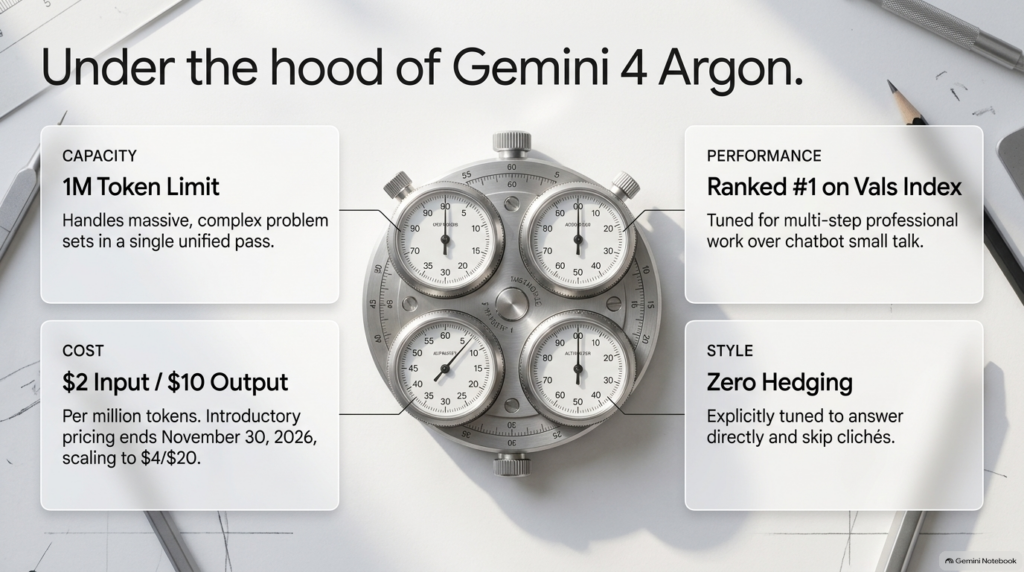
One more detail, and it’s my favorite. Google says Argon follows style instructions better than its previous Gemini models, answers more directly with less hedging, doesn’t repeat itself more than necessary, and skips clichés. If you’ve ever edited AI-written copy, you know exactly why that sentence matters.
Why a Model Release Is an SEO Story
Here’s the thing. Most people treat a new model launch as a tech story. For anyone whose business depends on being found, it’s a search story.
Google says Argon is available to Pro and Ultra subscribers in AI Mode in Search. That means for a slice of searchers, the model reading, interpreting, and summarizing the web on their behalf just got a major upgrade. When the system answering the question gets better at reasoning and better at cutting through filler, the bar for what earns a citation goes up with it.
The reality is that generic content was already struggling in AI search. A model explicitly tuned to skip clichés and answer directly is not going to reward pages stuffed with them. What gets cited is content with real experience, specific detail, and a clear point of view. That’s E-E-A-T in practice, and it’s the core of how I approach GEO.
So what should you actually do? Not panic, and not rewrite your whole site because a new model shipped. Do the boring, valuable work: make sure your most important pages answer real questions clearly, show who’s behind the expertise, and say something a competitor couldn’t copy and paste. That’s true for Argon, it’s true for ChatGPT, and it will be true for whatever ships next.
Notice something else about my test: it was video, not text. Google describes Argon as combining frontier reasoning with deep visual perception, and my sleigh clip is a small, silly example of that in action. As these systems get better at understanding images and video, your visual content becomes more of what they can actually read and interpret. That’s one more reason I treat video as part of an AI search strategy, not just a social media play.
I don’t know yet how Argon changes citation behavior in AI Mode specifically. Nobody does, it’s brand new. That’s exactly the kind of question I want our team testing rather than guessing at.
I’m Still a Claude Guy, and That’s the Point
I’ll be upfront about my bias. I’m a big fan of Claude. It’s the model I use most, day in and day out.
But at my company, we use a lot of models, and that’s on purpose. Loyalty to one tool is not a strategy. Every model has strengths and blind spots, and the businesses that win know which tool fits which job.
Here’s my process whenever a big model drops, and I’d recommend it to any marketing team. Start by testing it yourself on something real, ideally something from your own life or business, not a canned demo. If it passes that gut check, hand it to the people who will do the structured testing. For us, that’s the AI task force and the marketing team. And only change your workflow once you have evidence it does a specific job better than what you already use.
What I’d avoid is the opposite pattern, which I see constantly: switching your entire stack every time a launch post trends on LinkedIn. That’s how teams end up with half-built workflows across five platforms and mastery of none.
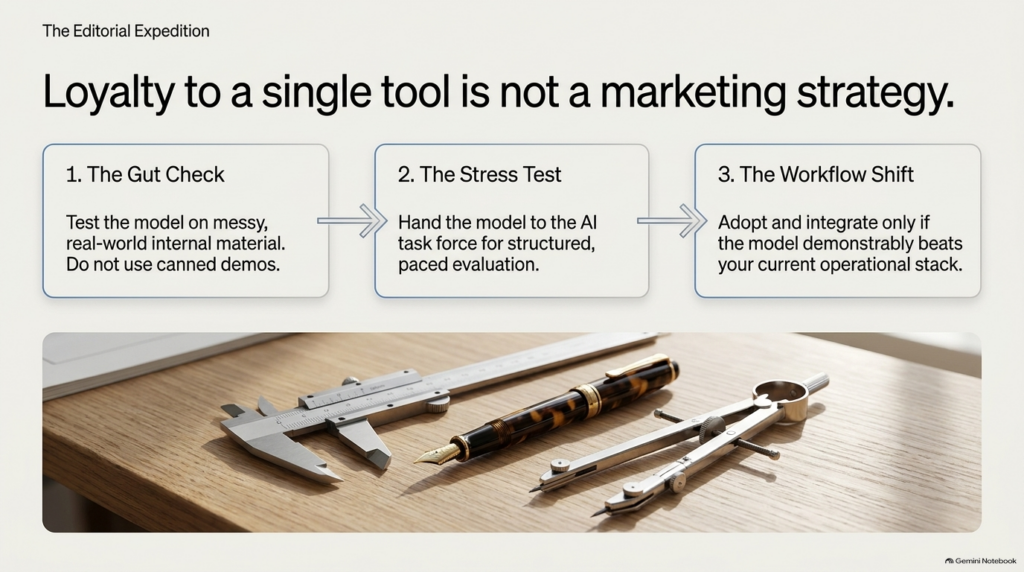
Argon earned the second step. It hasn’t earned anything beyond that yet, and that’s fine. That’s how it should work.
Where to Go Deeper on Argon
My video is intentionally short. If you want more, here’s where I’d spend your time.
Start with Google’s announcement post itself. Then, if you’d rather watch than read, I highly recommend two YouTube videos.
The first is from Google Cloud Tech. They’re doing a really good job showing ten examples of what can be done with this new model. I watched it, and it’s pretty impressive.
The second is from Paul Lipsky. I follow him because he sends a weekly update on what’s happening in AI, and this week’s edition focused on Gemini 4 Argon. He goes way deeper than I do in my short video, so if you want the full picture, that’s your next stop.
Between those three, you’ll understand what Argon can do far better than from any headline.
What Our October 7 Summit Taught Us About Getting Found
Now let me connect this to something we just did.
On October 7, 2026, we hosted the AI SEO & GEO Online Summit, a two-hour event built around one question: what actually gets a business found in AI search? In my humble opinion, the information shared was incredible.
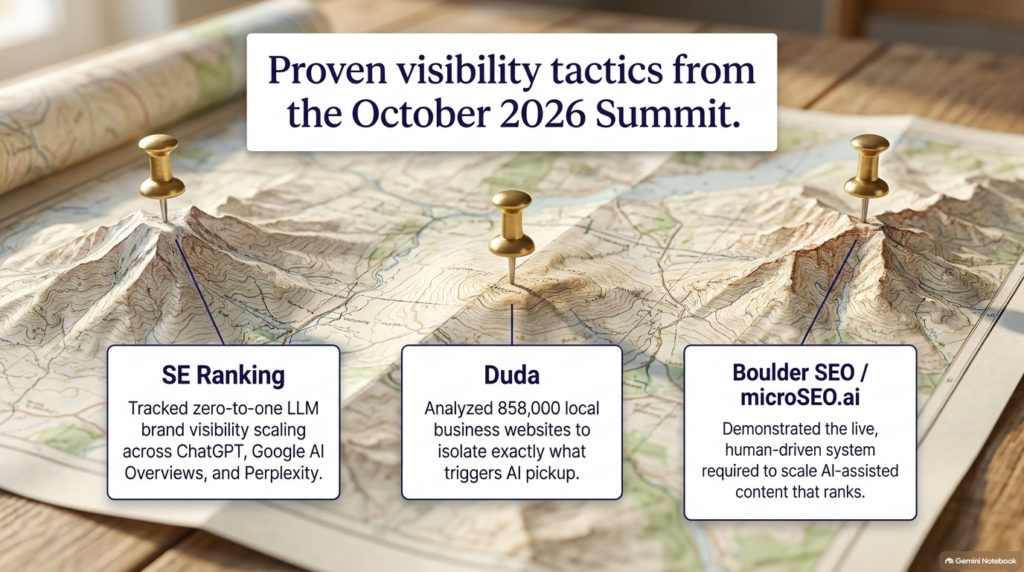
Our headliner was Bogdan Babiak, CMO of SE Ranking. He walked through SE Ranking’s study on building LLM visibility for a new brand with zero reputation, tracking how it surfaced across ChatGPT, Google AI Overviews, AI Mode, Perplexity, and Gemini. Thank you, SE Ranking, for making Bogdan available.
Then Shawn Davis of Duda presented his study on local businesses, drawing on data from more than 858,000 small business websites, and broke down what separates the sites AI systems find from the ones they overlook. Very, very impressive work.
So the first two presentations were studies on how to earn visibility in AI search. Then our own team showed how to actually do it. Simon Golding and Daniel Burns of Boulder SEO Marketing covered the strategy and the system behind creating content at scale with the help of AI, content that ranks in Google and gets picked up by AI search. Harold De Guzman closed it out with a live demo of microSEO.ai, the platform behind our human-driven AI-assisted workflow.
Here’s why it belongs in a tip about Argon. Models will keep getting smarter. The fundamentals our speakers covered, earning visibility through real signals and producing quality content through a repeatable system, don’t change when a new model ships. They get more important. The replay has timestamps, so you can jump straight to the session you care about, and it’s already getting a lot of views and thumbs up.
What to Do Next
If you only do one thing after reading this, test Gemini 4 Argon on a real task from your own work, not a demo prompt. One honest test on your own material will tell you more than an hour of launch coverage.
Then watch the summit replay and pick one idea from it you can apply to your own site this month.
If you want help building an AI SEO and GEO strategy that holds up no matter which model is answering the question, take a look at how I work with businesses, or reach out to me directly. And if you want more tips like this one, browse the full archive of AI SEO Tips.
Questions or thoughts on Argon? Post them in the comments.
Stay safe and healthy.
Cheers,
Chris