Feature Stacking Wins AI Search
The Three Numbers That Frame This Episode
95.9%. That’s the AI crawl rate on local websites that stack four or more key optimizations. Those same sites receive 16 times as many crawler visits as the average site.
81%. That’s the share of all AI crawler traffic in February coming from one single company.
33x. That’s how many more AI crawler visits sites publishing 50 or more blog posts get versus sites that don’t blog at all.
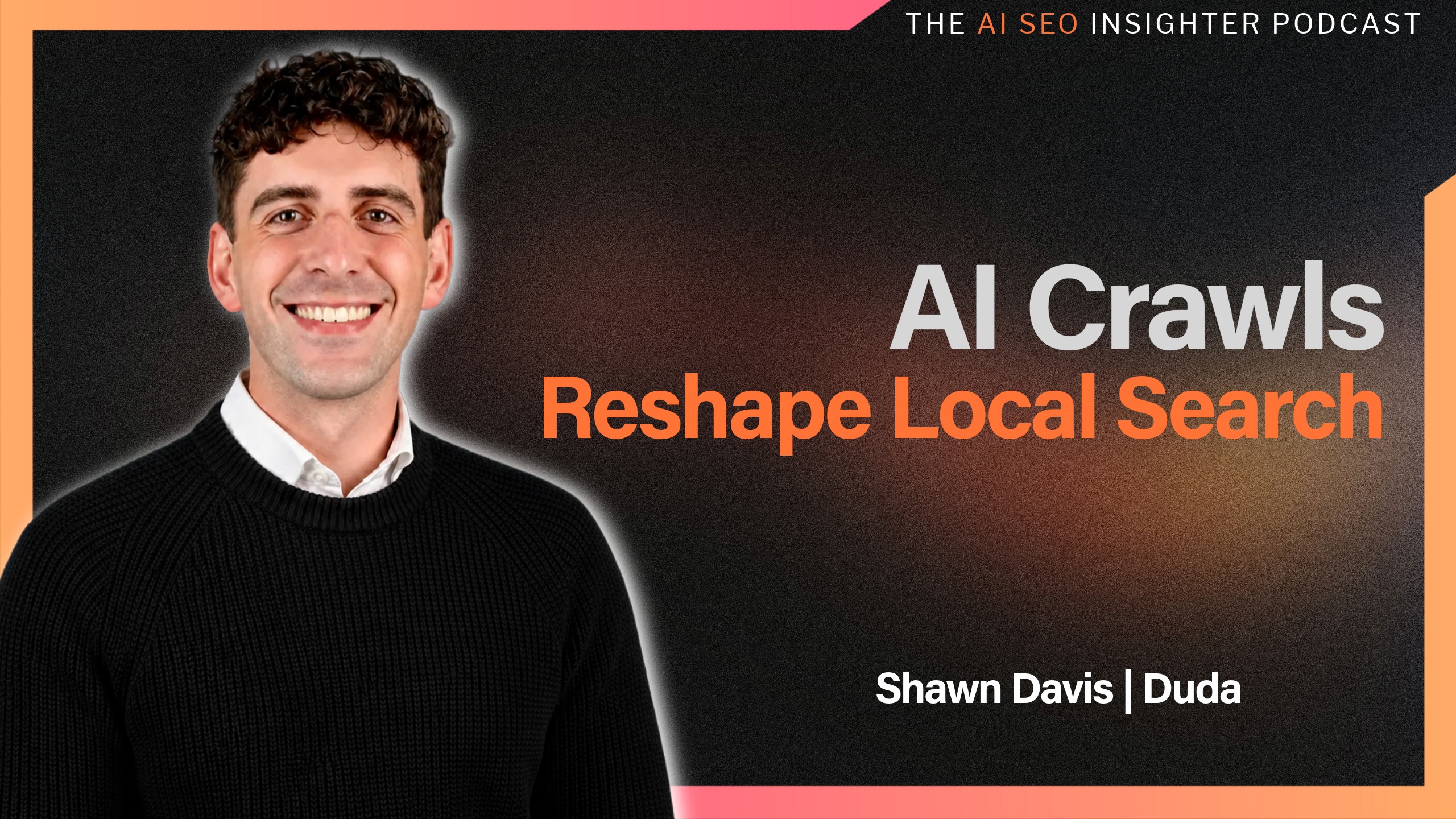
These numbers come from one of the most rigorous AEO studies the industry has produced. And in Part 2 of my conversation with Shawn Davis, Head of Content and Communications at Duda, we unpack exactly what every agency and local business owner should do about them.
If Part 1 sold you on why AEO matters for small and medium-sized businesses, Part 2 hands you the playbook.
Catch up on Part 1: https://www.youtube.com/watch?v=pIda01bXnMs&t=153s
Google Business Profile Sync Is the Single Largest Lever Most Agencies Aren’t Using
The biggest correlated factor in the entire study turned out to be Google Business Profile sync. Sites with it active see a 92.8% AI crawl rate. The catch? Adoption is shockingly low across the entire base.
Shawn was clear that this isn’t really about one tool. It’s about a discipline. If your client’s business information is consistent, accurate, and continuously synced across their website and Google Business Profile, AI crawlers reward you for it. If it’s stale or mismatched, you’re leaving crawler visits and citations on the table.
This is classic local SEO done with a modern incentive structure layered on top.
Local Schema Is the Most Scalable AEO Lever Any Business Can Pull
Local schema markup yields a 17 percentage-point lift in crawl rate, and adoption is already at 22%. That makes it one of the highest-leverage, lowest-effort moves on the entire list. Any decent developer can implement it in an afternoon.
This was actually Shawn’s favorite finding from the research, because it confirmed something the team had been wondering about.
“These crawlers do not only look at these SMB websites, but they care where they’re based.”
— Shawn Davis, Duda
What can a client realistically expect after adding local schema this week? Better visibility in location-aware AI answers. Queries like “best mechanic for a hybrid vehicle in Boulder” or “gluten-free bakery near Pearl Street.” The AI engines are already running these queries. Local schema is how you tell them you exist in that conversation.
Feature Stacking Is Where the Real Compounding Happens
Here’s the data point that made me sit up. Sites with zero active AEO features have a crawl rate of 50.7%. Sites with four or more active features hit a 95.9% crawl rate and receive 16 times the average number of crawler visits.
That’s not linear improvement. That’s compounding.
Local schema plus the reviews app plus a blog plus Google Business Profile sync, and suddenly you’re not just optimized. You’re dominant. Each feature adds a different kind of usefulness, and stacking them sends the full set of signals AI engines are looking for. The blog provides depth and content. A local schema provides crawlers with structured, machine-readable facts. Reviews add third-party authoritativeness.
This is the part of the research that gives agencies real ammunition for proposals. You can show a client exactly which features they’re missing and exactly what the data says happens when those features get added.
OpenAI Is Doing 81% of the Crawling. Plan Accordingly.
This number genuinely surprised me. Of all AI crawler traffic in February, OpenAI accounted for 81%. Anthropic Claude was 16.6%. Perplexity was 1.8%. Google was 0.6%.
Shawn flagged that Google’s number is artificially low because Duda’s data only counts the Gemini crawler, while much of Google’s AI Overview activity happens through its regular search infrastructure. So the real Google number is higher than 0.6%, just hard to isolate.
The strategic takeaway? ChatGPT alone drives 57% of all AI crawler traffic and almost all of the user-fetch activity, which is the live answers piece and the closest proxy we have to actual citations happening right now.
Then there’s the Claude growth story. On Duda’s platform specifically, Claude grew 23 times in 12 months. The absolute numbers are still smaller than ChatGPT’s, but the growth rate is the signal.
In my own business at Boulder SEO Marketing, most of the professionals I talk to have switched from ChatGPT to Claude for their daily work. But when I ask my sales leads where they found me, they still say “ChatGPT” more often than anything else. Both platforms matter.
What Local Search Looks Like Two Or Three Years From Now
I asked Shawn the big-picture question. His answer was direct. Local AEO will take precedence over local SEO. Not because the fundamentals change, but because the bar for what counts as “useful” content keeps rising.
“EEAT content is going to become completely indispensable. You really truly need to be prepared to present your whole SMB’s value proposition online in every possible way.”
— Shawn Davis, Duda
The ultimate guide blog is dead. What replaces it is specific, opinionated, useful content that reflects how a business actually does its work.
Chris’s Take
The moment from this conversation that’s going to stay with me longest is Shawn’s framing of feature stacking. Not the individual data points, but the compounding effect. A 50.7% crawl rate increased to 95.9% with four features stacked. That’s not optimization. That’s transformation.
Most of our industry is still selling AEO as a single tactic. Add schema. Write more blogs. Get more reviews. Each one in isolation. Shawn’s research flips that on its head. The features aren’t competing for attention or budget. They’re amplifying each other.
If I’m an agency owner reading this, I’d pull up my client list, score each site against the four-feature stack, and treat anyone scoring below three out of four as priority outreach this month.
The Action Plan: Three Things to Do This Week
I asked Shawn for the playbook. Here’s exactly what he said:
☐ Add reviews to every client site that doesn’t have them. Easiest possible win. Social proof, authoritativeness, and correlation with higher crawl rates.
☐ Lock in Google Business Profile and local schema on every site. Foundational, not advanced. If a single client is missing, that’s your starting point.
☐ Start producing real EAT content. Not generic “ultimate guide to” pieces. Specific, opinionated, useful content that reflects how your client actually does their work.
Run this checklist against your full client book in the next 30 days, and you’ll outperform every agency still treating AEO as theoretical.
About the Guest
Shawn Davis is the Head of Content and Communications at Duda, the white-label website building platform powering over a million active sites. He led the research team behind Duda’s landmark AEO study, which analyzed 858,000 paid websites and nearly 70 million AI crawler visits in a single month.
Connect with Shawn on LinkedIn. Learn more about Duda at duda.co.
About Chris Raulf
 Chris Raulf is an international AI and SEO expert, global keynote speaker, and founder of Boulder SEO Marketing. He’s known for his Micro-SEO Strategies℠ and helps brands worldwide grow their online visibility using human-focused, AI-powered strategies.