
Forty-five minutes. That’s how long keyword research was taking our team per client project, every single time. Harold De Guzman, our Head of AI and Research Development, just solved that with SE Ranking’s new MCP server. The result? The same research now takes under five minutes. I want to break down exactly how he built it, what it looks like in practice, and why this kind of integration is where AI-assisted SEO is actually headed. Watch the full video above to learn more.
The Real Cost of Manual Keyword Research
Here’s the thing. Keyword research isn’t difficult. It’s operationally expensive. Logging into your SEO tool, running queries, pulling exports, reorganizing spreadsheets, cross-referencing difficulty scores: every step adds friction and burns time you don’t have. Multiply that across 20 client projects, and you’re looking at a serious throughput problem that quietly eats your capacity week after week.
Harold was tracking it carefully. Forty-five minutes to an hour per project on this one task alone. That’s time that belongs in strategy, content planning, and the kind of high-judgment work that actually moves the needle for clients. Instead, it was going into data wrangling, a task that, frankly, a well-configured AI should be handling.
I’ve watched this same pattern play out across agencies for years. The bottleneck isn’t the strategy. It’s the time tax on getting the data into a usable form. Every tool switch, every export, every spreadsheet reorganization is a small cognitive interruption that adds up fast. When your team is doing this 15 or 20 times a week, you start to see why operational efficiency is a competitive advantage, not just a nice-to-have.
What SE Ranking’s MCP Actually Does
MCP stands for Model Context Protocol. It’s the technical bridge that allows AI models like Claude to communicate directly with external data sources in real time, without manually pulling data, formatting it, and pasting it into a prompt. The model just queries the source directly, processes the response, and returns structured output in a single conversation.
SE Ranking built an MCP server that connects their keyword and competitive intelligence data directly into Claude Desktop. Instead of opening SE Ranking in one tab, running a query, exporting a spreadsheet, opening Claude in another tab, and pasting in the data, you just ask Claude in plain English: ” Find keyword opportunities for local SEO services in Denver with search volume over 1,000 and difficulty under 40. Claude queries the SE Ranking API silently in the background and returns a fully formatted report. No export. No spreadsheet. No context switching. Just live data, in context, ready to act on.
What makes this particularly powerful is that the data is live. You’re not working with a cached export from three days ago. You’re pulling real-time keyword intelligence directly into your AI conversation. That changes the nature of the workflow entirely. Research and analysis happen in the same session, which means faster decisions and fewer opportunities for data to become stale or miscommunicated across steps.
What You Need to Get It Running
Harold walked through the full technical setup in the video and strongly recommends watching the SE Ranking MCP webinar before attempting the installation. The steps need to be followed in sequence, and the webinar is thorough. Here’s the quick version of what you’ll need:
First, you need to install Claude Desktop on your machine. This is the local application, not the browser version.
Second, you need Docker Desktop running. Docker manages the containerized environment in which the MCP server runs.
Third, you clone the SE Ranking MCP server from GitHub and build the Docker image following the instructions in the repository. Then you add your SE Ranking API key to the Claude Desktop configuration file, save it, and restart Claude Desktop.

Once everything is live, you’ll see the SE Ranking MCP listed under the Developer settings inside Claude Desktop. From that point on, every new chat session has direct access to live SE Ranking data. Harold notes that the actual configuration step is where most people run into issues, so following the webinar walkthrough carefully, especially around the API key format and config file syntax, will save you a lot of troubleshooting time.
The SE Ranking free trial gives you 30 days of access with no credit card required, which means you can test the full MCP integration before committing to a paid plan. That’s a low-friction way to evaluate whether this fits your workflow before building it into your standard process.
The Denver Demo: What It Looks Like in Practice
Harold ran a live demo in the video, making the value immediately concrete. He opened a new chat in Claude Desktop and typed a single natural-language query: “find keyword opportunities for local SEO services in Denver with search volume over 1,000 and keyword difficulty under 40.”
Claude accessed the SE Ranking MCP in the background. You can see it working in real time, and within seconds, it returned a structured keyword opportunity report. The output was organized into clear categories: low-hanging fruit, near-miss opportunities, and secondary targets. Each keyword came with the relevant metrics already attached. No reformatting required.
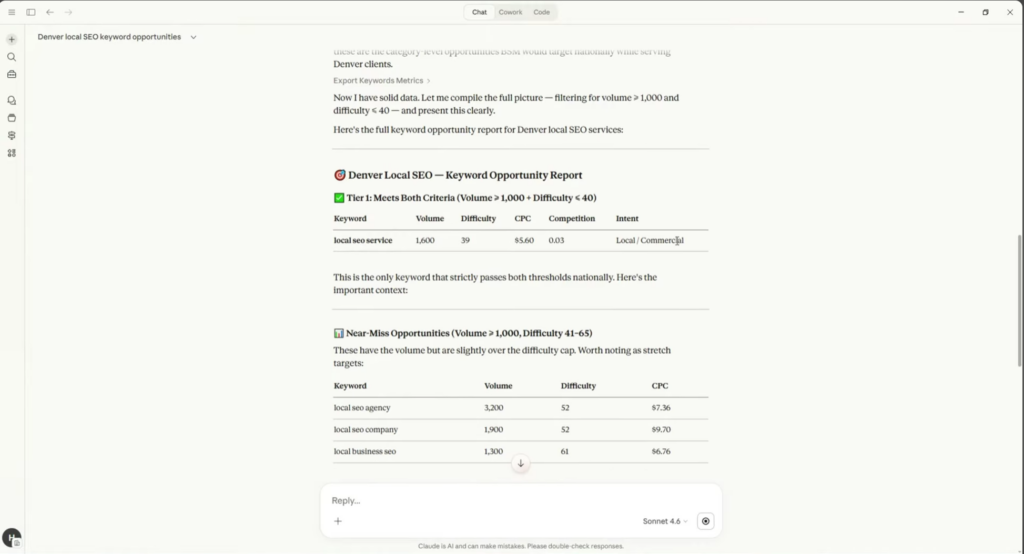
The output is immediately actionable. You can export it as a formatted spreadsheet for client reporting, or feed it directly into a content cluster plan as seed data for your next content build. For anyone running Micro SEO Strategies℠ work, specifically targeting the winnable 11-to-30 position keywords, where you can actually move the needle for clients. This kind of precision research delivers exactly what you need at the start of every engagement, in a fraction of the time.
What struck me watching the demo is how the workflow changes when data retrieval becomes conversational. You’re not just saving time. You’re staying in the analytical frame longer. Instead of breaking your focus to go pull data, you stay in the strategy session, and the data comes to you. That’s a subtle but meaningful shift in how the work actually gets done.
Why This Is Bigger Than the Time Savings
I’ve been saying for a while now that AI is most powerful when it handles the research and data layer, so your team can stay focused on judgment calls, the kind of strategic thinking that actually requires human expertise. This MCP integration is exactly that philosophy in practice, and Harold’s implementation is a clean example of what it looks like when you build AI into the workflow architecture rather than bolting it on as an afterthought.
Harold isn’t just saving 40 minutes per project. He’s creating a repeatable, consistent research workflow where keyword discovery happens in natural language, the data is live, and the output is structured for the next step in the process without any manual reformatting in between. That’s not a productivity hack. That’s a workflow redesign. The 45-minute task didn’t just get faster. The nature of the task itself changed.
For boutique agencies especially, this kind of operational efficiency is a genuine competitive advantage. You’re competing with larger teams that have dedicated research staff and larger tooling budgets. When you can match or exceed their research output with a well-configured AI workflow, you stop competing on resources and start competing on expertise. That’s a much better game to be playing.
The reality is, the agencies that figure out how to systematically remove manual overhead from repeatable tasks like keyword research, competitive analysis, and reporting are the ones that will scale without proportionally increasing headcount. MCP integrations like this one are a meaningful piece of that puzzle.
Where MCP Integrations Are Heading Next
What’s fascinating is that SE Ranking’s MCP is just one example of a broader pattern. More SEO and marketing platforms are building MCP servers that connect their data directly into AI workflows. That means the same model helping you write content can also pull live ranking data, competitor analysis, backlink metrics, and site audit results, all within a single session, all through natural language.
The implication for how agencies operate is significant. Right now, most AI-assisted SEO workflows are still sequential: you use AI for one step, manually export, then use AI for the next. MCP breaks that pattern by making the data retrieval itself conversational. The session becomes the workflow, rather than just one piece of it.
I think we’re about 12 to 18 months away from a point where a well-configured Claude Desktop environment, connected to your keyword tool, ranking tracker, CMS, and analytics platform, handles the entire research-to-brief pipeline in a single conversation. What Harold demonstrated with this SE Ranking integration is an early but very functional version of that future. It’s worth getting familiar with it now, before it becomes table stakes.

What to Do Next
Start by watching the SE Ranking MCP setup webinar. Harold specifically recommends it because the installation steps must be followed in a particular order, and the webinar clearly covers each step. Don’t skip it and try to improvise from the GitHub readme alone. Then grab a free 30-day SE Ranking trial (no credit card required) to get your API key and run the full integration in a real project context before committing.
And if you want to see where AI SEO and GEO are heading in 2026, join us at the free AI SEO & GEO Online Summit on April 1st (9–11 am MT). Harold will be presenting alongside Mordy Oberstein from SE Ranking and other incredible speakers covering AI search optimization, generative engine optimization, and how AI is reshaping content strategy. Two hours, completely free, 100% virtual.
Register at chrisraulf.com/ai-seo-geo-online-summit. Seats are going fast, so don’t wait on this one.
Stay safe and healthy.
Cheers,
Chris