
Are you still optimizing only for the blue links? Google now shows AI overviews in nearly 70% of all searches. Large language models like Claude, Perplexity, ChatGPT, and Gemini are answering questions that used to send traffic directly to your website. If your content strategy is not built for this new reality, you are losing ground fast. I have been doing SEO since before Google was called Google, and I have never seen the landscape shift this quickly. And right now, I am seeing too many businesses and SEO professionals still treating AI search as something they will get to eventually. That is already costing them visibility.
Watch the full video above to learn more.
I want to be direct with you. The way content gets discovered is changing at a pace none of us anticipated even two years ago. The question is no longer whether AI search matters. The question is whether your content strategy is built to compete in it. I have three events coming up in the next few weeks, specifically designed to answer that question, and I want to make sure you know about them all.
Why GEO Is the Strategy Conversation Everyone Should Be Having
GEO stands for Generative Engine Optimization. It is the practice of structuring your content so that AI-powered systems, including Google’s AI overviews and standalone LLMs, recognize it as authoritative, relevant, and worth surfacing. In my experience, most businesses are not even aware that this is a separate discipline from traditional SEO. They are still chasing keywords and backlinks while AI is rewriting how answers get delivered.
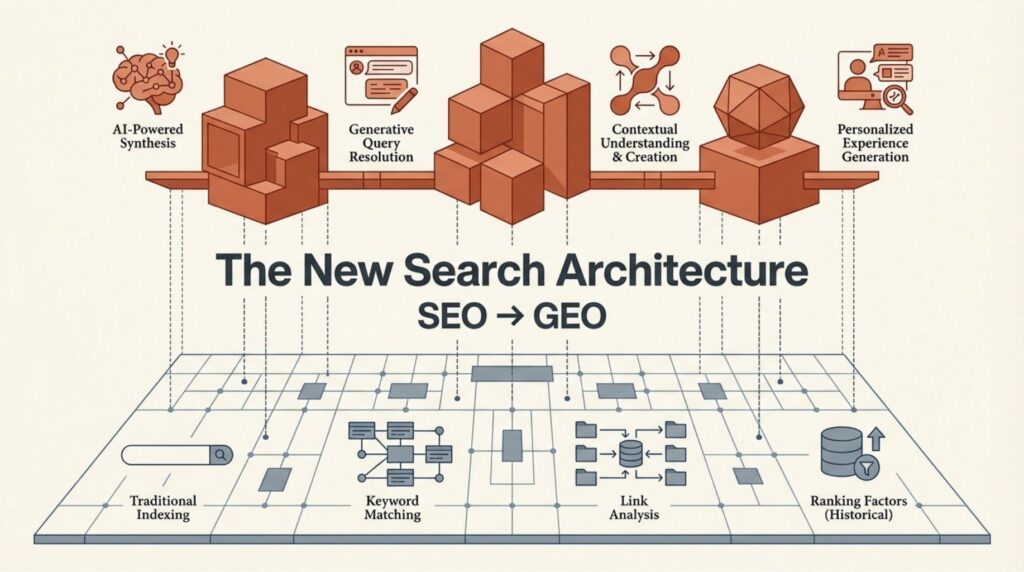
The reality is, if you are not optimizing for GEO alongside your traditional efforts, you are only playing half the game. Traditional SEO gets you into the blue links. GEO gets you into the AI-generated summaries that now appear above those blue links, and into the answers that Claude, ChatGPT, Gemini, and Perplexity deliver when someone asks a question your business should be answering. These are two different disciplines, and they require two different strategies. The good news is they are not mutually exclusive. But you do need to understand how to approach both intentionally.
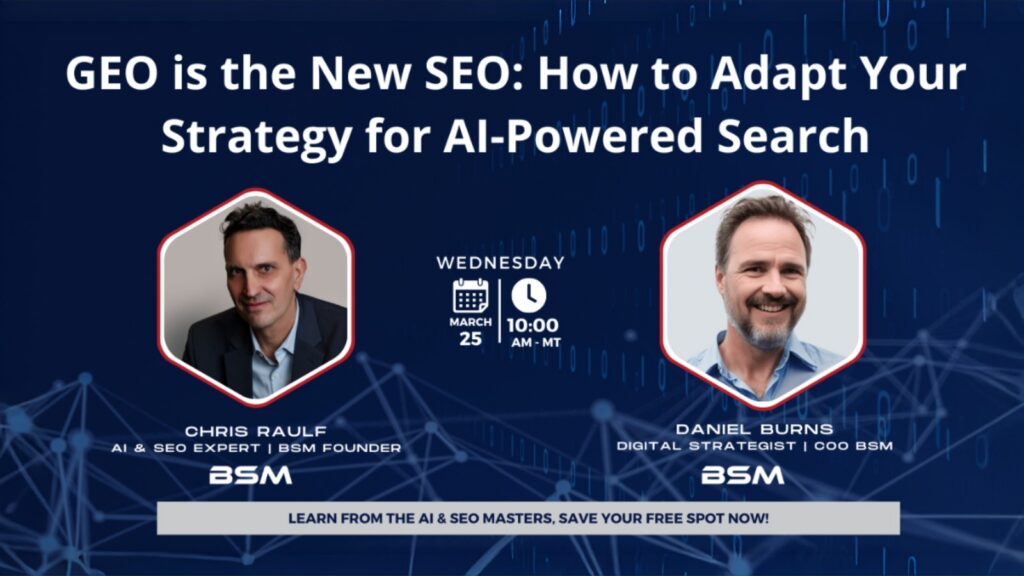
Event One: GEO Is the New SEO Webinar (March 25, 2026)
On March 25, I am co-hosting a free one-hour webinar with my business partner, and COO at Boulder SEO Marketing, Daniel Burns. We are calling it GEO Is the New SEO, and we are not going to hold anything back. We will cover what GEO actually is, how it differs from traditional SEO, and how you can implement a powerful Generative Engine Optimization strategy for your business or your clients. This is not rocket science, but it does take time, resources, and the right knowledge base.
If you have been hearing terms like A2A protocol, Universal Commerce Protocol, or WebMCP and wondering what they mean for your SEO work, this webinar is specifically where we break that down. These are not buzzwords for the sake of it. They represent real shifts in how AI systems communicate, retrieve information, and surface content. Understanding them is becoming part of the job. Daniel and I will explain the concepts and connect them to practical implementation steps you can actually use.
Event Two: AI SEO and GEO Online Summit (April 1, 2026)
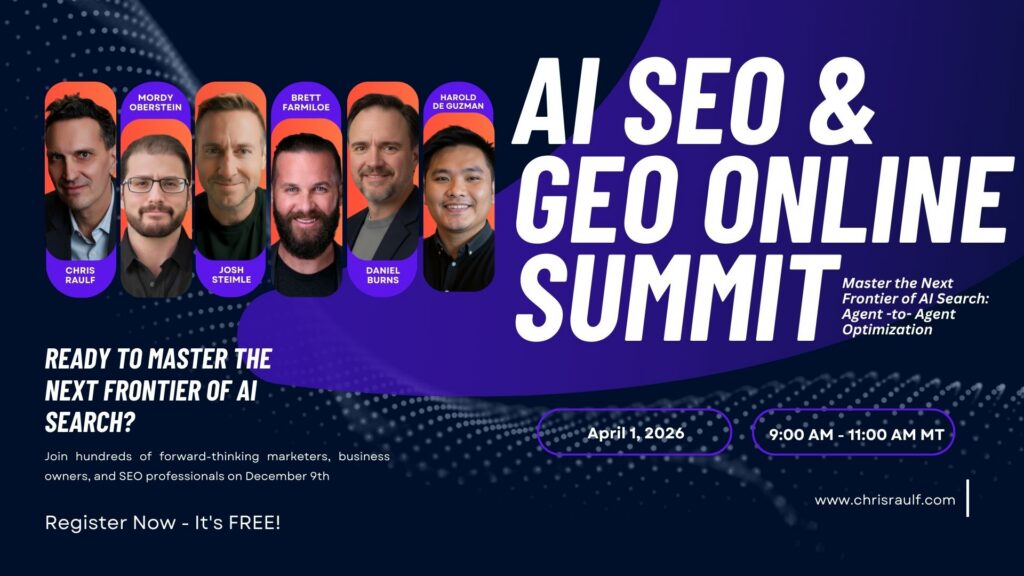
On April 1, we are hosting the second AI SEO and GEO Online Summit. This is a two-hour free online event; Mordy Oberstein of SE Ranking had to cancel his participation. But I am excited to announce that Dennis Yu, CEO of Local Service Spotlight, will be joining us as a speaker. Dennis is an industry veteran, and like me, he has been in this game long enough to know what actually moves the needle versus what just sounds good at a conference.
What I love about this summit format is that it gives you real access. You can ask questions, interact with the speakers, and get answers from people who have been working in SEO and digital marketing for decades. The field is full of opinions right now, many of them based on very limited testing. This event is designed to cut through that and give you a perspective grounded in long-term experience. It is free to attend.
Event Three: GALA WorldReady Conference in Berlin (April 13, 2026)
If you are in Berlin, Germany, on April 13, 2026, I would love to see you at the GALA WorldReady Conference. I am presenting at 1:30 PM German time in a session titled “From Search Engine to Answer Engine: Why Your Global Content Strategy Needs GEO Now.”
I actually just wrapped up teaching part of this content as part of a master’s degree program at the University of Strasbourg, which gave me the opportunity to really stress-test how well these concepts land with a highly educated, internationally focused audience. The feedback was strong, and I am bringing the same depth and clarity to Berlin. I will be handing out prompting examples that give you a practical framework for creating content in multiple languages that ranks well on Google and with large language models. If you work with international brands or multilingual content, this session is directly relevant to your work.
What This All Comes Back To
Here is what I have learned across 30-plus years in this industry. The professionals who stay ahead are not the ones who wait for the dust to settle before they move. They are the ones who build fluency in what is coming while everyone else is still debating whether it matters. AI search is not coming. It is here. 70% of searches are already triggering AI overviews. LLMs are being used to research purchases, evaluate service providers, and find experts in every field.
Your content either shows up in those answers or it does not. And the frameworks that earn you a place in AI-generated results are different from the ones that got you to page one five years ago. That gap is exactly what all three of these events are built to close. Whether you attend the webinar, the summit, or join me in Berlin, my goal is the same: to give you the knowledge and tools to compete in the AI search landscape that is already here.
What to Expect From Each Format
I want to be transparent about what each of these events actually is, because I think it matters when you are deciding how to spend your time. The March 25 webinar is a one-hour focused session. Daniel and I will present and walk through the frameworks, and there will be time for questions. It is designed to be dense and actionable, not a general overview.
The April 1 summit is a two-hour event with multiple speakers. That format works differently. You get multiple perspectives, different angles on the same problem, and more time to ask specific questions to the people in the room. The value there is in the range of experience and the conversation it creates. And the Berlin session on April 13 is a conference presentation, a tighter format designed for an international, multilingual audience. I will be sharing content specifically shaped for professionals who are thinking about AI search in a global context, not just a US one. If your work spans multiple markets and languages, that session is particularly relevant for you.
All registration links are in the video’s description field. These events are free or complimentary, so the only cost is your time. I genuinely hope to see you at one or more of them. And if you have colleagues or clients who are still on the fence about investing in GEO knowledge, forward this to them. The window to get ahead of this is still open.
Stay safe and healthy.
Cheers,
Chris