Google Rankings Multiply AI Citations
The Three Numbers That Frame This Episode
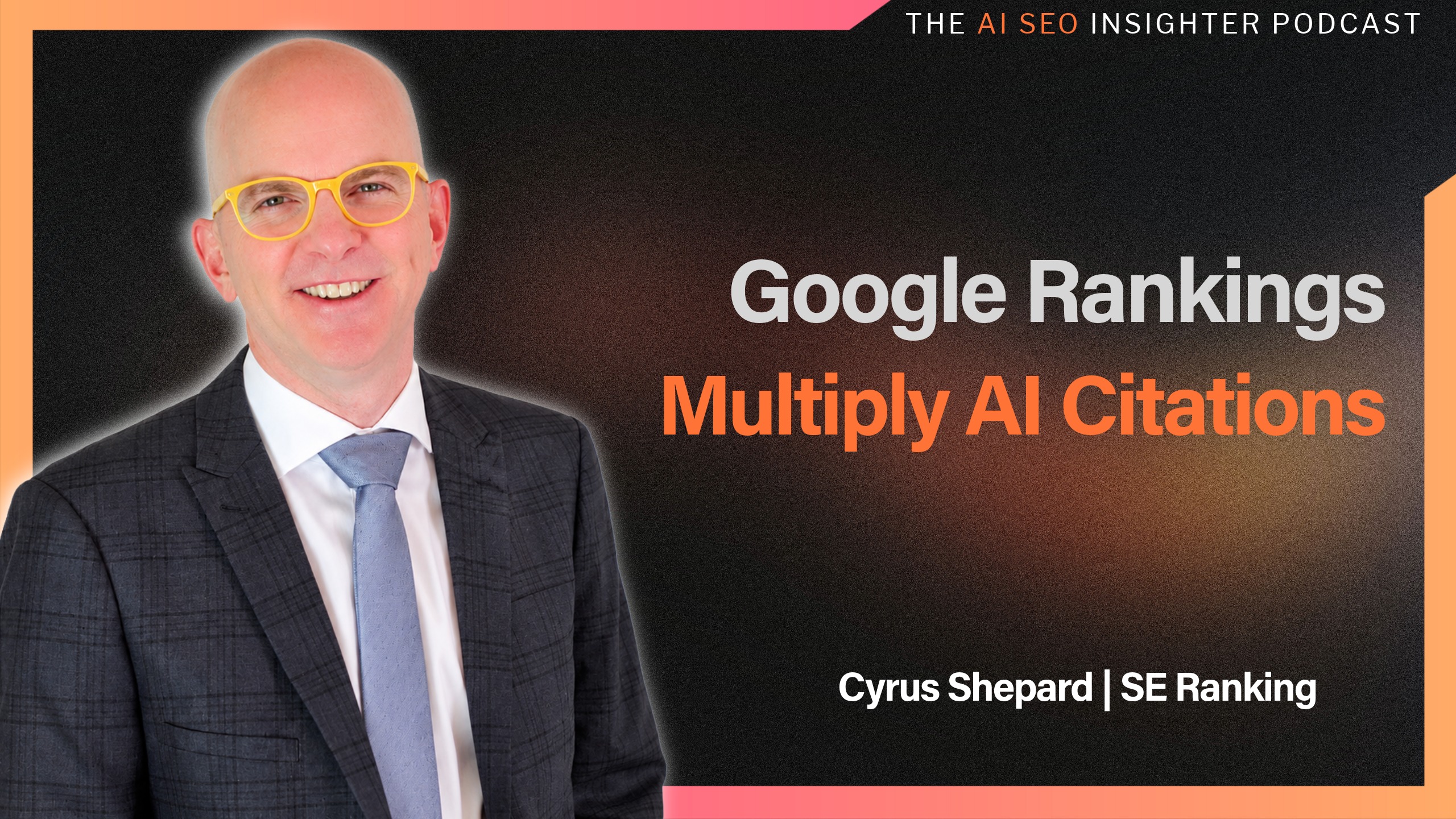
54: That’s how many experiments, patents, and case studies my guest read so you don’t have to. Cyrus Shepard, founder of Zyppy SEO, spent two weeks building a hand-weighted analysis of what actually earns citations in AI search. No hot takes, just evidence.
9.4. That’s the score search rank earned in his framework, one of the highest of any factor. The headline most people missed after Google I/O is that ranking in Google still decides whether AI engines cite you, because nearly every AI answer is grounded in real search results.
33% to 90%. Rank on page one for a single query and you have about a one-in-three shot at a citation. Rank across the fan-out queries too, and that climbs to 80 or 90%. That multiplier is the heart of this conversation.
Watch the full episode here:
What an AI Citation Actually Is
Before we talked tactics, I asked Cyrus to explain citations in plain English, because most business owners have no idea what we mean. His answer was refreshingly simple. When an AI engine answers a question, it grounds that answer with links to the sources it pulled from. Those links are the citations. In Google AI Overviews, they sit on the right. In ChatGPT, they’re scattered through the response. Every engine does it a little differently.
Do people click them? Some do, not as much as a regular search result, but the bigger win is brand visibility. A citation signals you’re doing something right inside the AI environment. And the leads that come through are often better qualified, because they have already done their research before they ever reach you.
Why Foundational SEO Still Wins
This is the part that calmed my nerves. After Google I/O, half the industry was convinced everything had changed overnight. Cyrus pumped the brakes. The reality is that the foundational work we have done for years still drives results.
When OpenAI first launched ChatGPT, the answers hallucinated, and the training data was stale. Since then, everything has moved toward grounding, anchoring each answer in live search results. Google has a massive advantage here.
“Those top-ranking results for the query and the fan-out queries are what inform 95% of AI answers these days. So just ranking becomes incredibly important.”
Cyrus Shepard, Zyppy SEO
Search rank scored 9.4 in his analysis, and 38% of AI Overview citations come from the top 10. If you want to be cited, you still need to rank.
The Fan Out Multiplier
Here’s the mechanic that gives this episode its name. When you ask an AI a question, it doesn’t run one search. It runs your main query plus a cluster of related fan-out queries. Ask about the best running shoes for men over 50, and it spins up searches for pronation, for Nike models, for related needs, building a universe of information to answer you.
Ranking on page one for the main query gives you roughly a 33% chance of a citation. Once you rank across the fan-out cluster too, your odds climb to 80 or 90% of being cited at least once. Fan-out rank scored 9.3, the second-highest factor in the study. The takeaway is clear: stop chasing one keyword and start owning the whole cluster.
How AI Reads Your Page
Cyrus pointed to Dan Petrovic’s research on how Gemini retrieves information. Each page gets a budget of tokens the engine will pull, and the higher you rank, the bigger that budget. Rank number one and it pulls generously. Rank lower and it pulls less and less, and it never pulls the whole page.
So put your most important information near the top, and structure it tightly, question and answer, question and answer. An AI-ready structure scored 8.6. Specificity matters just as much. Factually specific content scored 8.3 because AI cites you when you give it evidence. “0.8 grams per kilogram” beats “adults need a lot of protein” every time.
The Over-Optimization Trap
This was my favorite stretch of the conversation. Cyrus, who actually worked inside Google as a quality rater, said one of the biggest shifts in recent years is that Google now seems to carry an anti-SEO bias. Too many exact match keywords, too many internal links, clickbaity titles, all of it works against you now.
“Sites that aren’t trying too hard with their SEO tend to perform better than the sites that are a little over aggressive with it.”
Cyrus Shepard, Zyppy SEO
His advice is to niche down, keep tight topical focus, and back every claim with evidence. Make a claim, then show how you got there: the awards, the process, the proof. That evidence cycle is the modern engine of E-E-A-T.
Measuring What Matters
The number one question at every conference right now is attribution, and Cyrus was honest: there are no clean answers yet. Set up visibility tracking, measure traffic and conversions from AI, but don’t obsess over a thousand prompts.
The bigger mindset shift is this. Raw traffic isn’t the prize it used to be. Plenty of clients have seen Google organic traffic drop while their business grows, because they’re getting the right kind of traffic. The evaluation phase that used to happen on your website now happens inside the AI. Feed the AI the right information and watch your visibility, not just your sessions.
Chris’s Take
What stuck with me is the discipline. Everyone has an opinion about AI SEO right now, and almost nobody has read the research. Cyrus read 54 studies and scored them by hand. That’s the difference between noise and signal.
Here’s what I’ve learned watching this play out with our own clients. The assumption that AI broke SEO and demands a brand new playbook is mostly wrong. The engine underneath AI citations is still ranking in Google. Get the foundation right and the AI visibility follows.
So if you’re an agency owner or a marketer, resist the urge to chase shiny tactics first. Make sure AI crawlers can actually reach your pages. Rank for the full cluster of queries, not one keyword. Put your evidence on the page. That’s the unglamorous work that wins, and it’s working for us right now.
The Action Plan
☐ Check your accessibility first. Confirm your IT team or Cloudflare settings aren’t quietly blocking AI crawlers. This was Cyrus’s number one takeaway.
☐ Own the cluster, not the keyword. Rank for your main query and its fan out queries to push your citation odds from 33% toward 90%.
☐ Front-load and structure your pages. Put key information near the top in a tight question-and-answer format, and make every claim specific.
☐ Run the evidence cycle. For every claim, show the proof on the page so AI has a reason to cite and trust you.
About the Guest
Cyrus Shepard is the founder of Zyppy SEO, a data-driven consultancy focused on SEO and AI search visibility. He previously led SEO at Moz and spent a year as a Google quality rater. He publishes original, evidence-based research through his Zyppy Signal newsletter and shares insights on LinkedIn.
About Chris Raulf
 Chris Raulf is an international AI and SEO expert, global keynote speaker, and founder of Boulder SEO Marketing. He’s known for his Micro-SEO Strategies℠ and helps brands worldwide grow their online visibility using human-focused, AI-powered strategies.