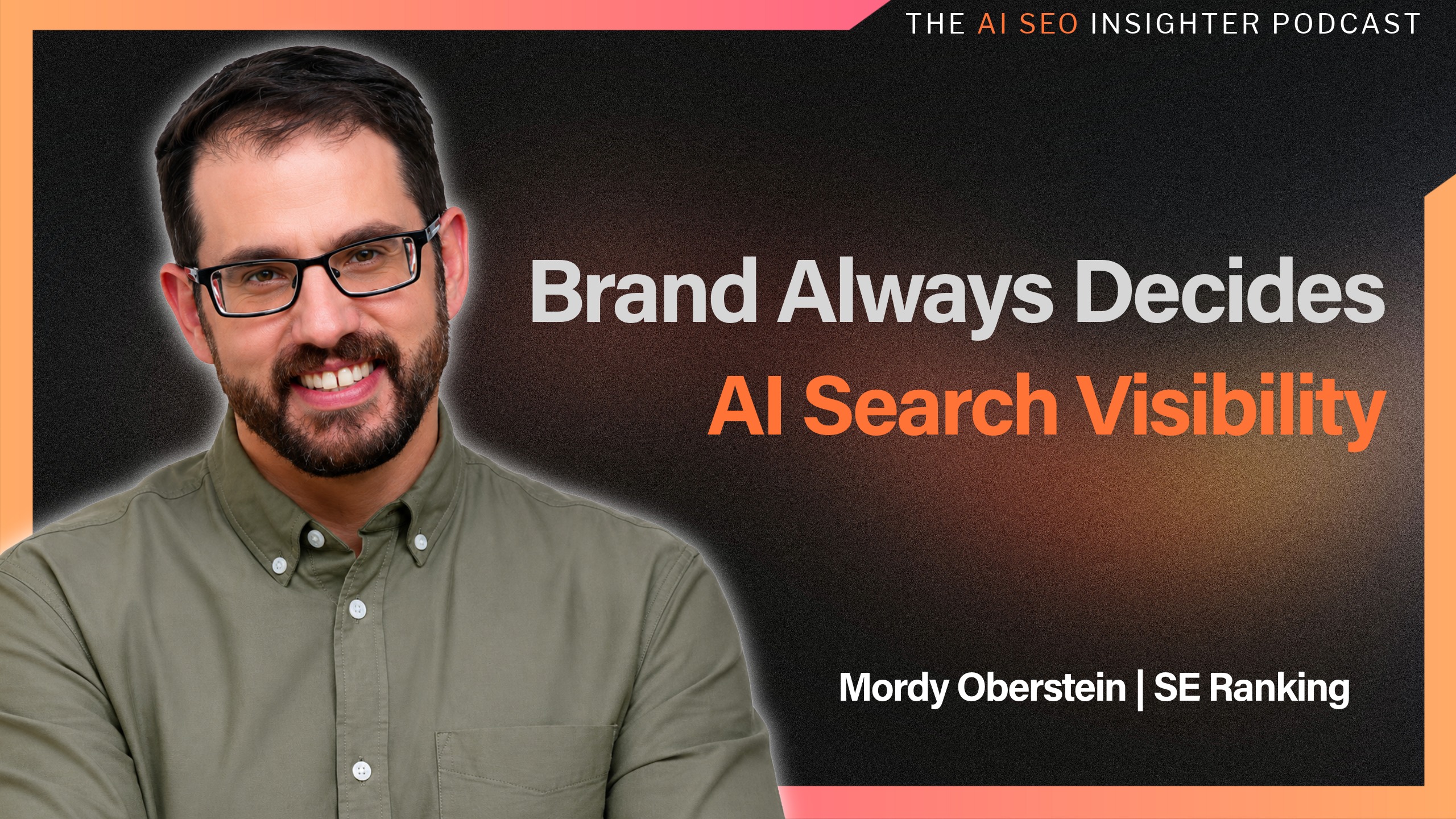
Brand Always Decides AI Search Visibility
The Big Idea That Frames This Episode
For 30 years, Google has been trying to identify brand signals through one proxy after another. PageRank. Hummingbird. RankBrain. The Medic Update. E-E-A-T. Every major algorithmic shift has been Google getting closer to what brand teams have been doing on TV since the 1970s.
Then LLMs arrived and accelerated everything.
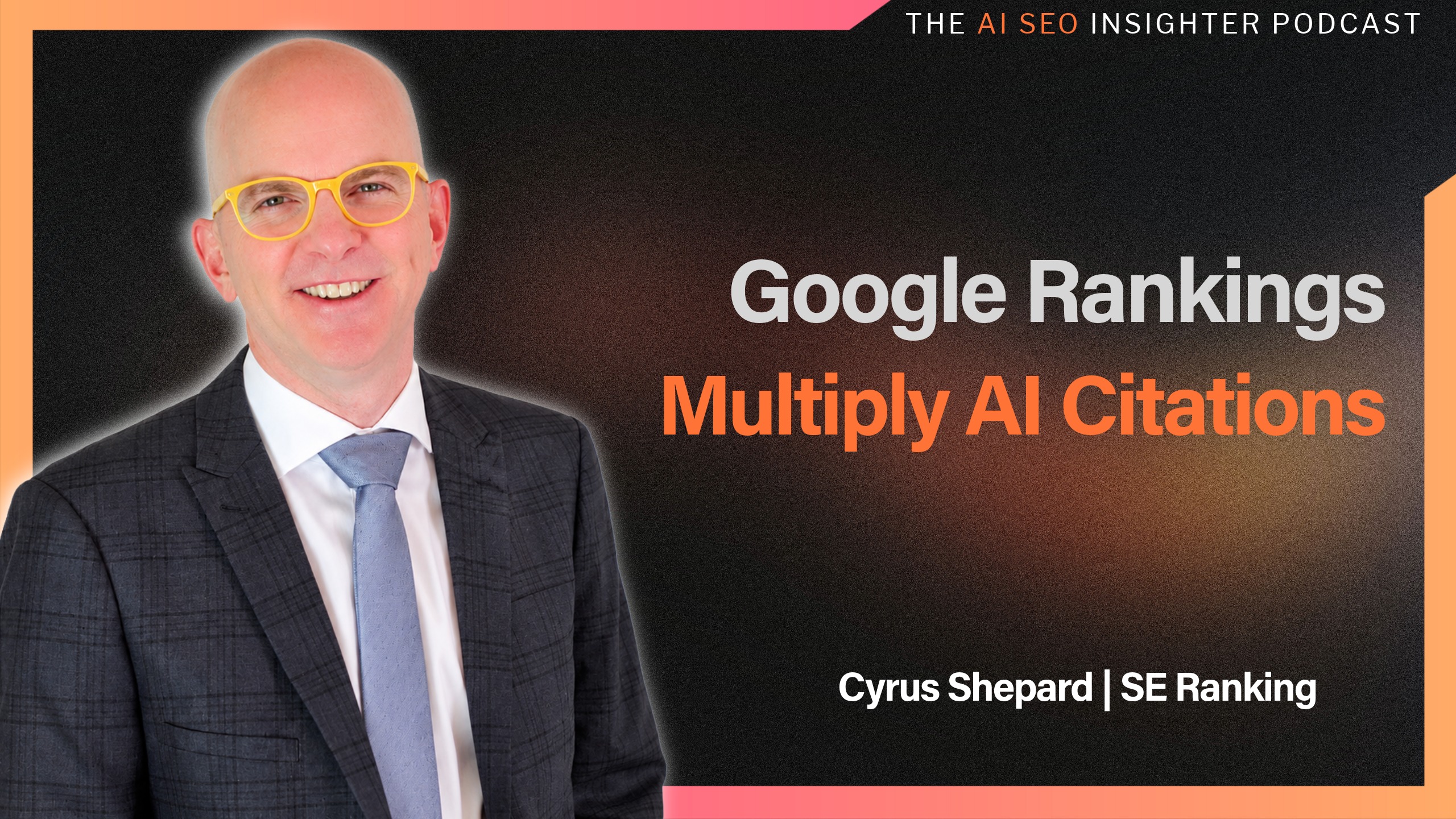
In this episode of the AI SEO Insighter Podcast, I sat down with Mordy Oberstein, Head of Brand at SE Ranking and one of the most opinionated voices in our industry, to unpack what branding actually means in an AI-driven search world. The answer is sharper, more practical, and more demanding than most marketers are ready for.
Watch the full episode here:
Why Brand Was Always the Game (Even When We Called It Something Else)
Mordy walked me back to the original innovation behind Google. PageRank wasn’t really about links. It was Google trying to replicate a brand move using the only signal they could measure at the time.
“Google was trying to replicate, hey, how do we have a proxy signal that this is perceived as being good, high quality, and relevant? And that was links, which is ironic because links became the most manipulated thing on the planet.”
— Mordy Oberstein, SE Ranking
Every major algorithmic shift since then has been Google adding sophistication to the same fundamental question. Who is this brand, what are they known for, and should we trust them? Hummingbird brought semantic understanding. RankBrain brought machine learning at the query level. The Medic Update brought E-E-A-T into the mainstream. Every shift made the proxy a little more accurate.
LLMs are the next leap, and they’re operating on the same logic with way more data.
Digital Footprint Is the New Domain Age
One of the sharpest moments in our conversation was Mordy’s framing of digital footprint. SEOs have argued about domain age as a ranking factor for decades. Google has consistently said it doesn’t matter. According to Mordy, that’s basically true, but it misses the point.
What actually matters is the size and specificity of your digital footprint. A 30-year-old brand has a comprehensive, well-known, qualitatively refined presence across the web. That’s what LLMs reward. Not the calendar age of your domain.
And here’s the part that stopped me cold. Big brands have the same problem too, just hidden. Nike dominates LLM responses for shoes. But if Nike launched a fringe product line outside their core, they’d struggle the same way an unknown brand struggles. The digital footprint problem is universal. It just shows up differently depending on where you’re playing.
Un-Siloing Is the Universal Fix
Mordy’s hot take on the SEO versus GEO debate was the most useful framing I’ve heard from anyone in the industry.
“Search engines and LLMs, they’re all moths, and they’re attracted to whatever has the biggest digital light. What marketing teams have traditionally done is silo that into channels. But when you look at an LLM, it doesn’t care about the channel. What it cares about is understanding who you are, what you’re about, and whether you have a digital light that it can grab onto.”
— Mordy Oberstein, SE Ranking
Search visibility, social visibility, PPC visibility, brand visibility. We’ve been treating them as separate channels with separate metrics for 20 years. LLMs collapse them into one ecosystem. Marketing teams now have to think about everything they do as one signal stream, not five.
This is the part that’s going to break the most marketing teams. Attribution gets messier. Performance metrics get harder to defend. The CFO wants to know which channel drove the lead. The honest answer in 2026 is “all of them, simultaneously.”
Your About Page and Homepage Are Gold
If un-siloing felt abstract, this one is concrete and immediately actionable.
Mordy was clear that there are only two places on your entire website where you can explicitly tell users, search engines, and LLMs who you are and what you do at the global level. Your homepage and your about page. Everywhere else, you’re talking about a specific service, product, or topic. These two pages are the only places where you get to define the brand itself.
Most about pages are wasted on company history. The right play is to use them for positioning. What do you believe? Who do you serve? Why does your approach work? That’s what LLMs are looking for when they’re building a picture of who you are.
I’m in the middle of rebuilding Boulder SEO Marketing’s website right now and this conversation is going to change how I approach those two pages.
Two Duplicate Google Products and What They Reveal
Mordy gave the cleanest explanation I’ve heard for why Google has both AI Overviews and AI Mode running at the same time.
In February 2023, Bing beat Google to the punch by launching Copilot. Two weeks later, Google held a live event in Paris and talked about Google Lens instead of AI. The market panicked. The stock dropped. The next event, Google announced SGE, which became AI Overviews. The next one, AI Mode. Each announcement moved the stock up.
So Google ended up with two products. AI Overviews to defend against Bing’s initial move, and AI Mode to actually compete with ChatGPT. They’ve talked about integrating them but haven’t done it yet.
What this means for marketers. AI Overviews and AI Mode function differently. AI Overviews are tied to the traditional algorithm. AI Mode behaves more like ChatGPT or Claude, looking at the wider digital footprint rather than just the immediate page. You need to optimize for both, but the optimization is not the same.
The 14% Citation Overlap Problem
Ahrefs released a study showing only about 14% overlap between top-cited domains across Google AI Overviews, ChatGPT, and Perplexity. Different LLMs cite different sources. So how should a brand think about being visible across all three?
Mordy’s answer was the most practical I’ve heard. Don’t try to optimize for each one separately. Understand that each model functions differently, then make sure your brand presence is strong enough to be picked up by all of them.
Perplexity relies heavily on the immediacy of the URL because it cites so many sources. ChatGPT and Claude take a wider lens view of your brand’s overall imprint. AI Mode sits somewhere in the middle. The brands that show up consistently across all three are the brands with a deep, well-positioned digital footprint. Not the brands optimizing for one specific citation pattern.
Stop Optimizing, Start Resonating
This is the line Mordy is most quoted on, and it lands harder in context than it does on its own.
Performance marketing has hit an inflection point. The mindset of optimize for the quick win doesn’t work the same way anymore because LLMs are not looking at the immediate page. They’re looking at the whole picture of your brand over time.
The marketers who win in 2026 are the ones who can hold two ideas at once. Performance still matters. You still need conversions, CTAs, and urgency. But underneath the performance layer has to sit real brand positioning. Real connection. Real understanding of who your audience is and what their life context actually is.
Chris’s Take
The conversation with Mordy reframed something I’ve been wrestling with for months. Most agencies and marketers are still selling AEO and GEO as new disciplines. New playbooks. New tactics. Mordy’s framing is the opposite. None of this is new. Brand has always been the game. Google has been chasing it for 30 years through one proxy after another. LLMs just made brand the unavoidable answer.
If I’m an agency owner reading this, here’s what I’d do. Audit every client’s about page and homepage this month. Score them on whether a brand-new visitor could understand the positioning in 10 seconds. Mordy ran this exercise on 1,000 websites and 70% of them failed. If your client’s site is in that 70%, that’s where your AEO work actually starts.
The Action Plan: Four Things Every Marketer Should Do This Quarter
☐ Stop optimizing channels in silos. Treat your search, social, content, and PR work as one ecosystem feeding one digital footprint.
☐ Rebuild your About and Homepage around positioning, not history. What do you believe, who do you serve, why does your approach work? Tell the LLM directly.
☐ Run a brand audit using an LLM. Type “is [your brand] good at [your service]” into AI Mode or ChatGPT. The answer tells you how the internet currently understands you.
☐ Get C-suite buy-in for content. Mordy and I both agreed: brands whose CEOs publish consistently are the brands that dominate LLM citations. If your leadership won’t show up online, you’re capped.
About Chris Raulf
 Chris Raulf is an international AI and SEO expert, global keynote speaker, and founder of Boulder SEO Marketing. He’s known for his Micro-SEO Strategies℠ and helps brands worldwide grow their online visibility using human-focused, AI-powered strategies.