
What if the last month of AI search updates was not four separate headlines to keep up with, but one clear play you could actually run?
That is the thing most people miss. When Google ships a hundred announcements in two days, then a new report, then a rebuilt research tool, it feels like noise. It feels like more work piled onto a week that was already full. But line the last four AI SEO Tips up in the order we published them, and they stop looking like updates. They start looking like a playbook. Our AI Director, Harold De Guzman, pulled all four into a single recap, and I asked him to make the connection plain: see the shift, measure your position, earn the citation, make the time.
Watch the full video above to learn more.
Here is why this matters. AI search is not coming. It is here, it is already the default for a growing share of your customers, and the businesses that treat these four moves as one connected system are the ones getting named inside the answers. The businesses treating them as a to-do list they will get to eventually are the ones quietly disappearing from the results they once owned, often without noticing until the phone stops ringing.
I have watched this pattern play out through every major search shift of the last three decades, and it always rhymes. Technology changes, anxiety spikes, and the people who do best are not the ones who chase every headline. They are the ones who slow down long enough to ask what the headlines add up to. That is the whole point of a recap. So let me walk you back through all four tips, pull the one thing that actually matters out of each, and show you how they fit together into something you can start on Monday morning.
Move One: See the Shift
We opened this run at Google I/O, where we broke down 100 announcements over two days. One number carried the whole story. AI Mode crossed one billion monthly users, with queries more than doubling every quarter. That is not a trend you casually monitor from the sidelines. That is the new normal of search, and it quietly changes what your website is even for.
Three announcements matter most for your business. Universal Cart lets your customers shop inside Google across Search, Gemini, YouTube, and Gmail without ever landing on your site. Sit with that for a second. The transaction can happen, and you never get the visit, which means your product data has to be structured and optimized for that surface now, not just your product pages. Gemini Spark is a personal AI agent that works around the clock, even when the laptop is closed, handling research and errands on your customer’s behalf. And Ask YouTube brings conversational AI search directly into YouTube, which makes your transcripts, chapters, and descriptions matter far more than they ever have. If your videos are not transcribed and structured, they are invisible to that search.
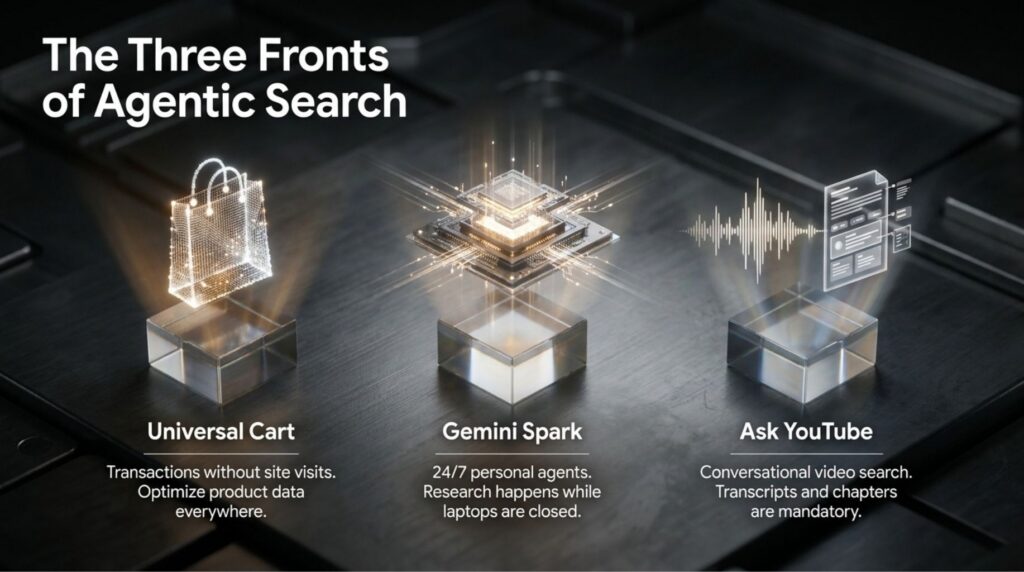
The line Harold closed that tip on still holds: the era of traditional search is over, and agentic AI search is here right now. If you want the full hundred-item breakdown, the Google I/O recap is the one to rewatch.
Move Two: Measure Your Position
So AI search is the new normal. The obvious next question is whether you actually show up in it. Here is the frustrating part. For two years, you could not tell. You could feel your traffic shifting, you could see AI Overviews eating clicks, but you had no data on whether your own pages were being pulled in. That changed. Google announced a brand new report inside Search Console that shows whether your pages appear in AI Overviews and AI Mode.
The Pages tab is the one I care about most, because it shows exactly which of your pages are getting pulled into AI answers. That is gold. It tells you what is already working, so you can make more of it. Two honest catches we covered. It is rolling out slowly in waves, starting in the UK, so if you open Search Console today and the report is not there yet, you are not behind, and you have not done anything wrong. And the data only goes back to May eighteenth, so everyone starts fresh and builds a baseline from there. There is also a new toggle, live June seventeenth, that lets you block your content from AI answers. My advice is simple. Leave it off. Blocking yourself from the answers your customers are already reading is like taking your storefront off the town’s busiest street. You want to be inside those answers, not hidden from them. The move here is small and worth doing today: open Search Console, get familiar with where the report will live, and you will spot it the day it reaches your account. The full walkthrough is in the Search Console tip.

Now, measuring is only half the game. Knowing whether you show up does not make you show up. The move that actually gets you named comes next.
Move Three: Earn the Citation
Right now, someone is asking AI the exact question your business answers, and AI is naming a source. The only real question is whether it names you. That is where NotebookLM comes in. Google rebuilt it so it no longer just summarizes your documents. It finds authoritative sources, runs real analysis with actual code, and builds citation-ready content you can export. Harold ran one query in and got a citation-ready brief out on the other side.
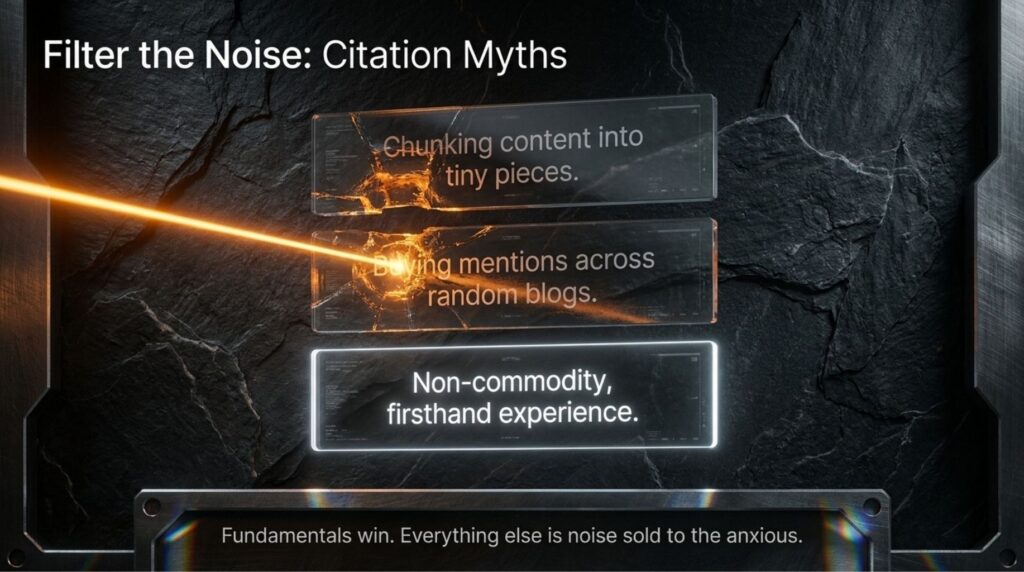
But the tool is not the lesson. The lesson is what earns a citation, and it comes down to a few key factors. Write non-commodity content, the firsthand stuff only you can say from real experience, because AI skips right past the generic. This is where E-E-A-T stops being a buzzword and starts being your advantage. Your real expertise and lived experience are exactly what a language model cannot manufacture on its own. Then format for extraction, which means using real questions as your headings, with the answer visible directly underneath on the page. And avoid what we call the schema fallacy: FAQ markup sitting in the background with no visible answer does nothing, because the model reads the words actually on the page, not the code hiding behind them. I see businesses spend weeks on markup while their visible copy stays thin. That is backward.
We also cleared out the myths, because they waste more time than almost anything else in this space. You do not need to chunk your content into tiny pieces. You do not need an LLMs.txt file. And buying mentions across random blogs gets blocked, so save your money and your reputation. The fundamentals win. Everything else is noise dressed up as strategy and sold to people who are anxious about falling behind. The NotebookLM tip is the one to follow along with step by step.
Move Four: Make the Time
Here is the honest problem with everything I just laid out. Seeing the shift, measuring your visibility, building citation-ready content, all of it takes time, and most teams do not have a spare hour in the week to give it. That is exactly why we ran the AI Task Audit tip, and it might be the most practical of the four.
At Boulder SEO Marketing, we are on a mission to automate eighty percent of our repetitive work. Not to replace people, but to free them for the work that actually matters, the strategy and the judgment and the firsthand thinking that earns those citations in the first place. That is what human-driven AI-assisted actually means in practice. The tip gave you a simple test. If a task occurs more than once a week, follows the same format each time, and takes more than 30 minutes, it is a candidate for AI. I will show you what we actually hand off: meeting notes into Claude, keyword research through SE Ranking, repurposing one piece of content into many, and even the avatar video style Harold uses to record these very tips. And the way to start is not to boil the ocean or overhaul everything at once. Pick one task, document the process end-to-end, and choose one tool to run it. That is the tip that buys back the time to do the other three. If busywork is eating your week, that one is worth your ten minutes.

The Four Moves Are One Play
Put them together, and here is the whole story of the last few weeks. Google I/O showed you the shift, and AI search is now the default. The Search Console update means you can finally measure whether you show up. NotebookLM showed you how to earn the citation by providing a trusted, well-sourced, firsthand answer rather than a generic one. And the Task Audit frees the time to actually do all of it. See the shift, measure your position, earn the citation, make the time. That is not four updates. That is one playbook, and it runs in that order for a reason. You cannot measure a shift you have not noticed. You cannot earn a citation you have never measured. And you will not do any of it if busywork owns your calendar.
Here is what I have learned watching businesses try to keep pace with AI search over the last couple of years. The winners are rarely the ones with the biggest teams or the fanciest tools. They are the ones who treat change as a system instead of a scramble. Four separate tips over a few weeks can feel like a lot to absorb. One playbook you run in order feels like something you can actually start on.
What to Do Next
Start with move two, because it is the fastest and it costs you nothing. Open Search Console this week and get familiar with where the AI visibility report will appear. Then pick one page you genuinely care about and rewrite it the way move three describes, with a real question as the heading and a clear, firsthand answer right below it. That single pass touches three of the four moves at once. And if you would rather not run all of this by hand, that is exactly what we built microSEO.ai for, formerly BSM Copilot. It handles the measuring and the citation-ready work, so your team can focus on the parts only humans can do well. Either way, the play is the same. Measure, and be worth citing.
Every one of these tips now lives in the archive, ready whenever you need it. Come back anytime.
Stay safe and healthy.
Cheers,
Chris