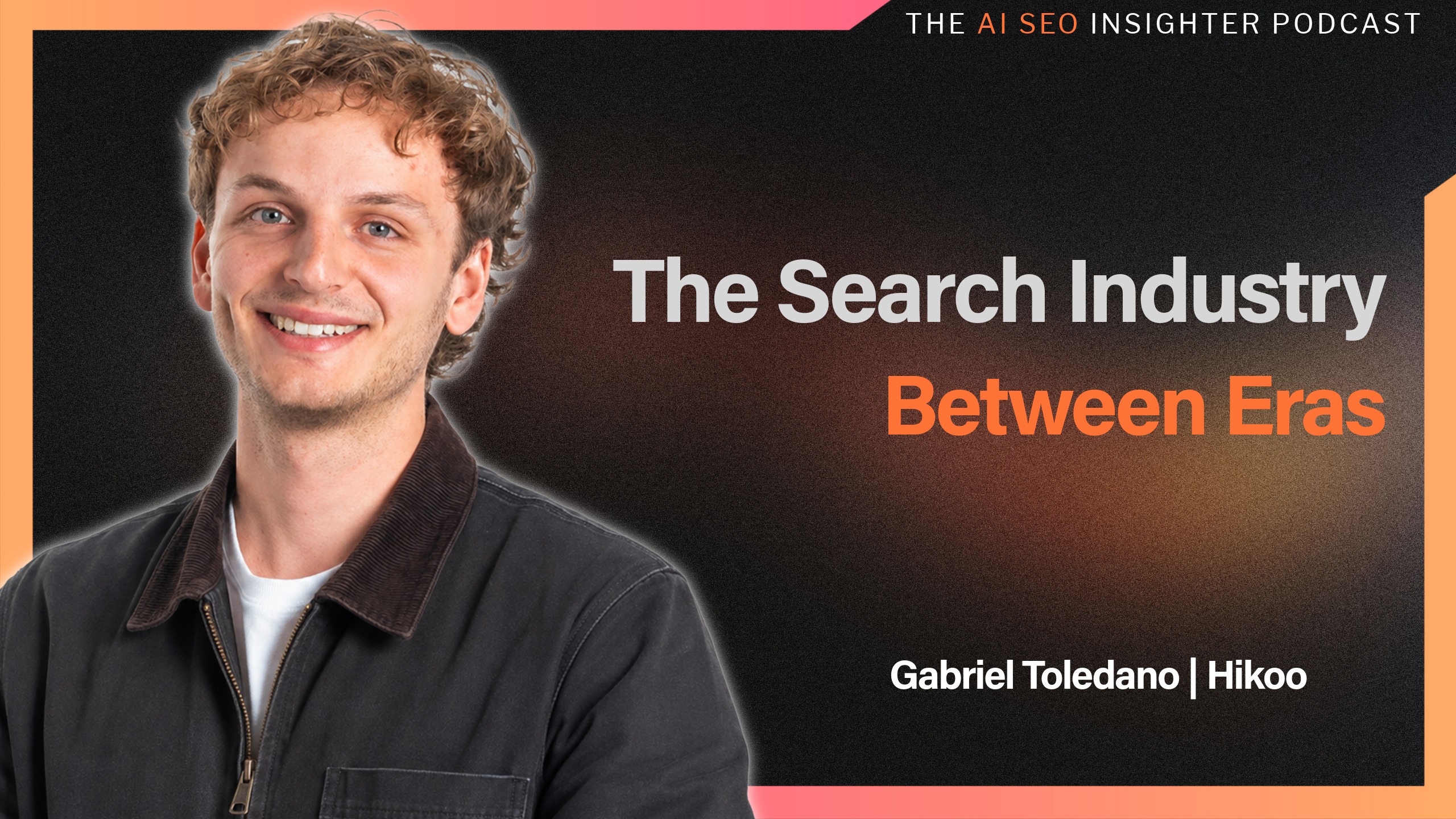
The Search Industry Between Eras
The Three Numbers That Frame This Episode
Eighteen months. That is roughly how far behind the US the European market is on AI search, and Gabriel Toledano has spent the last two years watching that gap open in real time from Paris.
Then 0.664 against 0.218. Brand mentions correlate with AI visibility at 0.664. Backlinks land at 0.218. Three decades of link building, and the signal that predicts whether an AI names you is people talking about you, not people linking to you.
And 51 percent. Buyers starting their research inside a chatbot crossed half, up from 29 percent in April 2025. In my own agency, at least half of our leads now tell us they found us through ChatGPT, Claude, Perplexity, or Gemini. They arrive already qualified.
Watch the full episode here:
Rankings Held, Pipeline Shrank
Gabriel was running an agency when ChatGPT launched. The first year, nothing changed. By 2024, the same call kept repeating. The client ranks one, two, three. Search Console shows impressions holding. Clicks fall. Nothing in the reporting stack explains it.
That is the part that breaks an agency relationship. You are telling a client they are winning on exactly what they hired you for, while their pipeline thins. Three brands came back in the answer, and theirs was not one of them. There is no analytics line for a conversation you were never part of.
Where GEO Actually Diverges From SEO
The baseline holds. Quality, structure, clarity, technical hygiene. A model cannot cite what it cannot parse. Gabriel is direct that the SEO foundation still matters.
The divergence is off-site. In SEO you control your domain and the links pointing at it. In GEO, the pages that decide the answer are pages you do not own and cannot edit. That makes it closer to public relations than to technical SEO, and the industry is not staffed for it. Plenty of content managers and SEO managers. Very few people whose job is getting a third party to describe you accurately.
Europe Watched From a Distance for Two Years
“People act on what they can see. Marketers in Europe couldn’t see it.”
— Gabriel Toledano, Hikoo
An American marketer watched a generated answer eat their traffic every morning. A French marketer opened the same results page and saw ten blue links, unchanged, for two years. The loss was already happening. Gabriel puts European usage at 40 percent of ChatGPT’s user base. There was simply nothing on screen to react to.
Ask a marketer to fund a channel with no visible interface and no measurement, and you get the perfect conditions for collective inaction.
AI Overviews landed in France on July 22, with a broader rollout Gabriel expects on September 23. What changed immediately was not user behavior. It was the behavior of marketing directors, who could finally see it. Audit requests started climbing, from bigger accounts and from sectors that had never asked before.
Why Waiting Costs More Than Entering
The objection Gabriel hears from French agencies is not that GEO is wrong. It is that clients are not asking for it yet. Rational, and expensive.
“The same conservatism that keeps you out, protects you once you are inside.”
— Gabriel Toledano, Hikoo
Models are conservative. Once a source set is established for a category, displacing it costs far more than entering early. US companies that got into those source sets two years ago now lead their categories. In France, many of those slots are still open. Add the fact that the deciding pages are third-party pages, which means press, citable studies, and listings on someone else’s publishing cycle, and every quarter of delay compounds.
Brand Name Is the New Keyword
I got into SEO thirty years ago, when Google was still called BackRub. I never expected to be optimizing for a company name.
Gabriel’s explanation for why mentions beat links: a mention is a sentence, sitting in a context, carrying a judgment. Models are trained on text and have no special organ for hyperlinks. What they have is a very good sense of which words sit near other words. That is also why sentiment became a real metric. Not just whether you are mentioned, but how.
AI Search Does Not Translate
This one stopped me. Gabriel’s team found it by accident, running the same category in two markets and expecting a translated version of the same list. It was not. The model retrieves text in the language of the question, not the country of the user. Ask about Paris tourism in English and you get American guides. Ask in French and you get an entirely different corpus, different publishers, different forums, different institutional sources, and therefore different brands.
The consequence is blunt. A multilingual company does not have one AI visibility problem. It has one per language. Most brands measure English, because that is where the tools were built, and fly blind everywhere else.
Off-Site Work Starts With Correction
Most people hear off-site and think link building or spamming Reddit. Gabriel’s version is quieter and more useful. It is not about volume, it is about accuracy. Your brand is already mentioned in the places that matter, with old positioning, old pricing, and a category label from three years ago.
He tested it directly. Ask Claude why it left a brand out and you get answers like: the site carries an affiliate link so it reads as advertising, and five sources describe the company differently, so nothing about it can be trusted. The first job is correction, not acquisition. It is also far cheaper, because the placements already exist. Only then do you produce something a third party has a reason to cite, which usually means original data nobody else has.
Chris’s Take
The line I keep coming back to is that the same conservatism keeping you out protects you once you are in. That reframes the whole cost argument. Every week of waiting is not neutral, it is a week someone else spends locking a slot you will later have to buy your way into.
The other thing worth sitting with is his workshop trick. He stopped asking rooms who is doing GEO, because nobody raises a hand and it embarrasses everyone. Now he asks who has typed their own brand into ChatGPT, which gets about a third of the room. Then he asks who has run their whole category without naming their brand. Back to two or three hands. That second question is the real audit, and it takes four minutes.
When I spoke in Berlin recently, out of about a hundred people, two hands went up. Same room, different country, same number.
The Action Plan
☐ Run the unbranded category prompt. Ask ChatGPT, Claude, Perplexity, and Gemini to recommend a provider in your category without naming yourself. Write down who appears.
☐ Audit accuracy before chasing volume. Find where you are already cited and fix the stale pricing, the wrong category, the outdated positioning.
☐ Do it per language, not per country. Every market you sell into is a separate visibility job.
☐ Move budget from last-click optimization toward whatever makes a third party say your name correctly.
About the Guest
Gabriel Toledano is the co-founder and CEO of Hikoo, an AI visibility and GEO platform helping brands measure and improve their presence across generative search engines. He works on AI Search, Generative Engine Optimization, and the new ways brands are discovered, cited, and recommended by AI systems. Connect with him on LinkedIn.
About Chris Raulf
 Chris Raulf is an international AI and SEO expert, global keynote speaker, and founder of Boulder SEO Marketing. He’s known for his Micro-SEO Strategies℠ and helps brands worldwide grow their online visibility using human-focused, AI-powered strategies.