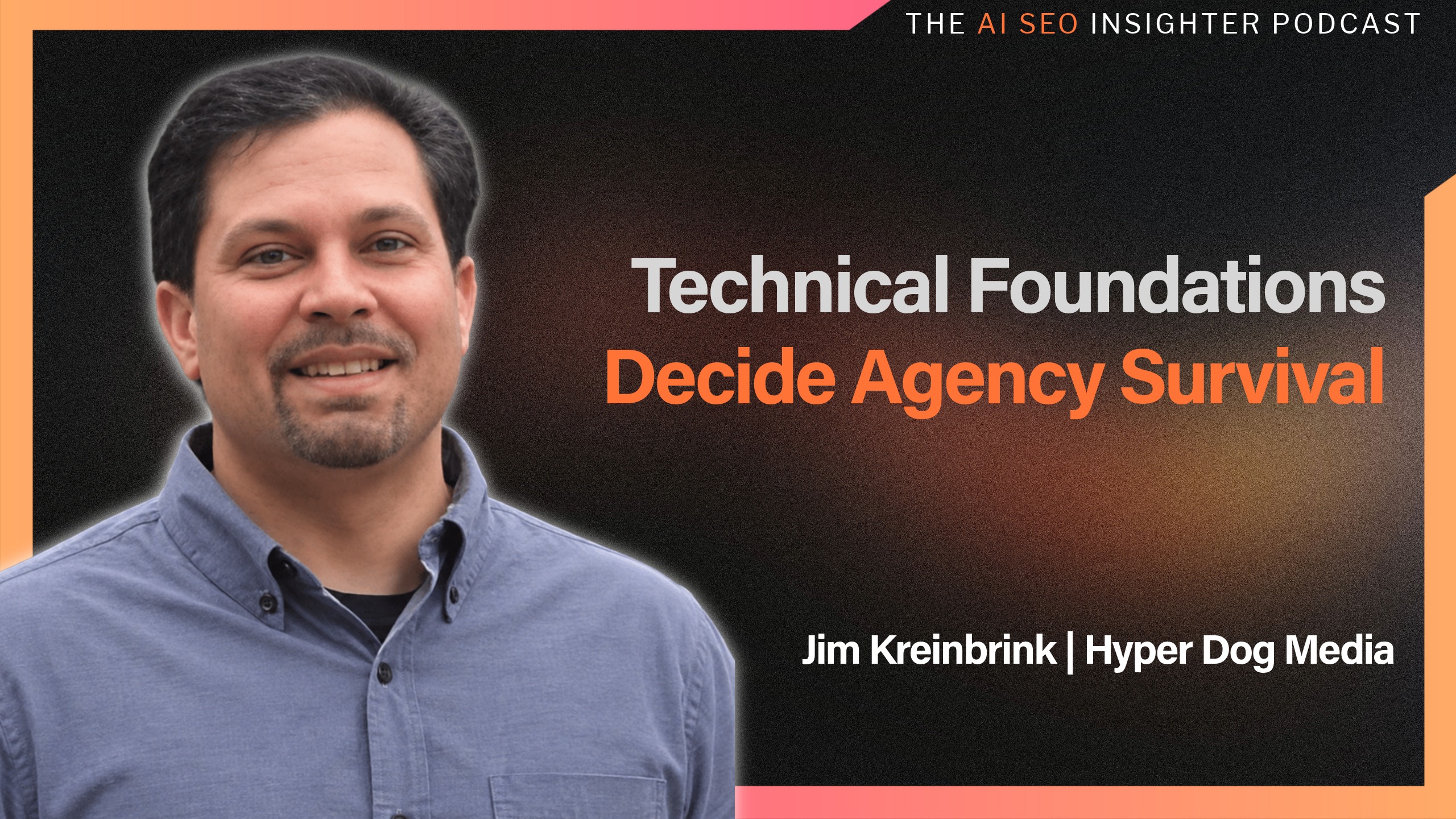
Technical Foundations Decide Agency Survival
The Pattern Nobody Wants to Admit Is Repeating
Jim Kreinbrink has been optimizing websites since 1998. He likes to say he has been doing SEO since the 1900s, and once did it on horseback, which is a real story about telling the Breckenridge stables they were blocking Google. In that stretch, he has watched three separate technologies get crowned the killer of this industry. Software. Then offshore teams and VAs. Now AI.
None of them did it. What changed each time was which agencies came out the other side, and the answer has been depressingly consistent. The ones with real technical foundations kept going. The ones renting a shortcut did not.
That is the argument of this conversation, and it is why I wanted Jim on. He is a technical SEO at his core, hands-on with the current tooling, and one of the few people willing to say out loud that a lot of the GEO advice circulating right now is snake oil.
Watch the full episode here:
Three Rounds of “SEO Is Dead” and What Survived Each One
Jim frames it as our industry quietly automating for decades, which is why he finds the current panic a little funny. Every wave arrived with the same obituary column. What actually happened is that the work moved up a layer. The tactic got automated; the judgment did not.
Look at where he started. In 1998, you could outrank Walmart, and Jim will tell you exactly why: their URLs were awful, and their internal linking was worse. A small operator who understood structure could beat a behemoth. I think we are living through that window again, which is the single most exciting thing about this moment for anyone running a boutique shop.
Technical SEO Is Now About Who You Let In
Ask Jim what technical SEO covers, and he does not start with crawl budget. He starts with a brochure locked in a closet. You can generate unlimited content now. If the machines cannot reach it, you have produced nothing.
Step one is confirming the newest bots can actually get to you. He singled out Cloudflare, and the timing is sharp. Starting September 15, 2026, Cloudflare judges multi-purpose crawlers under the most restrictive rule that applies to them. Googlebot is exactly that kind of crawler. If anyone on your team ever clicked the old “Block AI bots” toggle and forgot about it, Googlebot follows.
Entity Maps and Speaking to Machines in Their Language
Jim built an actual entity map on the Hyper Dog Media site, which is still rare enough to be worth stealing. The concept came out of Dixon Jones’s work at InLinks, and the mechanics are simple: knowledge graph IDs in your schema, the Wikipedia concepts Google trained on, and no guessing left for the machine. Hyper Dog trademarked the phrase for it a few months ago. Connect the Dots for the Bots. Good line, accurate description of the job.
“We’re seeing that pattern with GEO that if you’re not careful about it, you might be gaining in ChatGPT, but you’re losing in Google.”
Jim Kreinbrink, Hyper Dog Media
Why the GEO Shortcuts Blow Up on a Delay
Here is the part every agency owner needs to hear. Jim has watched teams generate unlimited content, see it work, and eat a penalty ten weeks later. Content is close to free now, so it has stopped working as a quality signal and started working as a target.
Google has always played police in search, and it is playing police in AI search too. Twelve years ago everyone said links would never get penalized, because links were the entire algorithm. Then Penguin landed, and it hurt. Same shape, different input. The trap is that the scoreboard lies to you for a while before it corrects.
Fewer Visits, Better Leads, and the Client Conversation That Follows
Jim’s example is a plumber whose blog post on the average local water bill used to pull real traffic. Someone wanted a number, read the post, learned the plumber existed. Now the answer sits in the result and nobody clicks.
Why do the remaining leads convert so much better? Because those people already ran the entire research loop inside ChatGPT or AI Mode. They arrive pre-qualified. I am seeing exactly this across our client base. If you are still reporting traffic as the headline number, you are handing your client a metric that now moves in the wrong direction for the right reason.
The Moat Is Gone, So Agencies Are Building Their Own Tools
This is the panel Jim built for AgencyCon. Everybody is creating their own software now. The old trade was accepting a platform’s workflow because you could not afford to build your own. With API access and coding agents, that trade is dead.
Jim standardized on Claude Code after experimenting with Make and n8n, and his warning is worth underlining: do not burn a quarter evaluating platforms, because whatever feature is missing ships in three months anyway. Pick something and build.
“Well, in the future, as you point out, it’ll be the bots come first, and then the bots come later as well.”
Jim Kreinbrink, Hyper Dog Media
What Comes After the Website
Jim’s forecast is that we keep the website, keep filling it with answers, and stop pretending humans are the primary audience. WebMCP is the piece to watch. It is a proposed standard from the W3C Web Machine Learning Community Group, authored by Google and Microsoft engineers, that lets a page declare what an agent can do on it instead of making the agent reverse engineer your buttons.
Then he gave an answer I did not expect about what our industry is sleeping on. Accessibility. The standards that should have been there from the start turn out to be what machines need. Jim pointed at a new beta in PageSpeed Insights. To be precise, Google shipped an experimental Agentic Browsing category in Lighthouse 13.3 in May, and the accessibility tree is one of the things it grades.
Chris’s Take
The moment that stayed with me was not the Cloudflare warning, useful as that is. It was Jim answering the sleeper question with accessibility. I expected a tool, or a schema type, or something with a launch date attached.
That answer reframes two years of GEO discourse. We have been treating AI visibility as a new discipline needing new tactics. Jim’s position is that machines mostly want what the accessibility community has asked for since the late nineties. Clean structure. Honest labels. Interfaces that announce what they do. The fix is not speculative, and it does not depend on any vendor’s roadmap.
If you are an agency owner deciding where the next quarter goes, run your top client’s site through an accessibility audit before you buy another GEO tool. One of those has a defensible floor. The other has a marketing department.
The Action Plan
☐ Check your Cloudflare settings before September 15. If anyone on your team ever enabled the legacy block-AI-bots toggle, Googlebot is now in scope.
☐ Put your social profiles into your Google Business Profile. Jim’s answer to the one-technical-fix question, and most people skip it.
☐ Build the entity map. Knowledge graph IDs in schema, Wikipedia concepts referenced, one authority page per concept.
☐ Audit accessibility this quarter. It serves users, agents, and Google’s newest Lighthouse category at the same time.
About the Guest
Jim Kreinbrink is the founder and resident SEO expert at Hyper Dog Media, a Denver digital marketing agency working across SEO, AI SEO, PPC, and paid social. His client list spans legal, home services, education, technology, and human resources. Having spent his entire career on the web, he understands the balance between what appeals to AI search robots and what appeals to the humans who actually visit the site.
He started the Denver SEO Meetup in 2007 to get the area’s SEOs and digital marketers sharing with each other, ran SearchCon in the mountains at Beaver Run for four years, and grew that into AgencyCon in 2017 after an attendee asked to speak on agency operations instead of search. AgencyCon 2026 runs October 8 and 9 at the Children’s Museum of Denver at Marsico Campus, where I will be on the AI Automation panel. Connect with Jim on LinkedIn.
About Chris Raulf
 Chris Raulf is an international AI and SEO expert, global keynote speaker, and founder of Boulder SEO Marketing. He’s known for his Micro-SEO Strategies℠ and helps brands worldwide grow their online visibility using human-focused, AI-powered strategies.