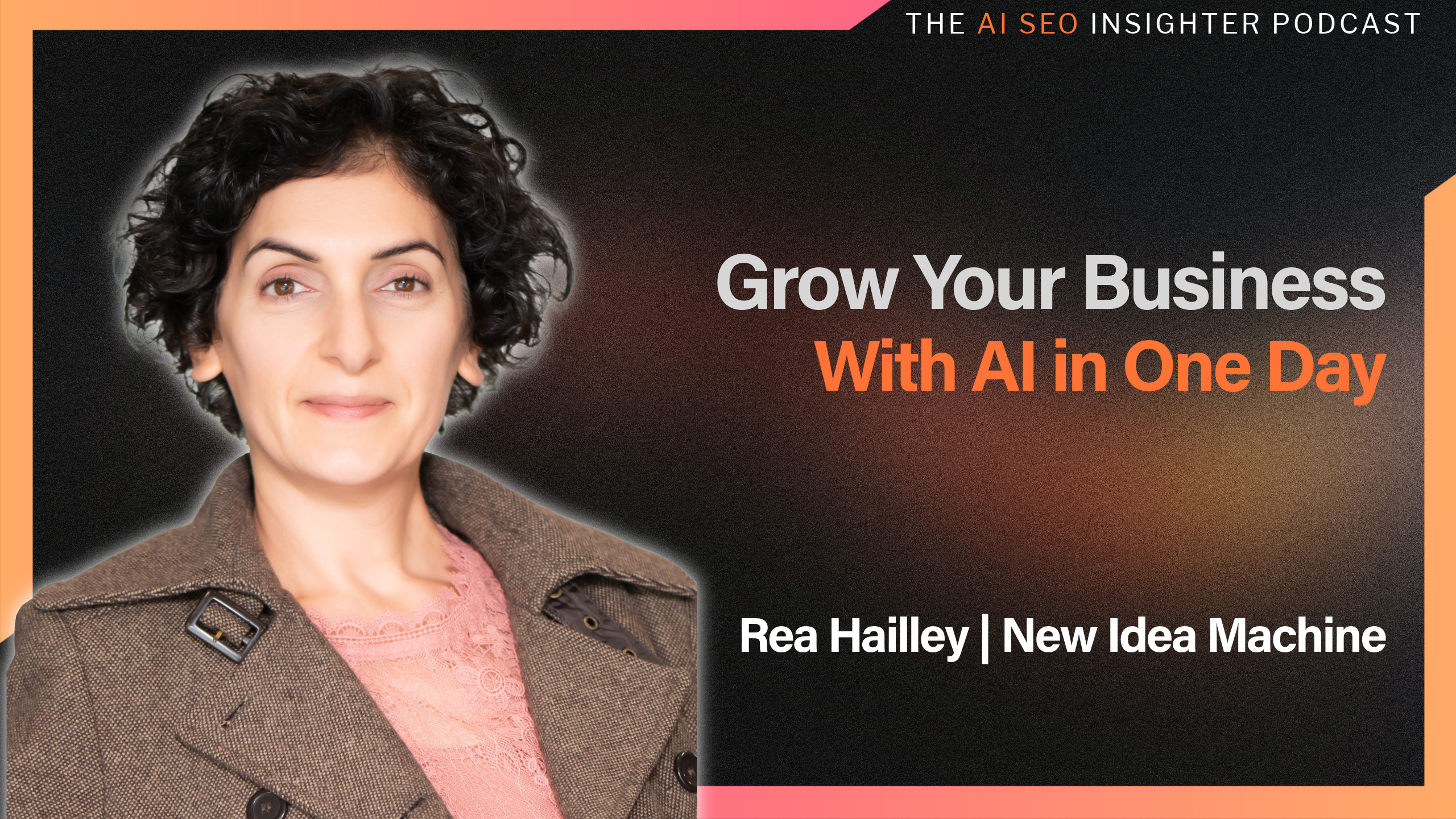
Grow Your Business With AI in One Day
The Three Numbers That Frame This Episode
$25,000. One day. Four weeks.
The first number is what a small business owner used to spend on a developer just to find out whether an idea was worth building. The second is how long it takes in Rea Hailley’s bootcamps today. The third is how long it took Rea, a self-described non-marketer, to go from building a prompt playbook out of my blog posts to getting a client sent her way by ChatGPT.
Rea is the CEO and Co-Founder of New Idea Machine. We talk about what changed, why guardrails and source material matter, and why GEO doesn’t have to be as intimidating as SEO.
Watch the full episode:
Why New Idea Machine Exists
Rea and her co-founder, AL Del Degan, started New Idea Machine during the pandemic. Small business owners are brilliant at what they do, but when it comes to automation or AI, they often don’t know what questions to ask or how to vet a developer.
AL brings 33 years as a developer, including work with the Calgary Airport Authority. Rea brings the business side, including growing a Shopify portfolio to $90 million. Together they help owners decide whether the right path is an off-the-shelf tool, something custom, or a hybrid of both.
From $25,000 to One Day
Owners kept telling Rea they wanted a simple internal tool or a prototype to test before investing. Nobody wants to spend $25,000 on something that may never get used.
AI changed the math. Rea and AL now teach non-technical people to think like a developer and prompt like a developer, so they end up with a solid prototype they can put in front of the market. Some participants have built theirs in about an hour. Others take a few days.
The key ingredient is guardrails. Because AL knows where AI hallucinates and goes off the rails, the bootcamp keeps participants on track.
Grit, Curiosity, and an 87-Year-Old Founder
When we first spoke, Rea mentioned that a rafting company owner doing a million a year sat in the same room as a first-time founder. What do they have in common? Grit, and a deep curiosity.
The rafting owner, who comes from a data background, wanted to build tools to work through large amounts of data. The other participant was an 87-year-old who spent his career in finance, spotted a gap in his industry, and didn’t want to spend $50,000 or more just to find out whether his idea was worth pursuing. He was so eager that New Idea Machine ran a summer bootcamp because of him, and he started applying what he learned immediately.
Rea also raised succession planning. When seasoned experts retire, their knowledge often leaves with them. Affordable AI prototyping gives that knowledge a way to be passed on.
Where AI Actually Saves Money
For a founder with almost no budget, Rea’s answer was market research. Before AI, understanding your ideal customer’s real pain points meant hiring research teams, waiting, and in some cases literally going door to door with surveys.
Now a few well-built prompts can search the web for what your ideal clients are saying: their frustrations, what’s working with the tools they use, and what isn’t. Weeks of work can happen in a day.
“No one will care about your business as much as you do, and no one will understand your business as deeply as you do.”
Rea Hailley, New Idea Machine
The Playbook Behind the ChatGPT Recommendation
Rea learned that lesson the expensive way. She paid $1,200 for a copywriter, then hired a marketer who admitted months in that she didn’t fully understand the company.
So she took a different route. After we met at a workshop, I pointed her to a few of my blog posts. She didn’t have time to master them, so she combined them with Donald Miller’s StoryBrand framework, extracted the actionable insights, and built a set of prompts she could reuse on every page of her website.
The first prompt shows how many of your claims a competitor could copy. Generic claims are easy to copy, and AI has no reason to cite you for them. The second prompt finds your ideal buyers’ own words for the problem you solve. The result: ChatGPT listed New Idea Machine first when her ideal client typed in his pain point.
Source Material and Guardrails Beat Generic Prompts
Before we met, Rea was already using AI to optimize her site, with mediocre results. Some areas improved, others didn’t move at all. Once she worked from real source material, she described the difference as night and day.
She also found that paid AI tools research far more thoroughly than free versions.
“SEO can be very overwhelming for someone who’s not a marketer. But GEO doesn’t have to be because of AI.”
Rea Hailley, New Idea Machine
Roughly 80 percent of GEO is still classic SEO: keyword research, title tags, on-page and off-page work. But the 20 percent that is new is driving most of the results right now. Rea’s story is proof. Four weeks after building her playbook, ChatGPT sent her a client.
Chris’s Take
What stuck with me is that I wrote that playbook for a conference in Berlin and had no idea whether anyone would actually use it. Rea did, and she wasn’t an SEO expert. She was curious, a little fearless, and willing to give it a go.
Here’s the thing most people get wrong about AI search: they assume they need to understand everything first. You don’t. You need good source material, the right guardrails, and the willingness to be an AI-first person.
If you’re a small business owner, take one piece of expert content you trust, turn it into prompts, and run every page of your site through them. That’s how this starts.
The Action Plan
☐ Audit your claims: Find every statement on your site a competitor could copy, and replace it with something specific to you.
☐ Use your buyers’ words: Research how your ideal clients describe their problem, and rewrite your pages in that language.
☐ Feed AI real source material: Build prompts from trusted expert content instead of generic prompts from the open web.
☐ Prototype before you pay: Test a new idea with an AI-built prototype before committing $25,000 or more to development.
Coming Up: LinkedIn Live, November 12
Rea and I go live on LinkedIn on Thursday, November 12, at noon Mountain Time, where I’ll walk through the Virtual Chris closed-loop system.
About the Guest
Rea Hailley is the CEO and Co-Founder of New Idea Machine, a Calgary-based custom software and AI automation company serving small business owners. She brings 20 years in B2B strategy, including growing a Shopify portfolio to $90 million. Get her two prompts at newideamachine.com/prompts and connect with her on LinkedIn at linkedin.com/in/rea-hailley.
About Chris Raulf
 Chris Raulf is an international AI and SEO expert, global keynote speaker, and founder of Boulder SEO Marketing. He’s known for his Micro-SEO Strategies℠ and helps brands worldwide grow their online visibility using human-focused, AI-powered strategies.