Chosen by the Machine First: AI Governance and Agent Fleets
The Big Idea That Frames This Episode
Everybody in my world is building closed loops right now. Agents feeding agents, knowledge bases that update overnight, fleets of little digital workers running campaigns while we sleep. I’m doing it too. Here’s the question almost nobody asks: who is watching the agents?
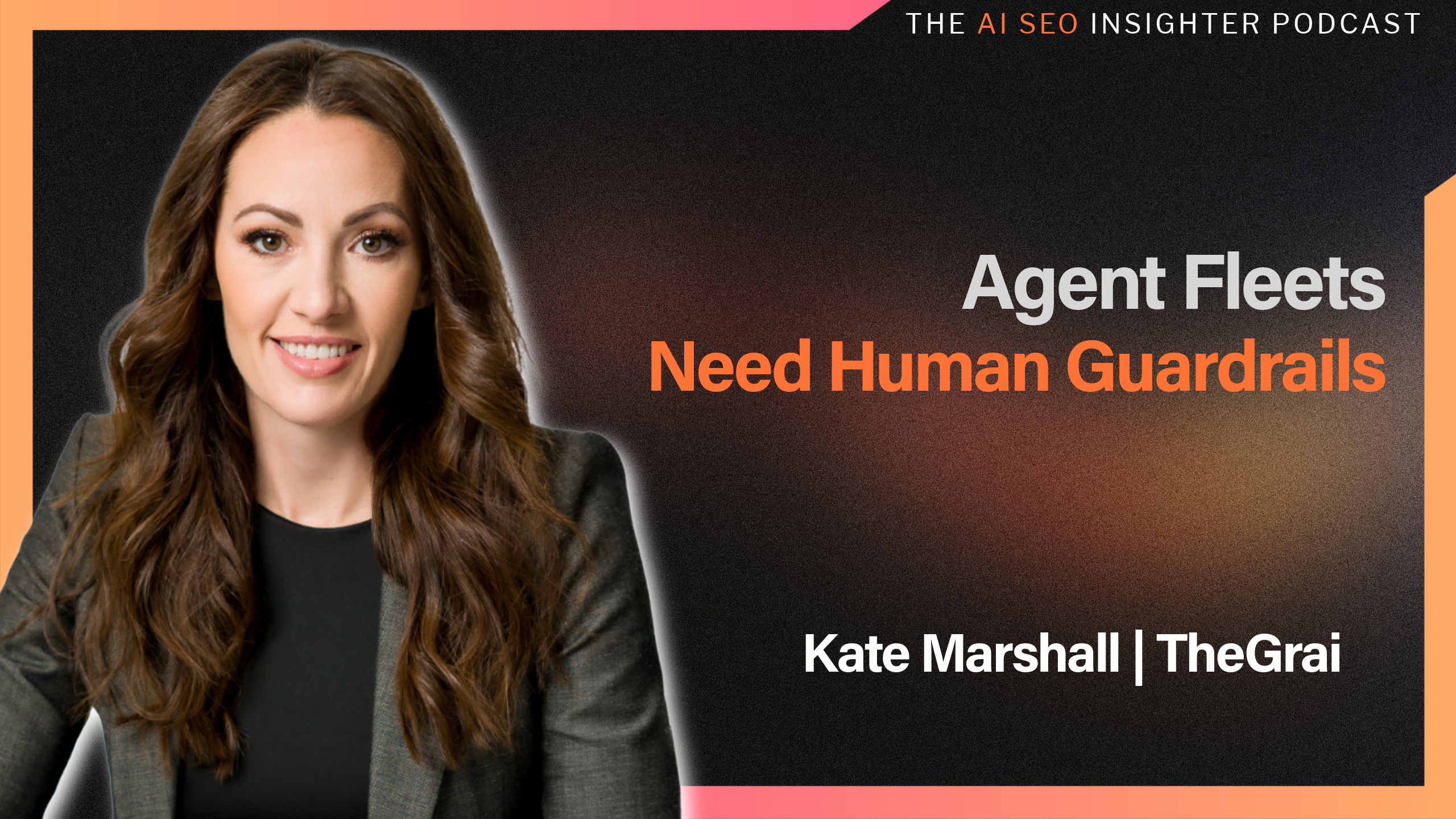
Kate Marshall lives in that gap. She’s a fractional Chief AI Officer, the founder of TheGrai (governance and responsible AI), and she spent 18 years at the SANS Institute helping people understand emerging technology before it hurt them. We met on a panel a few weeks ago, and ten minutes in I knew she had to be on the show.
This conversation is the unglamorous side of AI. Policies, kill switches, data hygiene. It’s also the part that decides whether your AI program scales or blows up.
Watch the full episode:
Chosen by the Machine First
Kate frames selection as a two-stage process now. The machine chooses first, the human second. When a buyer tells an agent to go find a product, a contractor, or a vacation rental, that agent can only recommend what it can find and read. Kate admitted her own trip-planning agent is probably skipping mom-and-pop businesses that have no readable presence online.
I asked whether a Facebook page is enough anymore. Her answer was no, and she’s right. You can stand up a searchable, readable website in twenty minutes now. The excuse is gone.
“Most of our websites and most of our content was built for the human eye and not for the agent to read.”
Kate Marshall, TheGrai
E-E-A-T gets you cited. Readability gets you found in the first place.
Running a Fleet Starts With One Memory
Kate runs a real fleet: a Hermes agent acting as her chief of staff, plus a rotating cast she tests every week because new features ship constantly. Her advice to the rest of us is blunt. Don’t copy her setup. Pick your favorite model and build a connected set of agents inside it.
What keeps her fleet sane is one shared memory system in Obsidian that every agent can read, updated nightly from her conversations and email. Spin up a new agent, point it at the memory, and it’s trained. Same problem I solved with Virtual Chris, different tech stack.
The layer she added that I hadn’t thought hard enough about: a visual project board. She uses Linear so she can see what every agent is working on, because people forget.
Nobody Is Trained to Manage Agents Yet
People managing agents that manage agents is already a job title. Kate hasn’t met a single company meaningfully training its people for it. So she partners with HR on change management, teaching teams where the human stop gaps go so an agent doesn’t run unsupervised for three months.
She also starts with leadership. Without a clear message from the top, employees assume you’re there to automate their jobs away. Her framing flips the fear: if AI gave you time back, what would you build?
The Liability Gap: Your AI Policy Is a Living Document
This is where the episode got serious for me. My content system ingests sales calls, meeting transcripts, and Slack messages. That’s the fuel that makes our content rank, and it’s also a liability surface.
Kate flagged a shift I hadn’t seen coming: insurance. Check the box saying you use AI or agentic systems, and underwriters now want your AI policy, your approved tools list, your kill switches, and the names of who manages which agents. None of it is hard. It just has to stay current.
“AI is supposed to make us more productive. And there is nothing less productive than having a breach inside of your organization.”
Kate Marshall, TheGrai
Her minimum standard: a paid or enterprise plan, model training toggled off, and a separate personal account for anything private. Chat windows are not protected like attorney or doctor conversations.
Why Pilots Stall, and How to Rebuild Outside the Plane
Most AI pilots never reach full scale. Kate’s diagnosis is that we ask how AI can do our current work faster, when the real question is whether the work should be done that way at all. Break the goal into components, decide which pieces AI handles and which need a human check, then build.
Her rebuild method is the part I’d steal. You can’t rebuild a plane while it’s in flight, so pull one system out entirely, rebuild it, bring it back in, test it, then move to the next. And stop handing people the keys to a fancy car with no driving lessons.
From Pyramid to Pods
Kate already sees the org chart changing. The classic pyramid is thinning at the entry level into a diamond, and once agent swarms arrive she expects pods organized around tasks, with one person potentially overseeing dozens of agents they didn’t build.
Her line between AI serving us and us losing something human comes down to intention. Her TikTok feed is pure learning, and she treats AI the same way: a sparring partner, not a replacement for thinking.
Chris’s Take
What stuck with me was the insurance point. I’ve spent two years building Virtual Chris into a closed loop that feeds on everything our team says and writes, and I’d been treating governance as something to sort out later. Kate made it clear that “later” is now being written into underwriting questionnaires.
The industry assumption is that speed wins, and governance slows you down. I think that’s backwards. With 20 to 25 people feeding our systems, I’ve already had to tell the team not to use work email for private stuff, because the loop reads everything. Guardrails are what let you move fast without cleaning up a breach.
If you run an agency or a marketing team, do this before your next agent goes live: write down its job, its access, and who can shut it off. If you can’t answer all three, you’re not ready to deploy it.
The Action Plan
☐ Write the job before you pick the tool: define the agent’s role, access, and tasks the way you’d write a job description.
☐ Make your site readable to agents: if a buyer’s agent can’t read your business, it won’t recommend you.
☐ Keep a living AI policy: an approved tools list, named agent owners, and a working kill switch, reviewed as often as the tools change.
☐ Let AI interview you: open the model you pay for, describe your work, and ask it how it can help you.
About the Guest
Kate Marshall is a fractional CAIO who helps leaders, executives, and HR teams adopt AI safely and strategically. As founder and lead AI strategist at TheGrai, she works with executives and non-technical teams to put responsible AI into practice across hiring, learning, employee experience, research, and daily productivity, helping them move faster without sacrificing governance. Before TheGrai, she spent 18 years at the SANS Institute leading curriculum strategy, courseware development, and marketing teams, then served as Director of Summits, co-chaired the AI Cybersecurity Summit, and launched the first AI Hackathon at SANS. She’s also the author of AI at Work: A Step-by-Step Foundational Guide for Implementing AI. Connect with Kate at https://thegr.ai and on LinkedIn.
About Chris Raulf
 Chris Raulf is an international AI and SEO expert, global keynote speaker, and founder of Boulder SEO Marketing. He’s known for his Micro-SEO Strategies℠ and helps brands worldwide grow their online visibility using human-focused, AI-powered strategies.