
What if the next customer researching your business never opens your website at all, and sends an AI agent to do it instead?
That is not a thought experiment anymore. It happened to me this week, and the businesses on the receiving end have no idea it happened.
I finally got access to Gemini Spark. Google announced it at I/O back in May; it is still in beta, and the other day it simply appeared in my Gemini account. So I did what I always do with a new tool. I gave it a real job from my actual life and watched what it did.
Watch the full video above to learn more.
I Asked an AI Agent to Shop for a Hot Tub
My wife and I have been talking about getting a hot tub. Nothing exotic. Room for about four people, a specific price range, a rough timeline for when we would want to buy.
So that morning I opened Spark, described the task in plain English, and closed the tab.
Eight hours later I came back to it. Spark had done the initial research on its own. It came back with a list of nearby businesses that fit what I described. And here is the part I want you to sit with: it had visited their websites. Not me. The agent.
Then I told it that from that point on, I wanted a weekly report on its findings against the specs I had given it. Five hours later, the first report landed. It is going to keep running, keep checking, and keep me updated until we actually buy something.
I never went back to Google. I never opened a single one of those websites myself. An agent did all of it, formed an opinion about which businesses were worth surfacing, and handed me a shortlist.
If you sell hot tubs anywhere near Boulder, you were either on that list, or you were not, and you will never know which.
Think about the asymmetry there for a second. A qualified buyer with a defined budget and a defined timeline just entered your market. In the old model you would have seen that person in your analytics, maybe as an organic session, maybe as a call. In this model, there is no session to see. The only trace is an agent request in a server log that almost nobody reads.
And this was not a one-time visit. Spark is going to keep checking, week after week, until we buy. Every one of those weekly passes is another evaluation of the same businesses, and the ones whose sites are hard to parse get quietly filtered out again and again without ever knowing there was a decision.
What Gemini Spark Actually Is, Briefly
I promised a short summary of capabilities, so here it is without the hype.
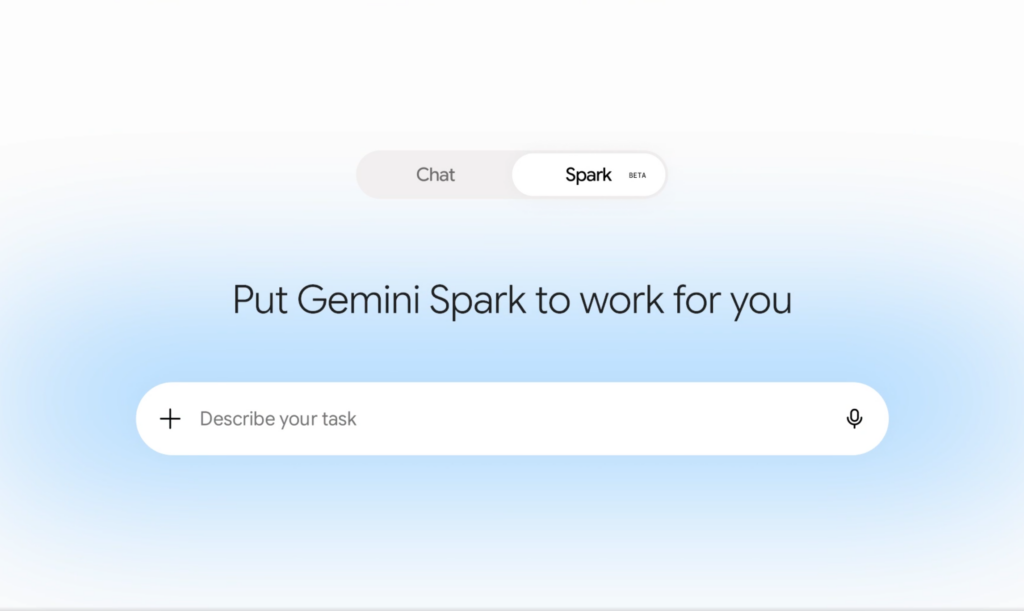
Spark is Google’s 24/7 personal AI agent. The difference between it and a normal chatbot is not intelligence; it is persistence. A chatbot answers while you are sitting there and stops when you close the window. Spark runs on dedicated virtual machines on Google Cloud, which means your laptop can be shut and your phone can be locked, and it keeps working.
Google built it from the Gemini base models paired with an agentic harness from Antigravity, the same platform our team has been building AI SEO tools on for months. It runs on Gemini 3.5 Flash.
The vocabulary matters if you want to use it well. A Task is the high-level goal you hand it. A Skill is a reusable set of instructions you teach it once and call again later. A Schedule is a trigger, either a time or a condition, that makes it act without you asking. Those three concepts are the whole system.
One more thing worth knowing, because it is the piece most people skip. If you turn on Personal Intelligence and connect your apps, Spark gets access to your own data and can act across it. I connected mine. The honest tradeoff is that the more access you give it, the more it can genuinely do for you, and that is a decision each person has to make deliberately rather than by clicking through a permission screen.
It connects to Gmail, Drive, Docs, Sheets, Slides, Calendar, Keep, and Tasks through proper API integrations rather than by reading your screen, which makes it far more predictable than agents that navigate pixel by pixel. It can pilot a remote browser to go out and gather information from the open web. It has its own Gmail address you can email directly. And a work panel shows you what it is doing so you can pause it or step in.
On availability, because people keep asking me: it started as Ultra only in the US, added a macOS app on July 1, picked up document editing in mid-July, and last week Google opened it to AI Pro subscribers in the United States. Ultra subscribers now have it in most countries, though the European Economic Area, the UK, Switzerland, and Nigeria are still excluded.
Here is my prediction, and I do not think it is a bold one. In the not-so-distant future, we are going to hand these agents our credit cards and let them make purchasing decisions on our behalf. The research step is already delegated. Buying is the obvious next step.
The Study That Puts a Number on This
I have been saying for a while that your website is being read by machines more than by people, and until recently that was an argument rather than a measurement.
Then Shawn Davis and his team at Duda ran the numbers. They analyzed roughly 858,000 websites and close to 68 million AI crawler visits in a single month. I unpacked the whole thing across two podcast episodes with Shawn, and it is still the most useful dataset I have seen in this space.
The headline finding is the one I opened this week’s video with. Sites that AI crawlers actually visit generate 3.2x more human traffic, 2.7x more form submissions, and 2.5x more click-to-call events than sites they skip.
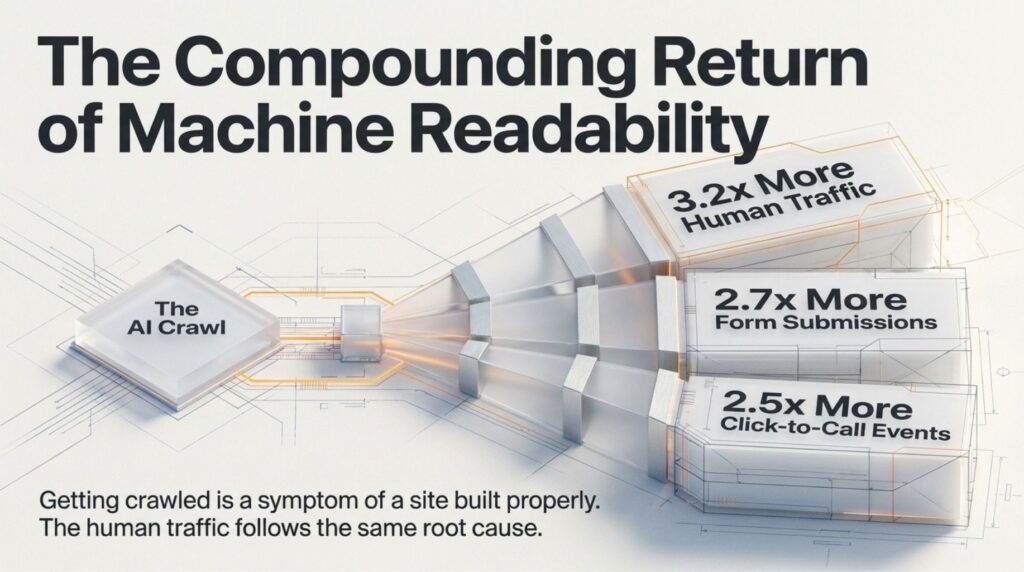
Read that again, because the causality is worth thinking about carefully. This is not “get crawled, and traffic appears by magic.” It is that the same structural qualities that make a site legible to an AI crawler also make it legible to a customer and to a search engine. Getting crawled is the symptom of a site built properly. The traffic follows the same root cause.
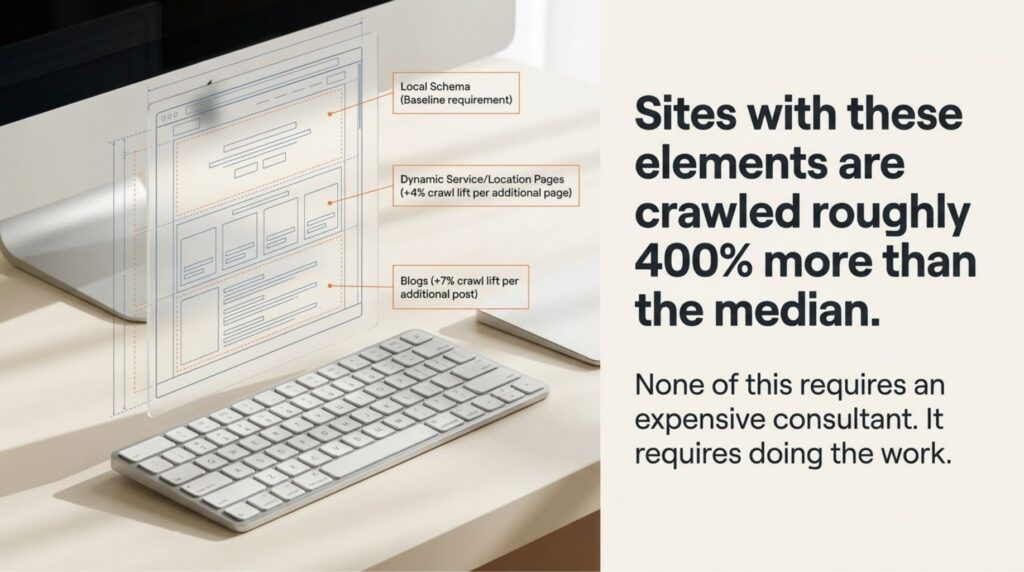
What predicts crawling, according to the study, is unglamorous. Blogs. Local schema. Google Business Profile synchronization. Dynamically generated service and location pages. Sites with those things get crawled around 400% more than the median. Each additional blog post correlates with about a 7% lift in crawler visits. Each additional page, about 4%.
None of that requires an expensive consultant. Most of it requires somebody to sit down and actually do it.
Why Agent-to-Agent Changes the Stakes
Here is the thing that separates this moment from the last two years of AI search conversation.
When an AI Overview cites you, a human still reads the citation and decides whether to click. There is a person in the loop, and that person can be persuaded by a nice photo or a good headline.
When Gemini Spark evaluates hot tub dealers at two in the morning while I am asleep, there is no person in the loop. There is no one to charm. The agent reads what is machine-readable, decides what matters, and either includes you in the shortlist it hands its human, or it does not.
When Cyrus Shepard came on the podcast, we arrived at the same idea from opposite directions: that the evaluation step has moved off your website and into the model itself. Your site is no longer where the deciding happens. It is the input to a decision made somewhere else.
That is agent-to-agent communication, and it is why I keep pushing local service businesses on this. Your site does not need to impress an agent. It needs to be parseable by one. Clear service information. Clean schema. Consistent business details that match your Google Business Profile. Real pages for real services in real locations, not one thin page trying to cover everything.
There is a second-order effect here too. Agents are patient in a way people are not. A human comparing four hot tub dealers gets bored and picks one. An agent will happily re-evaluate all of them every week for two months, which means the gap between a well-structured site and a sloppy one does not just cost you one visit, it compounds across every pass the agent makes.
I have been optimizing websites since the late nineties, and the fundamentals have never changed as much as people claim. What changes is who is reading. Right now the reader is increasingly a machine acting on behalf of somebody with money in their hand.
If you want to see how this fits with everything else that has shifted this year, I pulled the last stretch of these tips into one connected playbook rather than a pile of separate updates.
Where I Am Digging Into This on Thursday
This Thursday, July 30, I am speaking at Duda’s Local AEO AI Visibility Masterclass. My session is at 1 PM Mountain Time.
I am walking through Shawn’s study in detail: what made those websites get crawled more often, how the crawlers behaved once they arrived, and then the part I care most about: the specific moves a local service business can make to get more visibility in AI search. Not theory. The actual list.
It is a day-long event with well-known people speaking, and last I checked, somewhere between 1,200 and 1,500 people had already registered. Credit to Duda for putting it together. Registration details and my session information are on my masterclass page.
I will be finalizing my slides in a few hours and sending them over. If you run a local service business, or you build websites for people who do, this is worth an hour of your Thursday.
What to Do Next
Three things, in the order I would actually do them.
First, go check whether your Google Business Profile is genuinely synchronized with your website. Most owners I talk to assume it is. It usually is not. In the Duda data, sites with GBP Sync enabled hit a 92.8% AI crawl rate, which is close to a guarantee of being seen, and only 0.4% of the sites studied had it turned on. Less than half of one percent. I have rarely seen a wider gap between the effort something takes and what it returns.
Second, look at your service and location pages and ask whether an agent reading them could answer a specific question. Not “do we look professional,” but “if something machine reads this page, does it come away knowing what we do, where we do it, and how to contact us?” If your pages are thin or duplicated across locations, that is the work.
Third, start measuring. Google Search Console now has a report that shows whether your content is appearing in AI features, and I walked through how to read it in an earlier tip. You cannot improve a number you are not looking at.
If you want the broader system I use for producing content that gets cited rather than ignored, the Universal Content Engine methodology is written up in full and free to read. Every one of these tips lives in the AI SEO Tips archive if you want to go back through them, and if you missed what Google shipped at I/O this year, the recap covers Spark alongside everything else that landed.
None of this is a reason to panic, and I want to be clear that I am not selling urgency here. The moves that make you visible to agents are the same moves that have made sites work for years. What has changed is the cost of skipping them. Two years ago, a badly structured site lost you some rankings. Now it removes you from consideration before a human is ever involved.
An agent went shopping for me this week, and I never saw the websites it rejected. Neither will your customers.
Stay safe and healthy.
Cheers,
Chris